My response is partially a response to the person who also answered, but also relates directly to your question.
Problems and comments:
So the strong players of the initial mandate did not care that much anymore. Moreover the league of nation was now dead, and hence one could argue that the mandate was non-biding anymore and that the UK could stay forever. Due to lobbying by many interests -including US one- it was decided that the mandate would end as agreed, and a preliminary map of what the area would look like, which countries were to be owned by who was drafted. This is the 1947 "United Nations Partition Plan for Palestine"
The Mandate did not end because of "lobbying". It ended because the British no longer wanted to invest the necessary resources for the meager benefits of maintaining the Mandate. They announced a withdrawal, and asked the United Nations to step in.
The UN formed a committee, the UN Special Committee on Palestine (UNSCOP), which drafted a report and recommendation (as well as a minority report that was the opinion of a minority of the committee). The majority recommendation was the proposal you have shown a picture of, though it was slightly altered during ad hoc committee processes.
It's worth noting that this proposal was passed by the UN General Assembly. This did not mean the plan was put in place, as many might think. The plan was a nonbinding recommendation to the UN Security Council for implementation. But upon the passing of the plan, an attack by a Palestinian Arab militia on a bus containing Jews led to a spiraling of violence, launching a civil war which persisted until May 1948, when the Arab states invaded following Israel declaring independence (Jews had virtually won the civil war by this point).
It is true that the Arab states rejected this plan.
The arab league gave it's blessing to military operations aimed at conquering the land, under the general propaganda pretext of making an independent Palestinian state -basically wanting an arab league protectorate of the area along with some land grabs near the border
It's worth noting here that the Arab states did not actually desire such a thing. Each of them wanted a piece of the land for themselves, rather than an independent Palestinian state. This meant that despite coordinating a plan of invasion, the Arab states ended up altering the invasion plans to fit their own needs, meaning they ended up following different plans instead of the one they agreed upon.
underestimated the young israel state army which was in fact already rather well equipped, numerous and trained
The Israeli army was not well-equipped. Up until the first ceasefire, the Israeli army was extremely out-gunned, and even then the supplies they received during that first ceasefire (primarily from Czechoslovakia) only established relative arms parity, not superiority.
The initial conduct of operations and negotiations suggest that the original political goal was not the negotiation of a strong position with a jewish state, but simply PREVENT the existence of such a jewish state
The goals extended beyond this, though they included this as well.
Consider, for example, the statement of the head of the Arab Liberation Army, Fawzi al-Qawugji. He told volunteers that:
We must expel the Jews from the Arab part of Palestine and limit them in that small area where they live and they must remain under our supervision and guard.
The Arab League Secretary General, Azzam Pasha, said:
It does not matter how many [Jews] there are. We will sweep them into the sea.
He also reportedly said, referring to King Abdullah of Jordan:
Either you will attack the Jews like Saladin attacked the Crusaders, or the curse of the world will fill upon you
The Syrian President described it in terms of the Crusades:
Overcoming the Crusaders took a long time, but the result was victory. There is no doubt that history is repeating itself.
That theme also came up in negotiations at the end of the first war, when the Lebanese Prime Minister Riad al-Sulh said:
not for the first time, that it had taken the Arabs over a century to expel the Crusader[s] but they had succeeded in the end
So the goals did not include merely prevention of a Jewish state, but also appear to have included some level of expulsion and destruction of the Jewish community there. And that's even if we don't consider the statements about "rivers of blood" and a "war of extermination" from Palestinian politicians, discussing what would occur if the UNSCOP plan passed in the General Assembly (which it did).
Gaza was egyptian until 1967.
Worth adding that Jordan was in control of the West Bank until 1967 as well.
You have to keep in mind the size of the conflict : A mere dozen thousand fighters on each side over an area smaller that what a WWII division would have to cover
The war involved far more than 12,000 fighters on each side. The Haganah alone fielded more than 16,500 troops at the start of the war.
The Arab invading forces sent in roughly 20,000 combat troops, 5,500 from Egypt, 4,500-6,500 from Arab Legionnaires, 2,750 from Syria, and 2,700 from Iraq, not to mention the air force personnel and the Lebanese troops who pressured Israel's northern border. 8,000 more troops arrived at the front from Arab states within the next 2-3 weeks after the war began.
During the war, both sides increased manpower, though Israel did far faster. By mid-July 1948, Israel was fielding 65,000 troops, 88,000 by October, and by January 1949, over 108,000, which was over 13% of Israel's population at the time. The Arab armies eventually fielded 40-50,000 troops by mid-July, 68,000 by mid-October, and probably peaking around 75,000 by December-January.
Disclaimer : I'm French of Franco-russian bloodline, atheist with distant christian ancestors, and have no emotional interests in either sides of the current conflict. I don't think I'm partial to anyone except maybe for French Interest in this whole affair.
What plans did the Arabs have for Israel had they won the arab Israeli wars?
I assume your question refer to the original 1948 war, as the other were much more one sided and more about political gain than total military conquest.
First, no one can answer for sure. Archives are still not open on the arab side, and it's possible that they are lost forever. It's still possible to understand what happened and trough that guess the motive of the players.
To answer your question more in depth, we have first to look a bit at the context.
Just like how Hong-Kong was given back to china in 1994, the British Empire only had a Mandate in Palestine. But while Hong Kong was cleanly handed back, the end of the British Mandate for Palestine was a much more complex affair.
Why ?
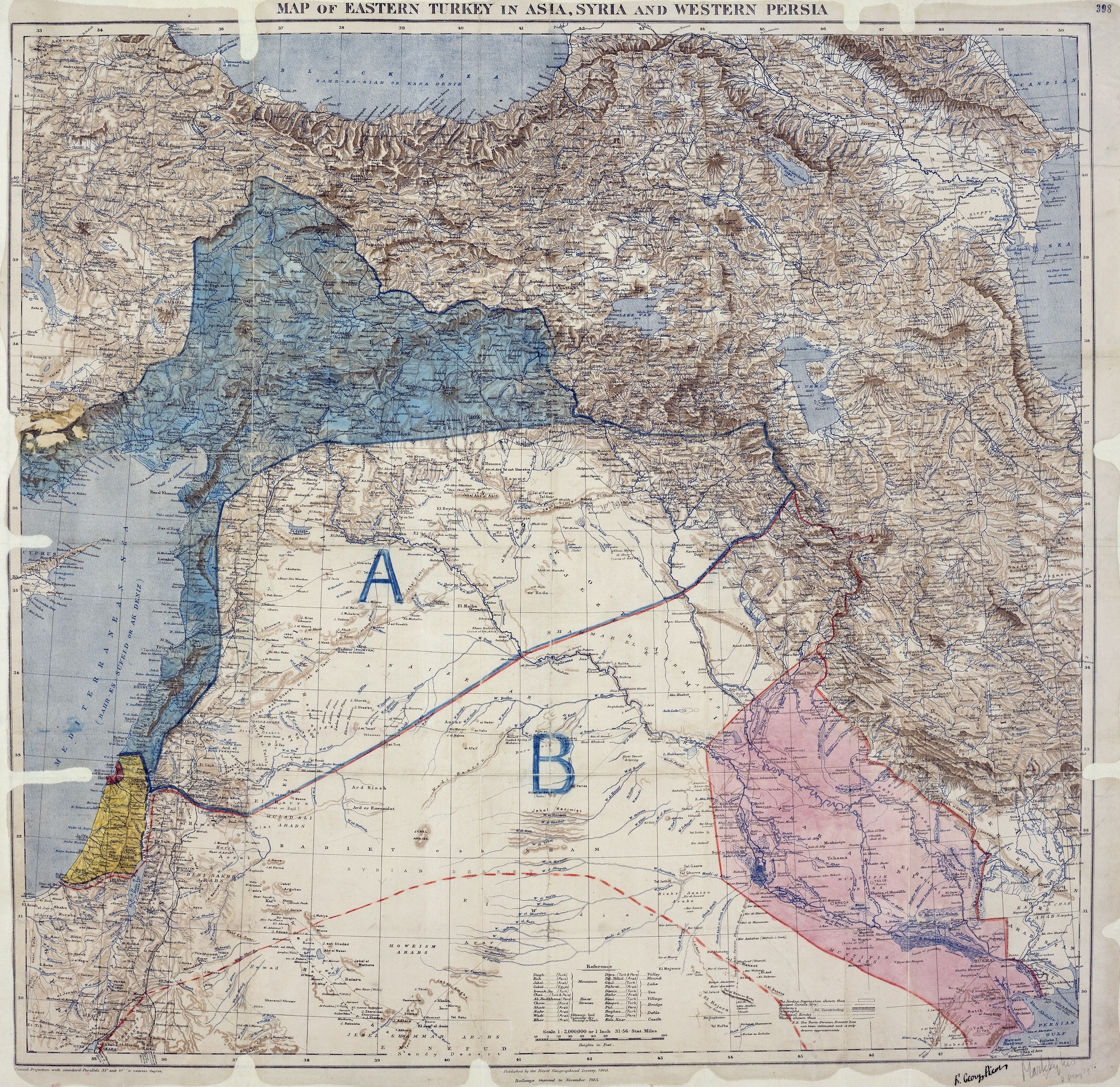
The origin of the mandate is the fall of the centuries-old Ottoman Empire following WWI. In 1916, while the war was still raging, UK and France discussed how the repartition of the land would go.
This map of the Sykes-Picot Agreement is basically the origin of the borders of most countries in the middle east even today. Dark Blue and Zone A is French, Red and B is British, yellow is international protectorate. The campaign of WWI led the british army to occupy Palestine, as a port in the Mediterranean sea were an army could land and protect the Suez channel in Egypt nearby. Suez was of geostrategic importance for the empire as the fastest way to access the British Raj (India).
After many political shifts and some warfare with the neighboring kingdom of Syria, The league of Nation (Think of it as the UN except you get kicked if you do bad stuff, hence it's failure to prevent WWII) gave the UK a mandate to rule the land and develop it up to the 14 May 1948. Afterward it would be it's own independent state. However, this whole negotiation was a strong arm between many interests. Arabs and Jewish of course, but ultimately it was about strategic balance between France and the UK, all the other actors being merely pawns in their game. They were the owners of the place.
And now, WWII happen.
Both France and the UK are devastated, ruined by the war, and do not have the military nor the political will to maintain their strong empire when their homeland and their economies are in such a bad state.
So the strong players of the initial mandate did not care that much anymore. Moreover the league of nation was now dead, and hence one could argue that the mandate was non-biding anymore and that the UK could stay forever. Due to lobbying by many interests -including US one- it was decided that the mandate would end as agreed, and a preliminary map of what the area would look like, which countries were to be owned by who was drafted.
This is the 1947 "United Nations Partition Plan for Palestine".
Neighboring Arab countries rejected this plan.
Some books suggest that it was both for the arabs leader seen as an easy way to appeal to the arab populace (No jewish in our holy lands) and a way to extend their border a bit by swallowing the nearby land.
The arab league gave it's blessing to military operations aimed at conquering the land, under the general propaganda pretext of making an independent Palestinian state -basically wanting an arab league protectorate of the area along with some land grabs near the border-. During the month proceeding the end of the mandate a bloody civil war was going on, and on the day of the end of the mandate, it escalated in full scale conflict.
However, the arabs grossly overestimated their army prowess, lacked a real operational plan and underestimated the young israel state army which was in fact already rather well equipped, numerous and trained. Instead of a decisive military victory it became some kind of bloody stalemate with no side able to really win. Which, from a political standpoint, was a crushing defeat for the Arab League.
So, from an Arab League perspective it was those fertiles land nearby, your population not wanting a jewish state existing at all, and all of those would only be protected by a bunch of farmers with rifles and no international state support. The initial conduct of operations and negotiations suggest that the original political goal was not the negotiation of a strong position with a jewish state, but simply PREVENT the existence of such a jewish state. After the first battles, extending your country border was more important than the creation of an arab league mandate in the area. This war of conquest was key in the defeat of the arabs, as the allies would not trust each other at all, everyone being aware that your neighbor only goal was to extend his land, not caring much about a common "Greater Good".
So during the peace negociation afterwards, everyone got more or less what they "secretly" wanted :
-Israel got it's state
-Neighboring countries had a significant part of the mandate territory
The only loser was the stillborn state of palestine.
It is a hot topic today because in later wars, the arab league would lose even more of their territories, making israel own pretty much all of the british mandate. Gaza was egyptian until 1967.
As a whole, the state of Palestine only ever existed on maps in the 1947 initial draft, and the draft defender was then Israel as creating a state of Palestine would mean creating the State of Israel. The reject of the draft by the Arab League and the incapacity to fully conquer israel then sealed the Palestinan State fate.
The true question that we still don't know the answer about (until archives are opened) is how much was it in abdullah goal to prevent israel from existing ? The king of Jordan had close relation with the west and was the leader of the Arab League army, so he was in an ideal position to prevent the Arab League from doing so well that foreign powers would have to intervene but securing land gains for the arab league at the same time.
OPINION
My personal opinion on the matter is that the goal of the arab league was much more a struggle of power between it's member (Especially Farouk and Abdullah I) than the creation of an independent Palestinian state and the prevention of the creation of a Jewish one. All of it's leaders knew from the start that the world powers would not let them completely conquer the area. They rejected the 1947 treaties as it would give them a good casus belli to simply grab more land. The unified Palestinian state creation was just the "casus belli", it was totally not the motives behind the war.
You have to keep in mind the size of the conflict : A mere dozen thousand fighters on each side over an area smaller that what a WWII division would have to cover. If foreign power ever got serious, it was game-over for the Arabs. Hence I believe the answer to your question was always : get as much land as possible without pissing off foreign powers. Why create a palestinian state when you can simply rule the land ? The destruction of Israel would be to big of a gamble due to lobbies in many powerful countries.
The answer to this is not especially clear-cut. Since there are no published war-plans which explicitly document how the Arabs would proceed in the event of victory, we are left to infer based on their own statements and actions. When the UNSCOP majority recommendation was adopted in Resolution 181, all the Arab countries rejected the idea of partition and publicly, formally and unequivocally ruled out the establishment of a Jewish state - this definitive public position gives one the impression of a monolithic stance adopted by the entire Arab world against partition, but the reality is much more nuanced. In fact, the “Arabs” did not have any plan for Israel in the event of victory, since the “Arabs” did not operate as a single force - the divergent geopolitical interests of the respective Arab countries involved would preclude any true unity.
At its most basic and universally applicable, the 'Arab war plan' can be described as being twofold: 1) ensure that Palestine is not partitioned; 2) ensure that, subsequent to the war, the balance of power has not changed in the favour of a regional Arab rival.
The section below will expand on the publically stated Arab reasons for entering war; namely, their view that the partitioning of Palestine was in violation of international law, and therefore intervened in order to prevent it. The subsequent section, however, demonstrates that once the war actually began, Arab actors were overwhelmingly concerned with containing the growth of regional, rival Arabs and maintaining the relative balance of power, while the fact of partition itself was largely unimportant and open to negotiation.
These narratives are not necessarily mutually exclusive: different members of the Arab league would variously emphasize these competing objectives in accordance with their interests. For example, the conflict between Abdallah and Egypt focused on the question of whether an independent Palestinian state would be established, in line with Egyptian interests, or whether Transjordan would annex those parts of Palestine that were designated to become an Arab state. More on that below.
THE CALL FOR A UNITARY PALESTINIAN STATE;
For the sake of brevity, I will assume you are already familiar with the basic chronology of the period. The Arabs made their position with respect to a partitioned Palestine unequivocally clear from a fairly early date - recognizing that, at the time, Palestine remained the only one of the formerly Mandated Territories not to become an independent state, Egypt, Iraq, Syria, Lebanon, and Saudi Arabia requested that Britain's Mandate be terminated and Palestine's independence recognized.
After three months of conducting hearings and a general survey of the situation in Palestine, the committee submitted its report to the General Assembly. The majority of members (seven) recommended ending the British Mandate, partitioning Palestine into two states: an Arab state and a Jewish state, and placing Jerusalem and Bethlehem under international trusteeship.
There was, however, an outstanding problem with this recommendation that was patent to many: the right of the Palestinian people to self-determination. In Mandate Palestine, Arabs constituted a majority of the population, and owned more land, in every district, including the future capital of Israel, Tel-Aviv/Jaffa. According to the UNSCOP report, Arabs were in possession of about 85 percent of the land, compared to only about 5.8 percent owned by Jews^1 - however, under the proposal, 45 percent of the land would be for the Arab state, compared to 55 percent for the Jewish state.
Indeed, the report itself conceded this fundamental flaw, observing that the principal of self-determination, which was “adhered to with regard to other Arab territories”, was “not applied to Palestine, obviously because of the intention to make possible the creation of the Jewish National Home there."^2 Furthermore, after receiving UNSCOP's report, the General Assembly established another committee, Sub-Committee 2, that similarly rejected the majority recommendation as being "contrary to the principles of the [U.N.] Charter," pointing out that the U.N. had no authority to "deprive the majority of the people of Palestine of their country and transfer it to the exclusive use of a minority in the country."^3 The new committee likewise proposed that the independence of Palestine, as a unified state, instead be recognized.
Thus, the partion of Palestine was bitterly opposed and major Arab leaders objected in principle to the right of the Jews to an independent state in Palestine, reflecting the policies of the Arab League. However, when Arab representatives had proposed a unitary Palestine with a democratic constitution guaranteeing full civil and religious rights for all citizens and an elected legislative assembly that would include Jewish representatives, UNSCOP dismissed this as "an extreme position."
The Palestine Arabs had no program of conscription or military training (especially compared to the much more effectively organized Haganah), but the Arab League took a decision to resist, by force if necessary, any effort to implement partition in Palestine.^4 In October 1947 the League resolved to send troops only if the Jewish Agency invited foreign troops on its side, and it decided to provide military aid to local militia of the Palestine Arabs. Though militarily weak, Palestine’s Arabs planned to resist the expected attempt by the Jewish Agency to take over Palestine.
Despite the obvious problems with the UNSCOP majority plan, on Nov. 29, 1947, the General Assembly adopted Resolution 181, which recommended that the majority UNSCOP plan (with some minor amendments) be implemented. The Yishuv and the Jewish Agency accepted the plan, but, predictably, the Arabs in Palestine and the surrounding Arab states rejected it. The Arab countries proposed to query the International Court of Justice on the competence of the General Assembly to partition a country against the wishes of the majority of its inhabitants, but were again defeated.
It should be noted here that, despite popular opinion, the U.N. Resolution 181 neither created Israel nor conferred upon the Zionist leadership any legal authority for its unilateral declaration on May 14, 1948 of the existence of the state of Israel.