It is a curious thing I have always wondered about?
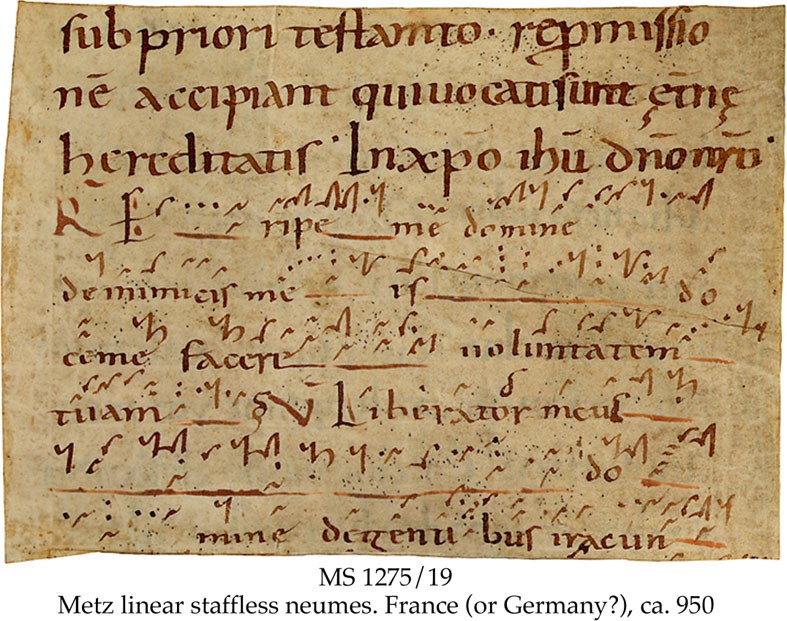
Well, the first thing to note is that modern music notation did not pop into existence all at once, but emerged gradually over several centuries. At the beginning of that development (sometime around the 9th century) was a very approximate way of notating the contours of melodic lines. I provide a brief gloss on this kind of notation in this thread:
The circumstances surrounding the first musical notations within the western tradition (and it must be stressed that this is not the only tradition of notation) are not very clear. What we do know is that it happened sometime in the 9th century, it was comprised of a selection of symbols (called neumes) that articulated the contours of a melodic gesture rather than its specific pitch (for instance, the "clivis" indicates "two notes with the second note lower than the first," but doesn't specify how much lower the second note is from the first), and that it was used to notate the gregorian chant repertoires. Leo Treitler argues that these neumes were used as a catalyst for recalling melodies learned previously through an oral tradition. They would have been used by the highest ranking singer (called a cantor) as a reference to help teach the rest of the order the chants through oral transmission.
This is the earliest surviving piece of a notational tradition that has been in continuous use and development to the modern day. However, there were certainly other kinds of musical notation that existed previously as well. Those kinds of notation I unfortunately don't know much about, but /u/erus provides some insight in this thread, and there's a moderator post in that thread with further links to additional answers.
So obviously, it's totally possible to play and learn music without recourse to musical notation. There are still plenty of guitarists, signers, what have you today who are great players in various genres but who cannot read a note of music. A good ear, good fingers, and (possibly) access to a mentor are all that a great number of people need to acquire competency in an instrument. The mode of learning just shifts back to being akin to various oral traditions. You learn to play the exemplary works of the past, you generalize from these works conventional musical "utterances" (such as guitar licks or chord shapes) that form a "lexicon" for you to use, and then with that in hand you can begin to craft your own works. We don't need a fixed notational system to be able to play music, just as one doesn't need a written alphabet to acquire the basic capacity to speak and communicate.
As I mentioned above, we have a pretty clear sense through the testimony of some early theorist/teachers like Guido de Arezzo that experienced musicians passed on how to sing the necessary chants to future generations largely by oral transmission. The first western notations were merely aids to memory for the teacher in that project, capturing only the bare-bones outlines of a melody. That outline is just enough to cue to a master "oh yeah, this chant, the one that goes like this.." and then they could sing it to their students who would practice and memorize it based on what they heard rather than what they saw. It'd be akin to you writing "naaaa, nanana naaaa, nanana naa nana naa nana naa, nanana naaaa" to cue you into remembering this. When there's a large body of music used regularly for a functional purpose (like chants were for catholic services), notational reminders like that are super helpful as memory aids. But still the basis of the practice is oral and rooted in memory. One didn't learn a piece by reading it off a page, one learned it aurally and then the page helped you in case you forgot. Thus, it's still not that far from the way we must assume practices without recourse to notations had to have worked (and that still work today).
In other words, it's really not hard to imagine how people learned and played music without access to a fixed notational system, it's just since it wasn't written down, we can't recover what that music actually sounded like. (except what we can partially reconstruct via things like surviving instrument specimens, reports on the pactise in a secondary source, etc.)