I've recently watched a video that claimed that archers only usually fired their bows up when shooting at enemies in towers or on walls during sieges, and that, normally, on the field of battle, they don't shoot up (supposedly, no evidence of it happening in visual sources, and it wouldn't make sense because then the arrows would lose a lot of kinetic energy and rely on gravity on the way back, etc.), but instead shot directly at the enemy.
Is the indirect, volley fire really a pop culture myth or is the video mistaken?
/u/MI13 wrote a post on this a while ago (I believe the OP of that linked post was discussing one of Lars Andersen's first popular videos from back in 2015).
In short, the idea that archers don't use indirect fire, or that anyone is rediscovering actual historical archery like Lars Andersen does in his videos, is plainly wrong. Accounts from numerous historical sources (Enguerrand de Monstrelet, Anna Komena for two differing time periods) show that indirect volley fire was anything but a pop culture myth.
The following is a very quick and dirty reply, also posted in reply to the video.
The following medieval manuscripts depict archers using elevated bows in non-siege conditions and where the terrain is not obviously different heights:
http://manuscriptminiatures.com/4582/12922/
http://manuscriptminiatures.com/4715/12752/
http://manuscriptminiatures.com/4164/7647/
http://manuscriptminiatures.com/5797/22221/
http://manuscriptminiatures.com/5797/22224/
http://manuscriptminiatures.com/4644/12892/
http://manuscriptminiatures.com/4230/8046/
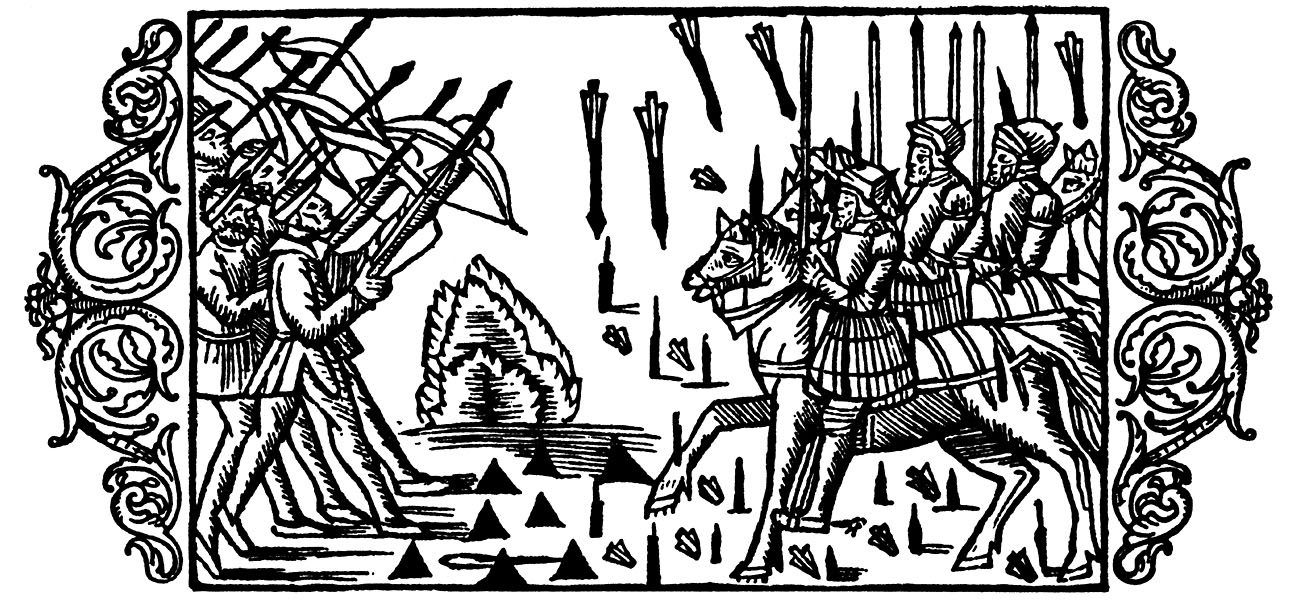
There's also this 16th century Scandinavian woodcut: http://www.avrosys.nu/prints/olausmagnus2/100544.jpg . According to Josef Alm, the artist credited the bolts with penetrating both helmet and harness, or else striking the horse and driving it wild. The penetrative power of that style of bolt was also noted in a 15th century chronicle cited by Alm as well.
Over 60% of projectile wounds at Visby were on the vertical plane, while the arrow which wounded Henry V at Shrewsbury entered at an angle, which suggests volley shooting to me.
Regarding loss of penetration at range, Mark Stretton has tested this and found that penetrating is almost equal at 40 yards and 220 yards: http://markstretton.blogspot.com.au/2016/03/the-penetrative-power-of-warbow-arrow.html . 80-120 yards seems to be the golden range for distances beyond 30 yards.
None of this is definitive proof that volleys were universal or even necessarily common. Much of medieval warfare involved sieges and skirmishes, where long range volleys were less likely to be used. On the other hand, we know for certain of at least one battle where volleys were used. This immediately opens the tactic up for use elsewhere in a similar time period, and the same tactic was used in the region over 150 years later (see the woodcut), which argues for some continuity, or at least that ideas might be reinvented multiple times throughout history.