If they thought that "Alpine" and "Mediterranean" whites were inferior why have such a raging hard on for Rome and Greece? Wouldn't German and Scandinavian culture be the only appropriate template for the kind of "lost purity" they were looking for?
Well first, Nazi beliefs were not a coherent and logical whole philosophy and aesthetic by any standard, and different Nazis believed very different things. Some of the artists the Nazis denounced as 'degenerate art' had themselves been long-time party members. Second you have the stylistic time period in which they were acting. They'd had backward-looking medieval-revival 'Germanic' art within the_Jugendstil_ movement (~1890-1920). The Völkerschlachtdenkmal is a good example of something supposedly 'medieval' and 'Germanic' (although it's neither). By the time the Nazis were gaining power, it was thoroughly out of fashion though, and with it the backward-looking styles.
Things had moved on into two broad directions. One was completely unadorned, minimalist modernism, the foremost representative in Germany and perhaps the world being the Bauhaus School. But Bauhaus was considered too modern, too progressive, and possibly communist by the Nazis, who wasted no time in shutting it down once they were in power.
That leaves the other option, which is neoclassicism, represented elsewhere as Art Deco, and in Germany with the Nazi version of it. This was not as backward-looking as it seemed, as it wasn't trying to outright imitate or 'appropriate' the Romans or Greeks. Rather, it was looking forward but drawing on what they perceived as a universal tradition.
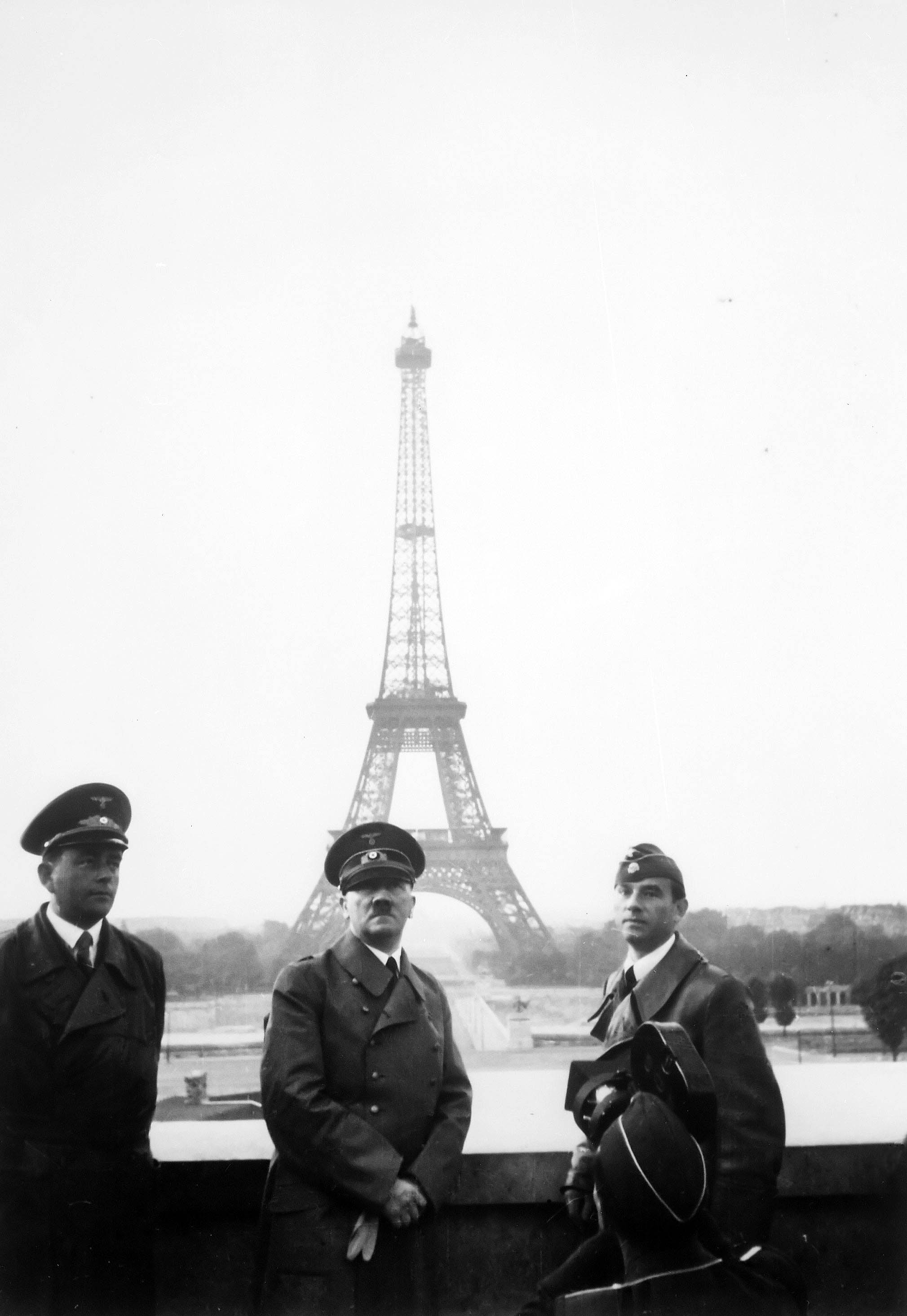
Perhaps most important, as usual with Nazi stuff, is what Hitler himself thought. And Hitler was a thorough neo-classicist. He had less respect for southern Europeans as people, but did not seem to mind their art at all. In the famous picture in Paris he was flanked by his 'fellow' neoclassical artists - architect Albert Speer on the left, sculptor Arno Breker on the right. Neoclassicism had been back in all of Europe for a good 200 years by that time, and wasn't really regarded so much as specifically Greco-Roman anymore, but something more universally European.
So with his monumental art Hitler was trying to create something universal, idealistic, new and yet referencing the past. And in that it wasn't very different from the contemporary Soviet neoclassicism of the Stalin era. Hitler was both a revolutionary and a romantic. He did not want to preserve the historic Berlin but completely reshape it and some other cities. With radical new monumental buildings, that were nevertheless neoclassical. In a way they had to be, as history left no ancient Germanic monumental buildings to draw inspiration from anyhow. To build a giant 'germanic' monument they'd have to make it all up, and this inherent 'fakeness' was part of the reason it'd gone out of style.
It's speculative but Hitler probably didn't want to hark back to a style dominant during the German Empire either. He wanted to abolish the old German Empire institutions and create some new amalgam of racial theories, worship of the medieval German society and other 'ancient' stuff, and yet forward-looking on the military, technology and such.
Another tiny example is that Hitler actually loathed German Fraktur cursive writing, and insisted that all official publications in the future would use a Roman font. Which is a bit funny considering how Fraktur has later been given so many 'Nazi' associations due to being the more common font in Germany during that period.
The fascists in Italy, naturally loved neoclassicism too, imagining themselves to be the new Rome. But unlike the Nazis (and more like the Soviets in the 1920s) they had some appreciation of (or at least tolerance for) modernist art, and specifically futurist art for the italians. This striking, daunting art for the fascists 1934 referendum for instance, - definitely not neoclassical.
So in short: They viewed neoclassical styles are more 'universal European' than specifically Greek or Roman, and art policy among the Nazis and Fascists were heavily influenced by their respective leader's personal tastes.