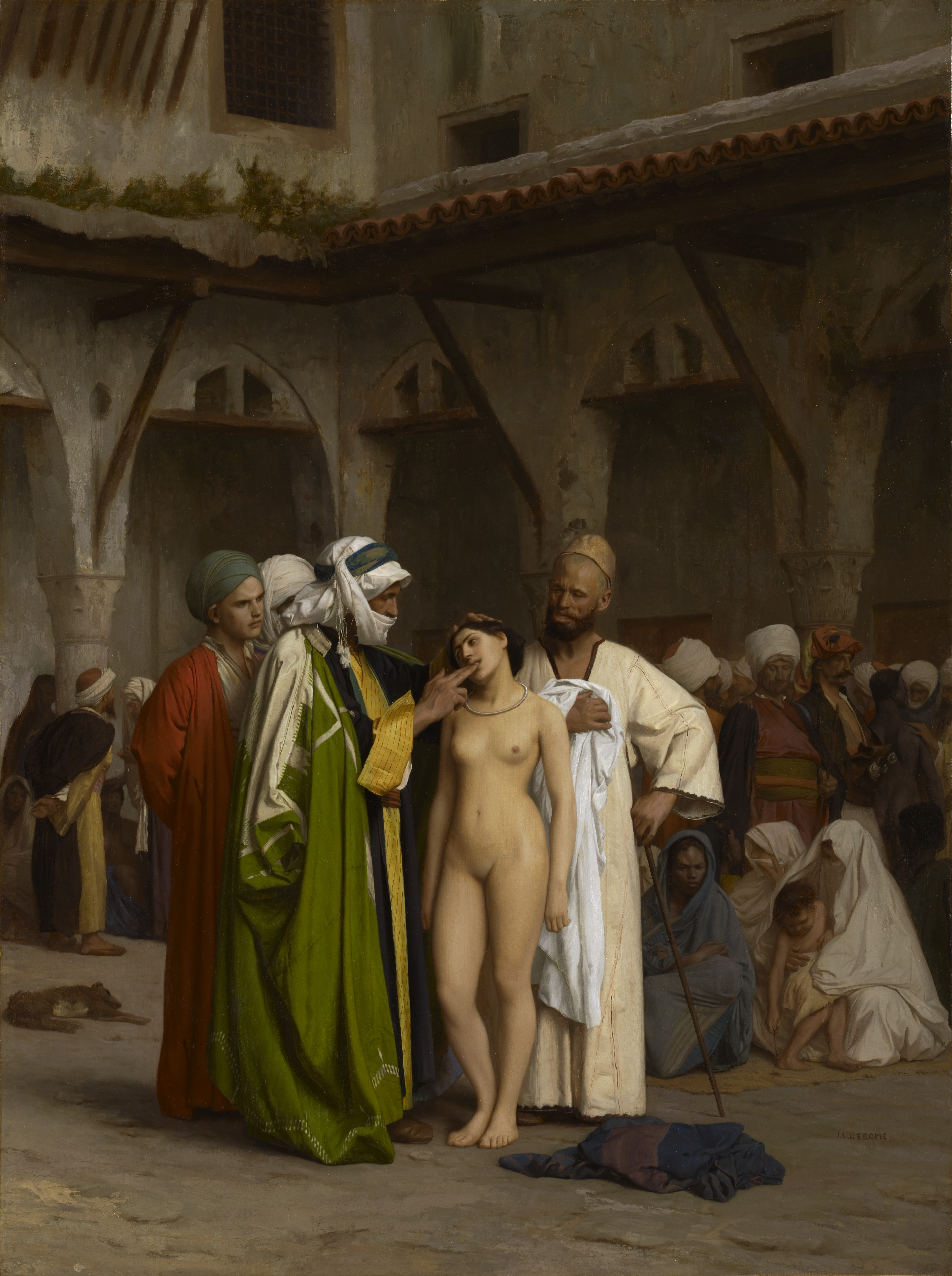
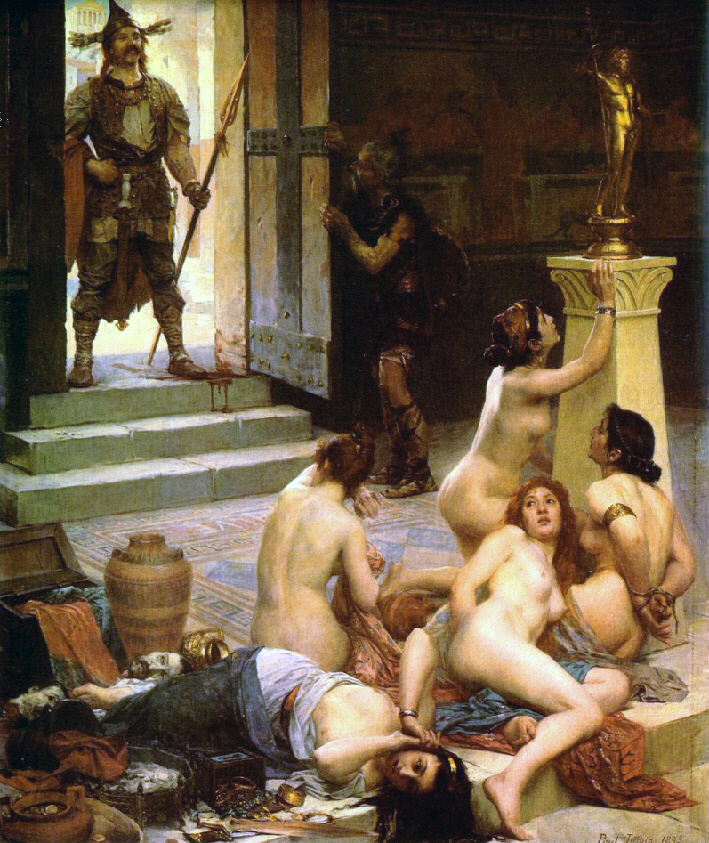
It's hard to say this is just "artistic nudity" when the whole subject matter is obviously just meant to be titillating. What kinds of people would have had these on their walls? Were they ever on public display?
Some examples:
"Slave Market" by Jean-Lean Gerome (1866)
"The Slave Market" by Jean-Lean Gerome (1884)
"The Slave Market Presentation" by Otto Pliny (1917)
"Inspecting the New Arrivals" by Giulio Rostati (1917)
"Brennus and His Share of the Spoils" by Paul Jamin (1893)
"Slave Girl" by Eduard Ansen-Hofman (1820-1904)
"Slave Market" by Eduard Ansen-Hofman (1820-1904)
You're missing a large subgenre of these by focusing on the word "slave". Many of these seem related to the tradition of painting odalisques. See Wikipedia here. Odalisque is Frankified version of the modern Turkish odalık, which implies literally "something for a room" from the word for room oda (cf. bookshelf, kitaplık, or raincoat, yağmurluk, from the words book kitap and rain yağmur respectively). An odalık were generally female slaves/servants within the sex segregated harem, but in the West, could be anything from "chambermaid" to "concubine" to "sex slave" (important members of harems, especially the Sultan's harem, generally had the legal status of slaves, so the differentiation between the three is rarely a clean one).
Odalisques and similar Orientalist harem themes were an incredibly popular painting subject in the 19th centuries, particularly in France and to a certain extent in Italy. Notice that you don't see very many English, American, or German painters tackling the subject. I should say I cannot think of the word "odalisque" without thinking of a poem by Billy Collins (former poet laureate of the United States) where he says his beloved is not like "an odalisque by Delacroix, veils lapping at your nakedness". Full poem here, or even better, hear it read by the author here (it's only one minute long). The most famous type of odalisque (or, perhaps the second famous, after only the many fictional narratives of Western European women getting caught up at sea and forced in the Harem) was the "Circassian beauty". While some of those are explicit Roman, you'll notice that many more fit into the Ottoman context. I don't know all the contexts of all the works, but I am positive Rostati's, for instance, is explicitly invoking the Ottoman context. In fact, it's even shown on the Wikipedia page for "Circassian beauties".
When you hear Orientalism today, if you're an academic, you think of Edward Said, and his castigation of occidental prejudices against the Middle East, which painted the region and its people as exotic, dangerous, uncivilized, etc. "Orientalist" is such a common academic insult it's easy to be unaware that it wasn't always a negative term. In the early 20th century, even, experts on the Middle East were called "Orientalists". But before that, and relevant to us, Orientalism was an arts movement. Most of the paintings you show are influenced by Orientalism, the remainder seem influenced by its cousin and forebearer Neoclassicism.
While there were earlier written exotifying Orientalist pieces by poets and travelers, the early 19th brought an explosion of Orientalist art, apparently in part influenced by the increasing European power within the Ottoman Empire and its former territories, starting really with Napolean's invasion of Egypt. Neoclassicism started in the mid-18th century, as a reaction against the Baroque. Some of its favorite subjects were nudes taken from classical scenes (see this c. 1757 Judgement of Paris), though the scene tend to be more simple and elegant than those scenes you post, which often betray an influence of writhing Baroque nudes (look at Rubens's nudes, for example).
I wish I could give you more art historical context, both in the details of how you move from Neoclassical to this Romantic Orientalism, and how people would actually hang these nudes, but I cannot. I can, however, give you other examples of Orientalism. Here's a bit of one of Lord Byron's poems, Don Juan, from slightly before your examples were painted (1824), but about the same time as Delacroix painted his first (very Baroque rather than Neoclassical influenced) odalisque (c. 1825). Delecroix would return to this theme frequently--here's one from three decades later. Anyway, from Byron:
Some went off dearly; fifteen hundred dollars
For one Circassian, a sweet girl, were given,
Warranted virgin. Beauty's brightest colours
Had decked her out in all the hues of heaven.
Her sale sent home some disappointed bawlers,
Who bade on till the hundreds reached the eleven,
But when the offer went beyond, they knew
‘Twas for the Sultan, and at once withdrew.
There you have a taste the exotic sex that made Orientalism so popular. Of course, that's not the only Orientalist tropes in Don Juan, as you also have exotic locales, easily tricked Easterners (Juan dons women's clothes to sneak into the Harem), the unsatisfied women (Juan is bought by a Harem woman, and several other Harem women want him to share their bed) and the cruelty of the Turk (it's not all sex, and there are several great battles in the poem). Skin color is very important (in Don Juan, in the harem scene the diversity of skin colors is emphasized, as is that he choose to share a bed with someone with white skin) and you notice quickly the trope of a central light skinned woman and, if there are men, they tend to be rather dark skinned.
Don Juan was one of Byron's most famous works (taste has turned away from epic poems, so it's less widely read now even while Lord Byron remains one of the English language's most famous poets) and about half the Cantos of Don Juan take place in the Ottoman Empire. There's a lot of sexiness to be had there, and eventually in Cantos IV and V we get to see a slave market, where most of the focus is obviously on female slaves meant for the harem. (The above quotation is from Canto V.)
The harem and odalisques were a key part of the Orientalist imagination, more important even probably than the turbans and leopard skins, and gave painters an excuse to paint salacious nudes with bright colors, the deep shadows, and flowing fabrics that many painters loved at the time. The particular focus on the slave market, rather than just the interior of the harem, seems like a natural escalation of the tropes. I imagine, but am not positive, that the Roman slave market scenes are taking these Orientalist tropes and reimagining them back onto the Classical world. Notice for instance your first and last paintings from Gerome are Oriental/Ottoman and the second and third are Classical/Roman. So the bare bones historical context of (most) of these works is that they were part of a broad European arts moved called Orientalism, which at times operated as a subset of Romanticism, at times as a moveable feast of tropes that could migrate between styles, tied with the increasing European power and influence in the Ottoman Empire, but I hope someone can add more about the specific art historical context of these works, particularly how collectors displayed them and how the various broader art movements (Baroque, Neoclassicism, Romanticism) combined in these Orientalist pictures.
Additional question: In the posted paintings a common motif was the arabic slave owner. Was this a cultural idea of the time? Was it part of colonial propaganda? The "spreading of civilization" narrative, where paintings like these would help dehumanize the competing civilizations in the minds of the common man?
One aspect that I would like to add to /u/yodatsracist's excellent comment in terms of the wider social context of Orientalism is that it's not a coincidence that the emergence of Orientalism in both its artistic and academic sense arose in a period of both imperialism and at the start of what we might call European tourist travel in the 19th century following Napoleon's invasion of Egypt in 1798 as /u/yodatsracist mentioned.
Lord Byron, for instance, actually travelled to Turkey and to Greece when it was still part of the Ottoman Empire. The most prominent Orientalist painters like Jean-Lean Gerome spent time in the Middle East.
Even the comparatively prudish (or perhaps abolitionist?) Anglophones were consuming this kind of art and literature en masse. The Arabian Nights, first translated into French in the 18th century, was incredibly popular when translated into English in the 19th, first in self-censored editions like Lane's then in exaggeratedly sexual ones like Richard Burton's.
Travel writing on the Middle East flourished in the 19th century. Perhaps the best known example today would be Mark Twain's The Innocents Abroad which chronicled his trip to the holy land, but he was hardly alone. After retiring from office, President Grant took a tour of the Holy Land as well. As did a young Teddy Roosevelt when his family took a cruise up the Nile in 1872.
Non-elites who couldn't afford to travel there themselves were just as interested. As Said and others like Timothy Mitchell have noted, oriental exhibitions were a major part of the World's Fairs of the period, which could extend to risque slave-esque motifs. I've written before about the advent of modern belly dancing, but suffice it to say that this more or less American invention was a hugely popular phenomenon both in the United States and Europe, with costumes that hinted at odalisque themes, not least in exposing bare flesh.
I can't say I've read anything specifically on why Odalisque painting was a less common theme than it was for English, American, or German painters, but as an artistic and cultural interest the Orient in general was certainly a captivating subject for pretty much the entire Western world throughout the 19th century and into the 20th.