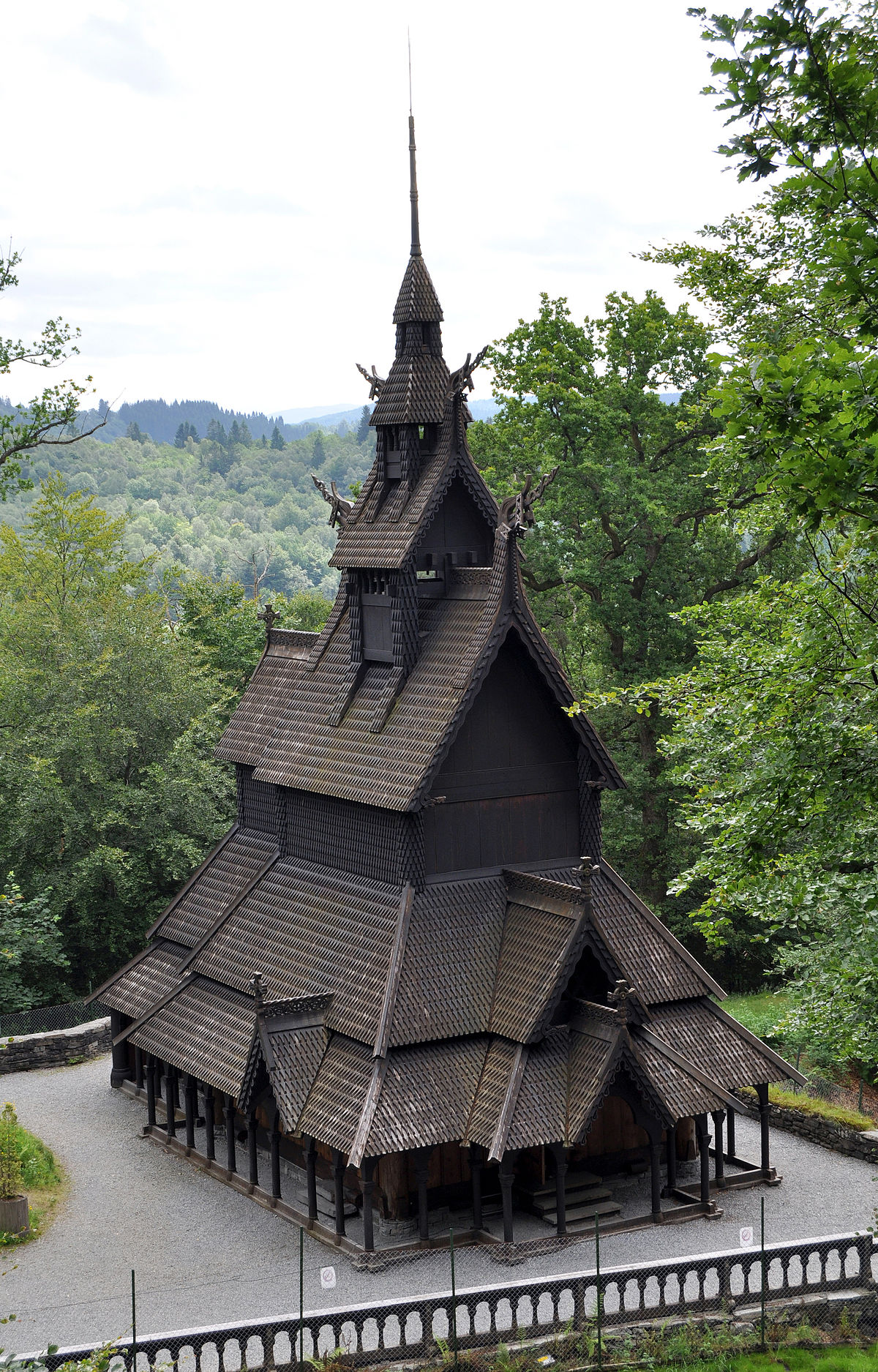
Here is a great example of a stave church.
What I'm wondering about is this — "Viking Era" and even earlier Vendel period architecture is admittedly a bit scant, or at least not as developed and then preserved as many other contemporary for the time wooden structures.
Yet with the adoption of Christianity and the construction of these churches throught the medeival period, it appears to be a massive burgeoning of architectural sophistication.
Did this come out a vacuum, or was there precedence for such ornamentation for earlier temples, public buildings, meadhalls, and so on?
We don't know. That's an unsatisfying answer I know, but its the only one that can really be defended with the evidence that we have available. We know that heathen sites had physical buildings for the use of the worshipers, but we do not get a clear description of what they looked like, and I'm going to try and describe what these structures that we do have evidence for might have looked like.
I'm going to draw a bit from other cultural contexts that I believe are comparable since there is evidence there that I think would be extremely useful. However there is one thing that is of the utmost importance to remember. There are no firsthand accounts from the heathen practitioners themselves. Only outside descriptions, often from those hostile to the heathen religions practices.
There are no extant examples of heathen sites of worship, and in regards to contemporary descriptions, they are few and far between. The most famous example of a contemporary description comes from Adam of Bremen who described the temple at Uppsala and provided us with quite detailed and graphic descriptions of the rituals and practices associated with it. The existence of the site has also been confirmed through archaeological excavations (though not his accounts of human sacrifice nor elaborate gilding).
So what does Adam of Bremen have to say about the temple and what might it have looked like? The things that stand out most are that the temple is home to three carved figures representing Odin, Thor, and Freyr. The temple itself is covered with gold and has a golden chain surrounding it, and nearby there is a sacred grove of trees where sacrificial offerings are placed, humans among them.
However he does not give us a very in depth architectural run down of the structure of the building, and there is nothing to indicate that it would have resembled a stave church in construction. But we can still learn some things from this description. He does not mention stone structures of any sort, only gold and wood.
From his description, we gather that there was a wooden central structure, with gilding and a golden chain around it that houses three figures of the Gods that are seated on thrones and that the idols are all carved, Thor with a mace, Odin in armor, and Freyr with an erect phallus. This is all near a sacred grove that was used for sacrifical offerings to be hanged. We do not get a very good depiction of what the structure looked like beyond this sadly.
This sort of solid structure is in fairly stark contrast to the earliest description that we have of Germanic religious practice. Coming from Tacitus's work on Germania, we have a description of what amounts to an open air procession of a statue of a Goddess that Tacitus names Nerthus and identifies as a fertility deity.
Her earthly abode, according to Tacitus, is a sacred grove where her statue is kept and maintained by a priest who is the only one allowed to touch the goddess. He also hints at the sacrifice of slaves who take part in the Goddess's procession. While this example is almost a full millennium removed from Norse or Anglo-Saxon practices, they do all share some common cultural practice with these early Germans, for example, we can see the continuity of sacred trees, and the necessity of idols to worship. Tacitus also comments on the importance of this singular idol to the lives of the people in this community, during her procession, warfare stops.
Another comparable area and context that we can look to is Anglo-Saxon England, and the period of conversion from Heathenry to Christianity is documented extensively by the Northumbrian writer Bede.
In his history of the English, Bede recounts the story of one former high priest of the heathen gods who converted to Christianity and ordered that the idols that he had formerly worshiped to be thrown down and the area burned. Now Bede does not clarify if this is in regards to a building or a sacred grove of trees where the idols were kept.
One hint that we may get comes from a later description that Bede provides of the King Rædwald who kept a temple dedicated both to Christ and to his heathen gods. While there is still some ambiguity about the nature of the temple to the heathen gods, it seems much more certainly to be a physical structure that was still standing some time after Rædwald's death.
So the Anglo-Saxons in their heathen days also seem to have had at least some structures dedicated to worship and sacrificial offerings. However we should keep in mind that the practices of one kingdom would not necessarily be the practices of another, and local patterns of worship could have been highly variable.
So there is evidence of heathen temples having been physical structures, potentially connected to sacred groves, that were adorned with idols that were used in ceremonies and given offerings, and possibly adorned with other substances such as gold. We do not know exactly what their construction was, however it does seem that these buildings were quite important and well maintained in many cases. Even though we can establish that there were adorned and apparently in Uppsala's case, quite impressively so, we cannot draw a straight line from these older structures and stave churches in the post conversion era.
Sources
Adam of Bremen: Gesta Hammaburgensis Ecclesiae Pontificum Bede: Historia Ecclesiastica Gentis Anglorum Tacitus: De Origine et situ Germanorum
There has also been quite a bit of research on these works and if you'd like some good examples of books that examine this time period in detail I'd be happy to provide some.