More specifically I'd like to know what machinery, materials, etc. were used to build/reinforce wharves and piers and how they managed to lay foundations or place pillars underwater to support those structures? Bonus question: Were others machines, materiel or methods used in the early colonies because of a (possible) lack of what they had back in Europe? Or was it just the same?
You're assuming there's a single, homologous method of construction was used in all all of Europe; but the fact is that methods of construction varied immensely and were much less important than geography as the biggest consideration in the establishment of a seaport. Under many respects geography is still an important determinant to this day; after the industrial revolution rolled around the development of poured concrete along with steam power allowed for the creation of small artificial harbors, but it is nonetheless still expensive and impractical to create an artificial sea wall large enough to shelter a harbor with facilities handling freighter traffic. For example, look at this image of the New York's harbor; you can easily make out the NY&NJ Port Authority facilities in the Upper New York Bay and the Bay of Newark, while there's literally nothing in the ocean-facing parts of Brooklyn and Staten Island. Most of the time, modern sea-walls will expand existing natural shelters, as we'll see below.
The most complicated hydrographic works in pre-industrial Europe were probably in Northeast Italy, where the Republic of Venice founded the Magistratura alle Acque, or "Magistrate for the Waters" whose function it was to oversee the maintenance of aquatic infrastructure (the bureau continued to exist, unmutated, until 2014). However, the Magistrate's office historically dealt with river redirection and inland canal navigation; the infrastructure in the actual city of Venice is rather simple. As you you can see in this arial view of the city, the entire historic center is contained within a brackish-water lagoon connected to the sea by three narrow channels; the sheltered waters of the Lagoon allowing for ships to be moored nearly anywhere. You can even see the poured-concrete modern docklands in the Marghera neighborhood just across the water from the old city. The historic docklands of the city are two adjacent parts of the historic center called il Molo and Riva degli Schiavoni which were high sandbar banks facing the deepest water in the lagoon and were paved with Istrian Stone as early as the eleventh century (you can see an 18th century depiction in this image). But the choice of Istrian Stone wasn't some significant europe-wide necessity; the Republic of Venice simply had historic ties to Istria it was easiest to pave the city with stones from there (more than half the city streets are paved with Istrian stone). There's an interesting story to be told about how city expanded and constructions were built increasingly densely on farther-out sandbars, necessitating some fairly innovative construction mechanisms: tree trunks were driven into the ground before construction to strengthen the structural integrity. However's that's a Venice-specific thing, and only tangentially related to seaport construction; the waters of the lagoon are calm enough that simple wooden piers suffice when ships and boats can't be moored directly to the banks. If anything, paving banks was by far the most common form of "port infrastructure" before modern cement, although you do see wooden docks and some dock constructions of Roman-style concrete slabs.
The size of ships in medieval Europe, and especially the mediterranean, meant that it was seldom necessary to build large dock structures jutting out into the port; there were, at most, one or two docks that could be made up of carefully placed stone, but were mote often than not wooden strictures. Ships, when necessary, would be moored alongside the bank (as you can see in this depiction of the Italian port of Genoa). And I stress when necessary, because as you can see in this depiction of Venice's lagoon basin, ships by and large dropped anchor in the protected basin, while smaller tenders manned by local boatmen carried their cargo to shore (you can see this happening on the bottom-left).
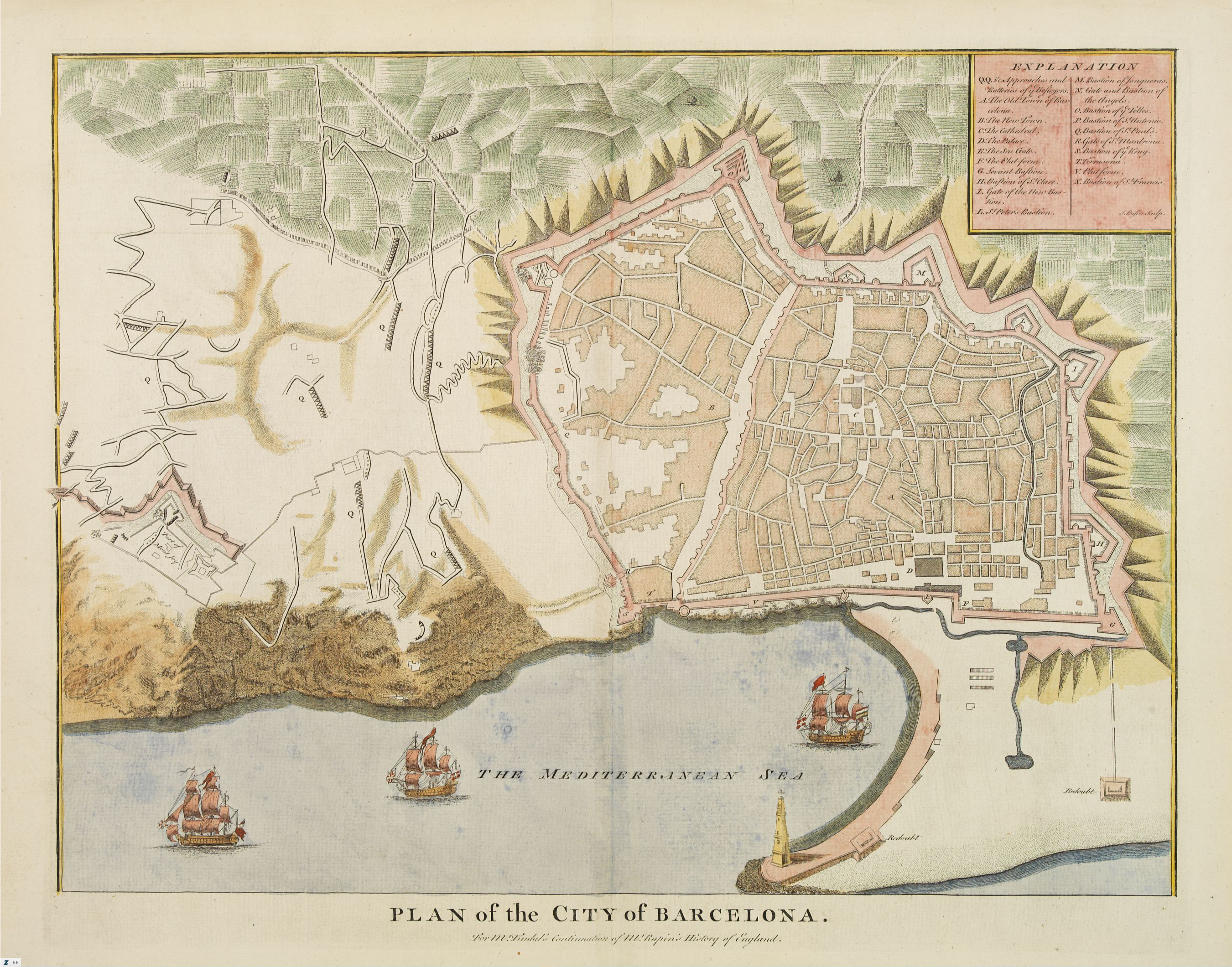
It's fair to say that not all European cities on the sea had deepwater ports; in cities with wide enough beaches, ships and boats could be dragged on land. In Barcelona, for example, ships had to be run aground in this way. The beach was only paved sometime in the 1700s to constitute a true dock; you can see how in this depiction of the city from the 1700s. The city's industrial explosion in the 19th and 20th centuries necessitated the artificial creation of more seaport capacity, so the government constructed a complex system of poured concrete sea-walls, but these could not have existed before the modern day. So predictably, sea-walls are much more likely to be seen nowadays than they were in the past; in this diagram of the French Navy's base in Brest, for example, you can make out the older facilities located up the Penfeld river in addition to the newer facilities on the coast encased by the sea-wall. Although there certainly is a pre-industrial precedent for sea-walls, most of the time they were built on existing sandbars or outcroppings for defense more so than for harbor expansions as they are now. You can see, for example, in this 15th century depiction of the seafaring city of Genoa the sea-walls are very clearly built on solid ground; you can also see some four docks (also visible in this later depiction) where the first seems to be made made of brick (recently unearthed, accidentally, during construction) while the other two look like they're "floating," possibly made of either wood or even large concrete slabs placed lengthwise. The point is, even a single seaport can have different elements constructed with different methods at different times.