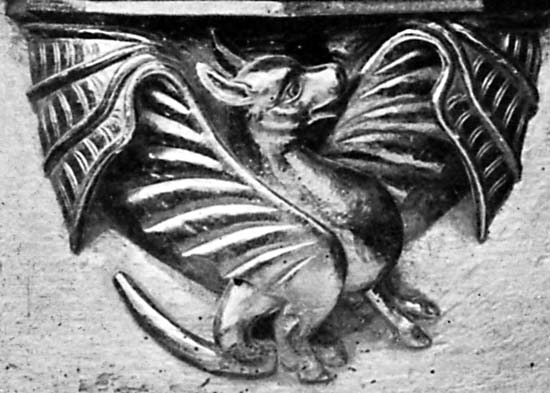
Surprisingly, the dragon as it appears in medieval natural science texts has very little in common with our modern imagination. In the Bestiary (and its sources, Pliny and Isidore, as well as related texts like Bartholomaeus Anglicus’ De proprietatibus rerum) the dragon is simply the largest of all serpents. It dwells in hot countries, has a harmless venom that belies great physical strength, and has an antipathy for elephants. Artists of the High Middle Ages generally depict dragons like this or this, as a large, two-legged serpentine forms with or without bird’s wings. Fire breathing is rarer in images from this period, and really only BL Harley 3244 could pass as our modern imagination of a dragon. By the later Middle Ages, however, the depictions have begun to adopt more recognisable features, as in this fifteenth-century French manuscript and this late fourteenth-century misericord.
Where did these features of later depictions come from, if not the various natural science texts of the period? One potential answer, at least in the English tradition, is that they survived from Germanic and Scandinavian myth. Here are some of the descriptions of the dragon from Beowulf, which survives in a single manuscript of the early eleventh century (although a great deal of ink has been spilt on the subject of how much earlier the poem was actually composed). I quote from Michael Swanton’s edition, which is the not the best but is the only copy I have to hand. I have lightly augmented Swanton’s translation where I think appropriate.
Đa se gæst ongan gledum spiwan, beorht hofu bærnan; bryneleoma stod eldum on andan. No ðær aht cwices lað lyftfloga læfan wolde. (2312–15)
Then the visitant [or “spirit, being”?] began to spew forth coals of fire [or “embers”?], to burn the bright houses; the light of burning rose, bringing terror upon men. The loathsome creature flying in the air wished to leave nothing there alive.
Scholars have come to different conclusions as to the actual form of the monsters in Beowulf, but the dragon is variously described as a “wyrm” (worm), a “ligdraca” and a “fyrdraca” (fire-drake), with a mouth full of “biter[an] ban[um]” (sharp bones/teeth). It dwells in a barrow, guards a hoard of treasure, and takes fiery vengeance upon thieves. It was this particular dragon that Tolkien had in mind when he wrote about Smaug.
This imagination of the dragon continues to endure in England after the Conquest (and of course also in Norse literature, although that’s a little beyond my knowledge), even as the rather different dragons of natural science texts begin to arrive in Western Europe. Saints' lives and romances continue to perpetuate the idea of the huge, fiery dragon of Germanic legend. Examples abound, but here’s a nice one from the Auchinleck Sir Tristrem (copied c.1330, perhaps written a little earlier):
Helle fere him þouȝt
Fram þat dragoun fleiȝe
...
He smot him in þe side;
It no vailed o botoun,
Oway it gan to glide,
His dent;
Þe deuel dragouns hide
Was hard so ani flint.
...
Þo was þe dragon boun
& cast fere ful riȝt
& brend
His armes þat were briȝt,
Schamliche he haþ hem schent.
It seemed to him that hellfire flew from that dragon... He smote him on the side but it was no use at all, his stroke glanced off; the dragon-devil’s hide was as hard as any flint... Then the dragon was ready and truly cast fire, and burnt his bright armour; he hurt them [the parts of the armour] shamefully.
It seems to have been this tradition that chiefly depicted dragons as we now imagine them, and which influenced some artists in bestiaries to paint creatures that increasingly bore less resemblance to the rather different serpent described by the text. Obviously, there’s more to this picture than English sources alone can provide; I alluded above to Norse, and of course there are also dragons in the distinct medieval Welsh literary tradition, from Geoffrey of Monmouth’s Latin Historia to the vernacular Mabinogion - and Henry VII eventually introduces a Welsh dragon in the Royal Coat of Arms. In addition to this are the biblical dragons, which are very much their own thing but might have influenced Beowulf and certainly influenced later saints' lives. These are pieces of the puzzle that others will need to supply.