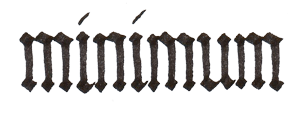
So like a lot of people I keep a journal. My hand writing is also just atrocious. Something I've thought about a lot is how do historians working on old documents figure out what's a typo/mistake, whats a regional difference and what's just what people actually called something?
This goes for pretty much every field, but as an example; If your reading the records written by a monk in Anglo-Saxon Wessex, all written in a cramped spidery hand writing, how do you separate mistakes from actual proper spelling/writing?
tl;dr: Plenty of experience and good pattern recognition skills.
My background in this: I'm in the [natural history] museum field where we sometimes have to "decode" old, handwritten labels and field notes; have participated in a historical transcription project; and am a beginner scribe in a living history group where more experienced scribes teach about this sort of thing.
You want to transcribe typos. You make note of what you think is one, but you never know when a typo might turn out not to be, or when a pattern emerges that tells you something else about language evolution. This is particularly true in pre-modern documents (speaking of English, specifically, since that's all I'm familiar with in this arena), when there was no standardized spelling. Shakespeare himself famously spelled his name in multiple ways. So, technically, there were no typos before standardization occurred. Oddities? Sure. But no dictionaries to say it's incorrect.
Beyond that, it's a matter of getting enough experience making observations to say "this spelling was correct in this time and place and that one is not", or "this person spelled this word in one way in a couple places, but mostly spelled it this other way, so the former was probably a mistake". Or, in the case of my job, "that's not how that species name is spelled in the original paper naming it, so it's a typo". Hard-to-read handwriting...that just takes a lot of getting used to. Sometimes you have to stare at text for quite a while to figure out what's actually written there (I'm looking at you, well-calligraphed gothic hands! Someone's added the dots to the i's in that pic, by the way. They wouldn't have been there earlier in period.). But the more you look, the better you get at it.
EDIT to add examples from a text I consulted while learning a hand: 'J' used to not be a thing in English and 'Y' was variable. The scribe wrote "reioyce" somewhere in there and it was correct for him to do so. 'V' wasn't used for a while either. So "double-u" really did start out as two 'U's. You can see how 'V' and a double-v-looking 'W' start showing up on some pages in this manuscript. It was written across the time that shift became more commonplace in this scribe's region.