I know the Han did it, but I'm wondering how they managed to get trade routes through the himalayas and the like.
Has anyone seriously studied up on this subject?
This is not exactly my area of expertise but I can enlighten certain aspects about your question and hopefully someone who focuses on the Silk Route answer more specifics about its full history.
So how exactly did the silk road get established???
I know the Han did it
As far as I know and understand, there was never one "establishment." No one, including the Han, built a road, laid down cobble stones, and then put up a sign saying "Silk Road." What we call "the Silk Road" (or what I see more increasingly as the more accurately phrased "the Silk Routes") was actually a network of trade routes (both overland from Asia and across the sea) from China to India and eventually extending to Persia and Europe.
These routes go back into basically unrecorded history, but it is Zhang Qian, a Han Chinese ambassador who is credited with pioneering the route. When he arrived in India (what John Keay calls "a shock to the Chinese world as much or more so than the Columbian exchange was in Europe") he was stunned to discover people who had Chinese goods (like silk and jade) but no knowledge of the Son of Heaven or what country he was from. This was the beginning of diplomatic relations, or at the very least, a cultural exchange of knowledge, between the Sinic and Indic worlds. As you can probably already deduce, since Indian peoples had Chinese goods prior to Zhang Qian's arrival, there were already trade networks in place, though I'm not aware of many documents from the first century AD until the Han Annals that discuss these trade routes particularly pointing to the natural arisal of trade routes followed by conscious awareness rather than the reverse (i.e. the recognition for economic potential and the conscious establishment of a trade route).
how they managed to get trade routes through the himalayas and the like
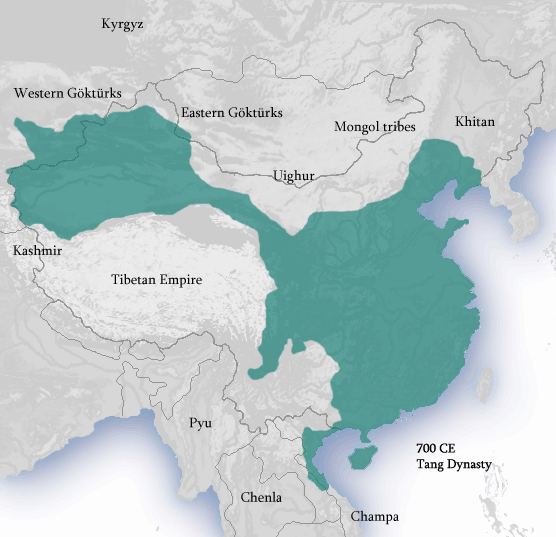
This I can speak more at length about. If you look at the map of what historians recognize as "the Silk Routes" you'll notice one very defining feature: that the Routes go out of their way - often incredibly far out of their way - to avoid the Himalayas. You can also see this in this map showing the direction Zhang Qian traveled in, and this map (poorly) detailing the countries he mentions in his report and their approximate locations. Many (in fact, most, I'd daresay) Chinese Dynasties have a pecular shape that thins out in the west. The Tang Dynasty is famous for its barbell shaped territory. The Ming never really expanded very far to the west, and were left with a dinky bit. This region where China literally thins out is called the Gansu Corridor. It is a valley formed between the Tibetan Plateau to the South and the Mongolian Plateau to the north. It is the last bit of Chinese mainland before the region becomes increasingly arid beyond what could be expected for traditional Chinese agriculture (and thus way of life, and every other mark of what we would traditionally think of as Chinese Civilization) to thrive. To the west of this corridor is traditionally nomadic land interspersed with desert city-states.
Since it was a region where China could easily (relatively speaking) extend their influence, it was often the safest land route to India. Even without Chinese imperial protection it was almost universally the easiest route (barring the fluctuating safety of the sea trade). Around the time Zhang Qian made his famous voyage, to travel through the Tibetan Plateau and traverse the Himalayas maybe wasn't impossible but it was incredibly difficult. Tibet - what little we know about the region prior to the seventh century - was at best a loose tribal confederacy, and pretty much always (as it still is) thinly populated with little obvious natural resources and pretty much no market value. By the seventh century when the Tibetan Empire was in full swing, they would gladly reach north towards the Silk Route's glistening city states like Khotan and Dunhuang and direct riches southward instead of on towards Xi'an, but that's beside the point.
That said, Tibetans, especially as trade continued to develop over the centuries, and more and more state control was established by various governments (Tibetan, Indian, Mongol, Bhutanese, Nepali, up to the Chinese and Indian governments of today still delineating the fathest reaches of the mountains today) some trade would start to leak over the borders. For people living in the Himalayas this trade is quite important. And Tibet, being rather naturally hostile to agricultural life, has always relied on various systems of trade for her civilization and state (this has led to the somewhat lax prohibition against Buddhist monks and monasteries being involved in commerce whereas in the hot and busy regions of Southeast Asia, those prohibitions are somewhat stricter).
The region Tibetans call Kham, and what to Chinese would be western Sichuan Province, however, was always much closer to the Chinese economy than the traditional nomadic one of Amdo (/Qinghai Province) and Central or Western Tibet. The Khampas have been particularly renown throughout Tibetan history for their travels (there's an old saying that Ngari has the holiest mountain [Kang Rinpoche, a.k.a. Mt. Kailash], U has the holiest temples [the Jowo Shrine, but also could refer to Gaden, Sera, and Drepung], and Kham has the holiest Lamas), their warrior prowess (their rebellion in the 1950s was what ultimately caused the largest rift in between the Dalai Lama and Mao's governments, not to mention that a brief encounter with some Khampas scared the bejeezus out of Heinrich Harrer, though that chapter never made it into the Brad Pitt film), as well as their penchant for trade. And you can see that in the first map showing the extent of the various trade routes: the lowlands of Kham, their cultural relationship and relatively short distance to Lhasa, and Lhasa's short distance and easy access through the Sikkimese lowlands to India, are the easiest Routes in that section of the world.
In one of my favorite AMAs from r/AH, there was a panel discussion on the Silk Road. The Silk Road/Route touches on my area of history quite a bit so it's interesting to me. There's this thread you can read through, if you'd like, but the tl;dr is that Sam Van Schaik, our modern rock star of Tibetology wrote an article on a Silk Road phrase book he found in Dunhuang written entirely in Tibetan. He describes that through this and some other works, that Tibetan was for some time a lingua franca of the route, though since the Route predates Tibetan writing and any sense of Tibetan political stability, there must have been other systems of writing and political control in place (other than Chinese since that was also very contentious in the region). Their conclusion: Sogdian. It's a really interesting read. I highly recommend it.
The Silk Route probably hasn't been as well studied as other periods of history in Western Academia, but there are a lot of recent publications that are looking into the history of the since it has been so instrumental to human history. The Mongols, infamous for their warmaking, were actually far more interested in the benefits of trade, and the empire Chingghis Khaan founded could be said to have been a "Silk Route free trade area" in some sense. For at least a short time, they made the region safe "so that an old woman could walk unmolested with gold on her head." Which is still an expression that survives today in Tibetan and Bhutanese languages as a description of an era of peace:
རྒན་མོ་གསེར་ཁུར་
rgan mo gser khur
(literally: old woman gold carry)
Sources (other than previous AH.com threads):
China: A History by John Keay
Tibet: A History by Sam Van Schaik
The History of Bhutan by Karma Phuntsho
(There's probably some other sources I made reference to as I was writing that, if you have a question about any particular claim, I can try to elaborate, I'm just running on fumes right now...)
It is a mistake to think of it as an actual "thing" that was "established". "The Silk Road" is a term coined by modern historians, not by the people who actually participated in it, and it was ever a single unified entity, rather it was a collection of local trade routes that, in aggregate stretched across Eurasia.
We recently held a Panel AMA on it you may find interesting.