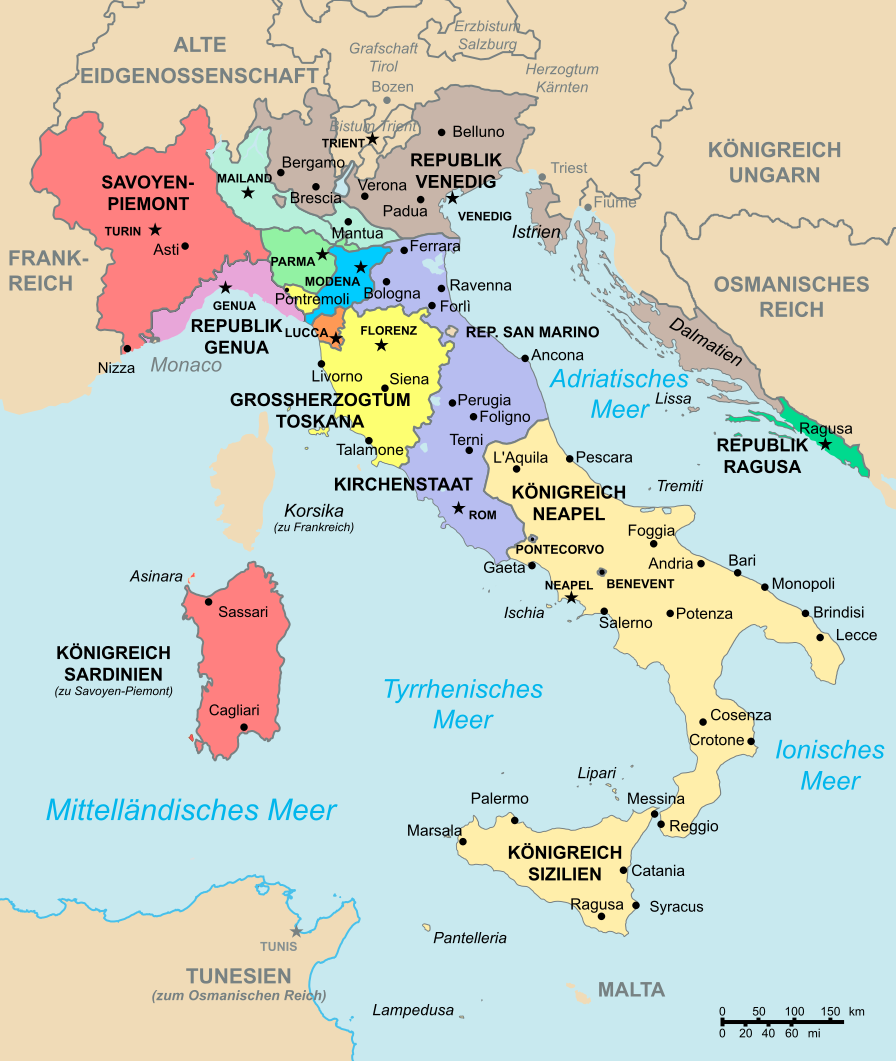
The process of Italian unification was followed by both the European Governments and the public opinion with both interest and concern. For the most part though, those weren't rooted in the issue of preserving the set up inherited from the Vienna Congress, as this had been already – if not shattered – deeply shaken, during the 1848-49 revolutions.
In fact the agreement between the major powers had ceased to exist early after the Congress; and while all more or less looked for a stable European balance to prevent a new age of wars, there was a significant difference of opinions on how this balance was to be kept.
The cornerstone of the Vienna Congress had been the principle of legitimacy: to this was inspired the Italian political geography after the award – notably the Congress did not restore the various political entities as they existed before though, as an immediate comparison shows. The basic idea was instead that the source of political authority of the State – i.e. the ruling dynasty – was neither God nor the People but rather the agreement of the various sovereigns: Italy was divided and ruled as it had been agreed upon by the major powers and that was the origin of the authority over the land.
In the words of Prince Metternich himself, addressed to to British Prime Minister Lord Palmerston in August 1847: The Italian peninsula is composed of states sovereign and mutually independent. The existence and the borders of those states are grounded on the general principles of public right [droit public general] and strengthened by political agreements that are not subject to challenging. The Emperor, for his part, has resolved to respect those agreements and to contribute, as far as his power goes, to secure their unalterable conservation.
In this overall picture, the “people” played no role and had no saying in the legitimacy of their rulers. Yet, despite the vague and uncertain nature of its political force, despite the often confuse nature of its claims, its oscillations between anger and dullness – certainly stronger in a Country where the social development was far less advanced than in other European Nations – the people appeared by 1847 already unwilling to submit to the agreements of the great powers.
And the ruling class had begun to take notice, realizing how the conservation of stability was no longer a matter of agreement between Kings but also of agreement between the Institutions of a State and the will of its people: in this light, many believed that the way for a European balance was paved with moderate social reforms – and in a way, those much moderate reforms advocated by a Palmerston for the Italian States, would have often appeared almost revolutionary to the Italians, used as they were to absolute censorship of the press, absence of any constitutional rights, persistent foreign interference in internal matters of public and private nature. It was not a surprise that the Sicilian patriots, looking for autonomy from the Naples Government, appealed to the 1812 Constitution forced on the King by the British Military Governor Lord Bentinck; nor that the Lombard elite looked to British liberalism as an inspiration to oppose the Austrian system of tariffs.
If we factor in the weight of public opinion, it would have been extremely hard for a British Government – either liberal or conservative – to outright refuse the plea toward reforms of the Italian moderates, especially since those looked explicitly to Britain as a model to balance the extreme principles of the French Revolution. This is evident in Palmerston's answer to Metternich's letter [unfortunately, I am translating it back from Italian – for those who can find it, it's Aug 12 to Ponsonby]. While reassuring his counterpart that the Kingdom was not looking for any change of the Italian political situation, he pointed out that Her Majesty's Government, on the basis of information coming from various sources, has developed a belief that a deep, widespread and well motivated discontent is dominant in a large portion of Italy. And where one is to consider how deeply flawed and full of any sort of abuses is notoriously the form of government of those states, and more prominently in the Roman State and the Kingdom of Naples, it should not surprise that such evident ailments give origin to the worst turmoil; and it is more than likely that men, feeling full the weight of the oppression they suffer and suffered for long years, without any hope of relief coming from their present rulers, would embrace even the most extravagant plot, hoping for any source of salvation.
As we can see, by the time of the 1848 revolutions, the British were already looking at the heritage of the Vienna Congress only as an instrument to keep peace and avoid committing to a new conflict on the Continent. The principles that had inspired the agreement were surpassed by the events – and in fact the Prime Minister in Vienna, Lord Castlereagh had been vehemently criticized at the time already, as those principles were at odds with the Institutions of the British State and the beliefs of British society. When, and where those agreements failed to keep that balance, giving way to social unrest, they were no longer useful – throughout the 1815-1860 the British Fleet had to keep a consistent presence in the Mediterranean, often to secure economical interests, providing assistance for British citizens during the various revolts that plagued the Southern Kingdoms and attempting a gentle persuasion in favor of reforms. The persistent backwardness and refusal to enact the most basic reforms led to actual diplomatic tension with the Italian States, culminating in 1856 with the withdrawal of the British (and French) ambassador from the Court of Ferdinando II of the Two Sicilies.
On the other side, the Austrian had pressing reasons to stick to the letter of the Vienna Congress – not last the fact that, in 1847, the old Metternich was still holding the keys of the Empire (the Emperor was partially infirm). It was obvious to everyone that simply accepting any principle of nationality would have put at risk the very existence of the Austrian Empire: if the Italians could leave, what about the Czechs? And the Croats? And even worse, the Hungarians? In fact a revolution was brewing within the core of the Empire – both in Vienna for social reforms and in Pest for independence. The issue was therefore not if the principle of nationality was to be accepted but whether it could be controlled through a pattern of federative reforms or suppressed through police measures.
A more prosaic matter tied the Italian lands to the Austrians as – generally accepted – data show that the Lombard and Venetian regions ran throughout the years of Austrian domination a significant active balance, while contemporaneously the Empire was running a deficit: the fiscal measures, tariffs and overall unfavorable economical policies (such as the refusal to allow for the railroad system to be connected to that of Piedmont or the damaging legislation imposed on the port of Venice) were repeatedly denounced even by those Italian moderates willing to cooperate with the Austrians; and highlighted as a source of conflict by the internal opposition to Metternich's party.
To secure the Italian lands, the Austrian Empire not only had to impose frequently punitive police measures on the Lombard and Venetian region but also to maintain a large standing army (70,000 in march 1848) and occupation corps in various cities of the neighboring Legations of the Papal State – garrisons were kept almost continuously in Ferrara, Bologna and Ravenna with the Austrians often forced to push further south to help the Papal troops control their domain and preventing the weakening Hapsburg rulers of Tuscany from tumbling over.
For this the Austrians paid a price: that of becoming a hated symbol of oppression throughout the Italian Peninsula – even beyond the actual responsibilities of their administrations. When the people of Rome, angered by the lack of those reforms that the election of the new Pope Pius IX (1846) had had them hope for, broke into a riot, their target was the palace of the Austrian ambassador. It is often noted in fact that the Italians were divided by barriers of traditions and language by that time centuries old; nonetheless the foreign interference and domination had helped them develop a general identity, almost by contrast. As the Lombard nobleman and moderate, son of an Austrian high functionary, the Count Federico Confalonieri wrote already in 1814 to Lord Castlereagh: I wish that you, Lord, fully understood the truth of what I am proud to proclaim; that we are no longer those of twenty years ago, nor can we go back to that state if not by giving up customs, sensibilities too precious to a Nation, that has a desire, means and energy to be one... More so it won't be lost to your understanding that all countries share limitations of nature, language and customs that prescribe their borders, boundaries that we all saw how dangerous and brutal is to cross. No ground is more than Italy divided from Germany, for natural barriers, language diversity, opposition of inclinations, character and customs. Here, Lord, the sacred reasons offered by the healthy part of my nation, that compel her to consider a misfortune, not yet the Austrian government, but the aggregation to this power as a province, with the sacrifice of her political existence.