Today:
You know the drill: this is the thread for all your history-related outpourings that are not necessarily questions. Minor questions that you feel don't need or merit their own threads are welcome too. Discovered a great new book, documentary, article or blog? Has your Ph.D. application been successful? Have you made an archaeological discovery in your back yard? Did you find an anecdote about the Doge of Venice telling a joke to Michel Foucault? Tell us all about it.
As usual, moderation in this thread will be relatively non-existent -- jokes, anecdotes and light-hearted banter are welcome.
Part 1
So, a couple of days ago /u/huzurarayan posted a META thread about what Askhistorians has taught people about the state of historical education and how non-historians approach history. For that I started some notes about my field in particular and what over three years and over 300 answers has revealed to me in terms of broad tendencies in the public view of the Holocaust and Nazi Germany, at least on reddit. I wasn't able to finish it in time for the thread to disappear again and so I thought I'd post it here.
Note that the study of the commemoration and public perception of the Holocaust and Nazi crimes as well as other genocides is a large subfield of the general study of how societies engage with their own past – so-called memory studies. While this isn't my primary focus, I'll at least try to take some ideas from this rather fruitful field that has expanded over recent years and thus contextualize some of my observations. These might not hold up for particularly individual users who have asked questions but have been shown through empirical research to largely frame Western publics engagement with the history of the Holocaust and Nazi Germany and how these historical events are viewed, framed, and contextualized. Also, I am excluding Holocaust Denial because while that is also something that happens shockingly often on here in my opinion, in-depth observation about what this reveals etc. are for another post at another time.
So, without further ado, here are some of my observations based on seeing what gets asked in this sub over the years:
There seems to be a sort of cognitive chasm about the meaning of the term Holocaust and what it is used to denote, whether it is a term used to describe the specific persecution and murder of the Jews (and so-called "gypsies") or all victims of the Nazis in total. This can take the form of a direct question or underwrite, as an assumption, a question on a different matter, e.g. a couple of days ago, someone asked why Oskar Schindler only saved Jews when other groups were also persecuted or before that what the difference between the so-called Generalplan Ost and the Holocaust is.
This is interesting for several reasons: While the term originated and is still in use in academia to denote the systematic and total persecution of Jews and so-called "gypsies", not in the sense of denoting a form of persecution that was "worse" than others but rather as a reflection upon the structural and ideological differences between what the Nazis termed the "final solution" and other campaigns of persecution and the centrality of anti-Semitism in the Nazis' world-view, within the general public, including the education system, there has been a definite push to include, commemorate and teach the fate of other victims groups of the Nazis – which is definitely a sensible move.
At the same time, the extension of the term Holocaust to include all (or at least more – more info on that later) victims of Nazi persecution and the teaching and narrating of the Nazis' crimes in a more broad manner has also lead – because of the limited time and resources available to public education as well as the general need for simplification in terms of broad narratives – to an decrease in knowledge about the actual history of various forms of Nazi persecution as well as a sort of decontextualization of the historical events and certain mechanics of further exclusion of certain groups of victims that don't seem to entirely fit the narrative.
For example, going by the experience of several years' worth of questions on this sub, the list of victims featuring large in public perception seems to be: Jews, Roma, the mentally ill and physically handicapped, homosexuals, political opponents and Slavs. Leaving aside for a minute the actual historical differences between the persecution of these groups, who is missing here – going by broad group categories the Nazis used – are so-called "asocials", so-called criminals, other groups persecuted under the label "gypsy" such as Sinti, Karrner, Bosnian Muslims etc. and certain Jehovah's Witnesses and others classified as "serious bible students". While the latter ones were admittedly only a small group, the first two in fact made up the majority of all Concentration Camp prisoners before 1939 with the so-called "asocials" being the largest group throughout 1938 and 1939 while the so-called criminals stayed an important and large group throughout the existence of the camp system.
Another factor that seems to be frequently passed over is that Jews and "gypsies" were the only groups that were systematically persecuted and murdered in their totality as a group because of their alleged racial characteristics. E.g. the overwhelmingly vast majority of mentally ill and handicapped people that were murdered by the Nazis were German citizens either in a hospital or asylum. Unlike with Jews there was no move to arrest and round-up all mentally ill and handicapped people in Germany or elsewhere in Europe in order to deport them to death camps. Similarly, the persecution of homosexuals was far from systematic and also affected in the overwhelmingly vast majority German citizens. The various plans to murder large parts of the population of Eastern Europe, specifically Poland and the Soviet Union, were also only ever implemented in parts, and never in their full extent, so that speaking of a systematic and all-encompassing genocide against Slavs like the so-called "final solution" represents for the Jews is not really possible.
There seems to be a distinct tendency to image the persecution of all these groups as having taken the same historical form when actually death camps like Belzec, Sobibor, and Treblinka were infrastructure specifically erected for Jewish victims and to a lesser degree so-called "gypsies" and not for homosexual men or political opponents. Again, pointing to these differences is not intended to establish some sort of hierarchy of who had worse – since "worse" is a category that hardly seems befitting to Nazi crimes – but it is important in terms of historical research and understanding for the differences in persecutorial practice and ideological basis between those crimes do reveal important facets of Nazi ideology and rule such as the centrality of anti-Semitism, the ideological specter of Judeo-Bolshevism as to how the attack on the Soviet Union was planned in the first place, and so on and so forth.
That public education and popular public engagement with the subject seems to be unable to impart a sense for these differences while at the same time teach about the different victim groups but rather tells a story that is in essence divorced from the historical context of the actual historical events can, in my opinion, explained with certain recent tendencies concerning the public image of the Holocaust, Nazi crimes and WWII.
Specifically with regards to what historians Daniel Levy and Natan Sznaider termed the "univerzalization" of the Holocaust in their 2006 book The Holocaust and Memory in the Global Age. Levy and Sznaider assert that with the Holocaust as a historical event making a massive entry into the Western public's shared memory in the 1980s and the simultaneous end of the Cold War and bloc confrontation, the events that occurred in Nazi Germany, including the persecution of Jews and others, have in some ways become a constitutive factor in how "the West" narrates itself and its place in the world. In absence of the Soviet Bloc as a negative foil to construct its image (not oppressive, democratic, free, and liberal in the classical European sense) new narratives needed to emerge and the Holocaust and WWII have become important ones.
This ranges from the sphere of politics, where e.g. it is telling that the German participation in the NATO intervention in Kosovo in 1999 was justified by foreign minister Joschka Fischer with the words "never again Auschwitz, thus Germany goes to war" to both the erection of the WWII memorial under George W. Bush as well as the non-too-veiled reference to the "Axis of Evil", to the proliferation of the holocaust as an educational "inoculation" against injustice and intolerance that is at display e.g. when the Anne Frank House organizes seminars on the story of Anne Frank in South Africa to teach kids that never experienced Apartheid about why racism is a problem. While there are certainly always arguments about the political uses of these reference and how much sense they make, with the latter one, there has been sensibly imo pointed out that it is far from necessary to go as far as Anne Frank to demonstrate the horrors of applied racism in South Africa.
Whatever one might think of the usage of the Holocaust, in a broadened definition, as a universal teaching example about injustice and racism, it has also contributed to the tailoring of a narrative where the differences in persecutorial practice and ideological basis concerning different group have been flattened or simply ignored and where other groups that don't fit the narrative as neatly ("asocials", "criminals") are still largely left out – a problem that needs more awareness with engaging with the subject matter in my opinion.
Are there any books by non-Western historians (African, Asian, etc) examining topics of purely European history? I don't mean colonialism stuff. I'm talking, for example, the Reformation or the Viking Age viewed from a non-Western perspective. Does such a thing exist?
Opium War humor on Twitter: https://twitter.com/thegrugq/status/923800827474542592
Well, I laughed.
Week 1
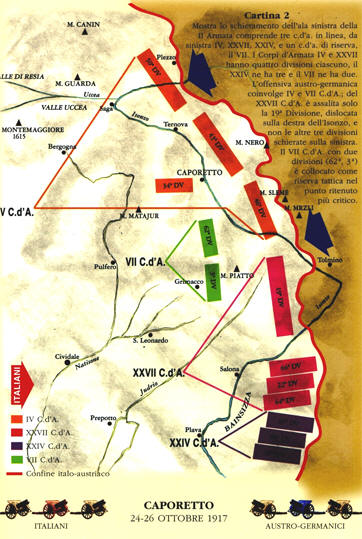
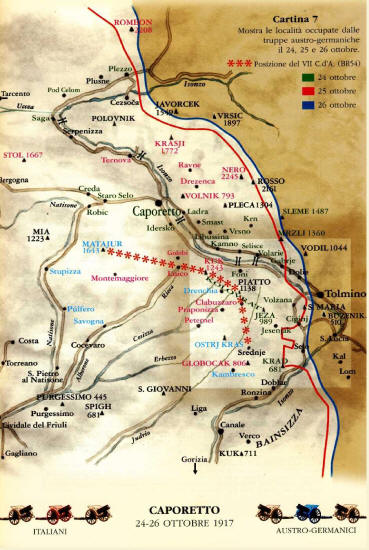
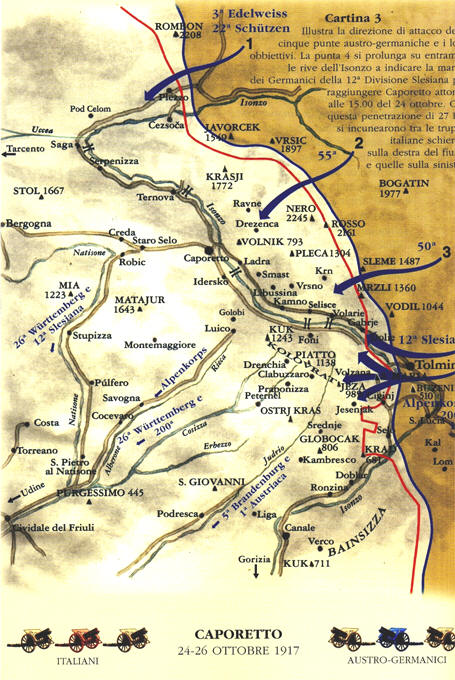
On October 24^th 1917, a concentration of Austrian and German forces broke through the Italian front line (held by a portion of the II Army of lt. General Luigi Capello) between the towns of Tolmino and Plezzo; since the early hours, the offensive (12^th division and Alpenkorps under lt. General Stein) developed along the course of the Isonzo River, from the Austrian bridgehead north of Tolmino to gain control of the crossing of Idersko and the neighboring town of Caporetto that allowed entrance in the Natisone valley. Thus creating a gap between the XXVII Army Corp (lt. General Pietro Badoglio) south of the Isonzo river and the IV Army Corp (lt. General Alberto Cavaciocchi) north of it; a gap that the meagre VII Army Corp (mj. General Luigi Bongiovanni) in the rear was unable to close. The contemporaneous push in the north (3^rd and 22^nd divisions under General Krauss) towards the Saga bridge left the IV Army Corp exposed to encirclement and forced its remains to withdraw through the Ternova bridge. By the afternoon of the 25th the Italians had been forced back in the sector from all of their static front lines making a standing defense impossible and exposing the flank of the XXIV Army Corp (mj. General Enrico Caviglia) and the whole III Army further south.
According to Enrico Caviglia's own summary, during the year 1917 the Italian Supreme Command had pushed the war effort to the extreme measure that the [condition of the] Italian population allowed for. In the battles from May to September it had brought to the front a number of divisions that could have been supported [in the upcoming months] only on the defensive. The Italian Army had lost [overall casualties from May to September] 350,000 men, thus remaining short of complement units and with numbers reduced barely over half [those of fully staffed units].
[Despite the fact that] the disarray of the Russian Empire, had left virtually all of the Central Empires' forces available for offensive operations on the Occidental fronts […] the Italian Army was, at the beginning of the enemy action, deployed as if it was still on the [strategic] offensive.
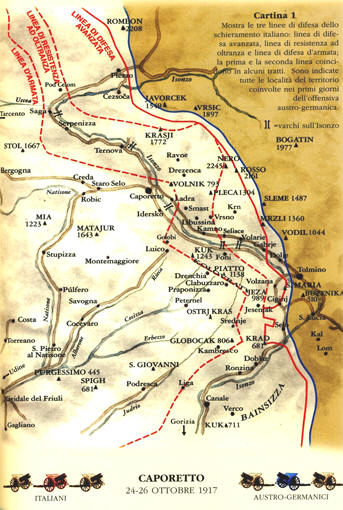
The first line, the only one permanently manned, was for practical purpose indefensible. Furthermore it offered the enemy three lines of maneuver, open or inadequately defended, towards our rear. Two from Tolmino, one from the Plezzo depression.
The Austro-German knew [the Italian] weak points; they knew those offered a chance of large strategic gains and operated accordingly.
Meanwhile the Parliament was in the middle of a busy week, giving the final touches to the extension of the provisional budget.
The Government, a national unity Ministry – with the Socialist on a position of external support – led by Paolo Boselli, was already on its last legs with many favoring a return to a more “political” Government. The Interior Minister, Vittorio Emanuele Orlando, had spoken on the 23^rd in an intervention that was both a statement of support of the current government action and a declaration of intents for a government to be, de facto an opening to a ministerial change, gaining wide appreciation.
Prime Minster Paolo Boselli had been appointed sixteen months earlier, after the Strafexpedition had determined the fall of the Salandra Ministry. Boselli was one of the last members of the Chamber to have lived through the entire unification process – as he had been born in 1838 and was at the time 79. On Thursday 25^th he was present; with him also Sidney Sonnino, in charge of Foreign Affairs since November 1914^1 ; the man who had finalized the terms of Italian intervention with the Treaty of London.
Still the session began on a rather low note. With a series of questions, including one by the Socialist De Giovanni to the Ministries of Public Education and War about the choice to grant exemption [from service] to a school teacher in Pavia and a typographer in Abbiategrasso.
It moved then towards the more pressing matter of the extension of the provisional budget.
General Vittorio Alfieri – newly appointed General Commissioner for Consumption and Supplies, a new Undersecretary Office of the Interior Ministry – spoke first, in a surprisingly effective break down of the necessities of war economy. He explained the need to reform and concentrate under control of the Interior Ministry the various functions previously handled by the various institutions, often competing and overlapping, created under contingent pressure during the first two years of war. He also announced the introduction of nation wide rationing for rice and pasta.
By this time, news of the severity of the military situation had reached the Chamber and de facto opened the process of Government crisis. Deputy Pietro Chimienti, a liberal of the Salandra fraction and tied to Sonnino – on record to talk about the agrarian policies of the Government – turned his intervention into a declaration in favor of the executive. After a short statement in support of the internal policy of the Government, he focused on the need for continuity in foreign policy, praising Sonnino' policy inspired of fortitude and prudence, of dignity and loyalty and remarking that any action, either of the parties or the citizens, in the Chamber or outside of it, that could cast a shadow on the stated intentions of foreign policy, constitutes a threat to [the Italian] diplomatic situation. He concluded declaring his intention to vote in favor of the Executive; but the underlying message was clear: under the circumstances, there was to be no opposition from the Executive to a Ministerial change but the continuity of the key positions of Internal and Foreign affairs was to be secured.
Sonnino himself picked up after Chimienti. He began explaining the workings of the newly instituted High Commissariat for imports from the United States of America and its relations with the Inter-Allied Committee, in particular the need to avoid any possible deleterious antagonism, arising from uncertainty of attributions even among people acting with the best intentions.
He then moved to the choice of denying passports to those [socialists] who had asked to take part to the Stockholm International Congress and the Bern Conference of Syndicalist Confederations. In fact those were various forms and opportunities for each pacifist party to deal with similar enemy groups with the purpose to force their peculiar point of view onto the Government. And with a not unremarkable distinction: that those parties were, in the countries at war with [Italy], in perfect agreement with their Governments and played along with them, while in [Italy] […] they tried to move forward with their own partisan policy, against and in spite of their Governments, supported by the will of the legal representatives of the Nation. We can't allow that, without betraying the Allied cause [continued Sonnino...] The whole Nation, represented by the Parliament and by the Government that holds its confidence, and as long as it holds its confidence, approved the war and supports it wholeheartedly without distinctions of classes and parties; the entire Nation […] will have to make peace. - Any particular action of a party, colluding with enemy groups, must be avoided
He then moved to a review of the diplomatic situation after the Paris and London Conferences of July and August 1917, that restated the immovable resolve of the Allies not to lay down arms before reaching the goal of making impossible the renewal of any unwarranted aggressions, such as the one the Central Empires were responsible of.
Along the same lines went his cautious dismissal of the Papal Note to the warring Nations as, when examined in search for practical guidelines for peace conditions, the same undefined character appeared, that was shown by the messages from enemy parts; which made impossible or useless any further exchange. [and] No solid ground was given by the Papal Note or by those speeches [of Enemy part], to lay the specific conditions of a future peace. [In absence of those conditions] entering peace talks would bring no useful outcome. And, if the Central Empires showed interest […] it was only for the purpose of gaining from the relaxation and exhaustion that the news of the beginning of [peace] talks would induce in the spirit of our people.
He then moved to the details of the Papal Note, arguing the difficult realization of the suggestion of abolishing conscription ad explicitly criticizing the Pope for including the Belgian question in the general statement about war reparations: The invasion of Belgium by German forces, violating a neutrality that Germany itself had guaranteed, moved centuries backwards the very notion of right of the peoples […] To equate the Belgian issue and its reparations to those of any other offense or damage in a legitimately and openly carried out war is a solemn sanctioning of this new right of violence and oppression.
It's almost Hallowe'en, and my thoughts have been turning increasingly to ghosts and ghouls and the horror tale in all its variations and hoary history - and a stark reminder too that the greatest monstrosities are usually reserved for the real world, and that there are unpleasant chapters to read in any history. It was in this mood I recalled a passage from Robert E. Howard's letters to H. P. Lovecraft - an important passage, even if it is unpleasant in parts.
As regards African-legend sources, I well remember the tales I listened to and shivered at, when a child in the “piney woods” of East Texas, where Red River marks the Arkansas and Texas boundaries. There were quite a number of old slave darkies still living then. The one to whom I listened most was the cook, old Aunt Mary Bohannon who was nearly white — about one sixteenth negro, I should say. Mistreatment of slaves is, and has been somewhat exaggerated, but old Aunt Mary had had the misfortune, in her youth, to belong to a man whose wife was a fiend from Hell. The young slave women were fine young animals, and barbarically handsome; her mistress was frenziedly jealous. You understand. Aunt Mary told tales of torture and unmistakable sadism that sickens me to this day when I think of them. Thank God the slaves on my ancestors’ plantations were never so misused.
And Aunt Mary told how one day, when the black people were in the fields, a hot wind swept over them and they knew that “ol’ Misses Bohannon” was dead. Returning to the manor house they found that it was so and the slaves danced and shouted with joy. Aunt Mary said that when a good spirit passes, a breath of cool air follows; but when an evil spirit goes by a blast from the open doors of Hell follows it.
She told many tales, one which particularly made my hair rise; it occurred in her youth. A young girl going to the river for water, met, in the dimness of dusk, an old man, long dead, who carried his severed head in one hand. This, said Aunt Mary, occurred on the plantation of her master, and she herself saw the girl come screaming through the dusk, to be whipped for throwing away the water-buckets in her flight.
Another tale she told that I have often met with in negrolore. The setting, time and circumstances are changed by telling, but the tale remains basically the same. Two or three men — usually negroes — are travelling in a wagon through some isolated district — usually a broad, deserted river-bottom. They come on to the ruins of a once thriving plantation at dusk, and decide to spend the night in the deserted plantation house. This house is always huge, brooding and forbidding, and always, as the men approach the high columned verandah, through the high weeds that surround the house, great numbers of pigeons rise from their roosting places on the railing and fly away. The men sleep in the big front-room with its crumbling fire-place, and in the night they are awakened by a jangling of chains, weird noises and groans from upstairs. Sometimes footsteps descend the stairs with no visible cause. Then a terrible apparition appears to the men who flee in terror. This monster, in all the tales I have heard, is invariably a headless giant, naked or clad in shapeless sort of garment, and is sometimes armed with a broad-axe. This motif appears over and over in negro-lore. I do not know what sort of tales modern darkies tell. For years I have lived in a section where negroes are very rare. Indeed, no colored person is allowed to remain over night in this county.
But through most of the stories I heard in my childhood, the dark, brooding old plantation house loomed as a horrific background and the human or semi-human horror, with its severed head was woven in the fiber of the myths.
But no negro ghost-story ever gave me the horrors as did the tales told by my grandmother. All the gloominess and dark mysticism of the Gaelic nature was hers, and there was no light and mirth at her. Her tales showed what a strange legion of folklore grew up in the Scotch-Irish settlements of the Southwest, where transplanted Celtic myths and fairy-tales met and mingled with a sub-stratum of slave legends. My grandmother was but one generation removed from south Ireland and she knew by heart all the tales and superstitions of the folks, black or white, about her.
As a child my hair used to stand straight up when she would tell of the wagon that moved down wilderness roads in the dark of the night, with never a horse drawing it — the wagon that was full of severed heads and dismembered limbs; and the yellow horse, the ghastly dream horse that raced up and down the stairs of the grand old plantation house where a wicked woman lay dying; and the ghost-switches that swished against doors when none dared open those doors lest reason be blasted at what was seen. And in many of her tales, also, appeared the old, deserted plantation mansion, with the weeds growing rank about it and the ghostly pigeons flying up from the rails of the verandah.
There is a legend that was quite popular in its day in the Southwest, which I am unable to place. That is, I cannot decide whether it is one of the usual inconsistencies negro-folk-lore often displays, or a deliberate Irish invention, intended to be a bull. That is the one about the headless woman, who strange to say, was often heard grinding her teeth in the angle of the chimney, and whose long hair flowed down her back!
The line on "mistreatment of slaves" being "exaggerated" was in keeping with the then-current pattern of scholarship which downplayed the horrors of slavery and uplayed the horrors of Reconstruction - the same face-saving denial that led to the second incarnation of the Ku Klux Klan and Howard asserting that his ancestors never mistreated their slaves... an attitude which has, sadly, not quite worked itself out even today. That Howard absorbed at least part of this folklore is telling in some of his horror stories, though the Texan never sought to rewrite any of these ghost stories directly, though he did incorporate the image of the decayed plantation house in his famous story Pigeons from Hell (1938), which has been adapted several times in comics and television.
If you transported trump back a few thousand years back to ancient Rome around the time of the Gracchi brothers; how would he do? In what terms would we talk about him today?
Yeah its crazy speculation but fun to think about I'd say.
Kind of a "shower thoughts" question: Human beings now are much taller than our ancestors. Was there a point in history where something happened that contributed to a sudden overall increase in height (ie. The Industrial Revolution), or has it been a very gradual thing as knowledge of nutrition and medicine have increased?
I had asked a question about the Scientific Revolution and how King Charles I's execution may have influenced/affected/shaped the rest of the revolution as it moved on to the Enlightenment period. I don't have a background in history, but I am in academia, so I do have access to databases. Are there any journals/articles/pieces of literature that comes to your mind that might help drive my interest and further me down a rabbit hole?
Probably doesn't deserve its own thread, but I'm curious:
I'm binging the tv show Black Sails, which is set in the "golden era of piracy".
A plot point that's come up several times is sailors swimming out to board a ship and capture it. It's happened two or three times in three seasons.
It seems very unlikely to me. Has this ever actually happened? Was this a real tactic in this era? Could most sailors then even swim? Could you board a ship of that era from the water without someone dropping a ladder to you?
I'm back doing another week of CRM in Wisconsin and we've moved on to Phase II. It's been a blast even with the 40F work days.
I'm also studying to retake the GRE on Nov 13th. For some reason, I assumed that the GRE scores did not matter when applying for doctorate programs since I had my MA. I was wrong. So now I'm scrambling to retake the test to have scores to send on my applications since my old scores are now out of date.
Also, fuck ETS and the ridiculous price they charge for their test. It was $130 when I took it in 2011, now it is $205.
Dear historians, I'm looking for a consultant familiar with Chinese history during the early 1900s, specifically on rural life and the cultural impact of the civil war.
If you are familiar with this historical period and interested in being a consultant, please write here or PM me, so that we can come to an arrangement, through Paypal or elsewhere. Hope we can work something out.
What I'm looking for is someone in an advisory role that I can ask questions I cannot find the answers to, someone who can point me to the right resources or direct answers.
Thanks!