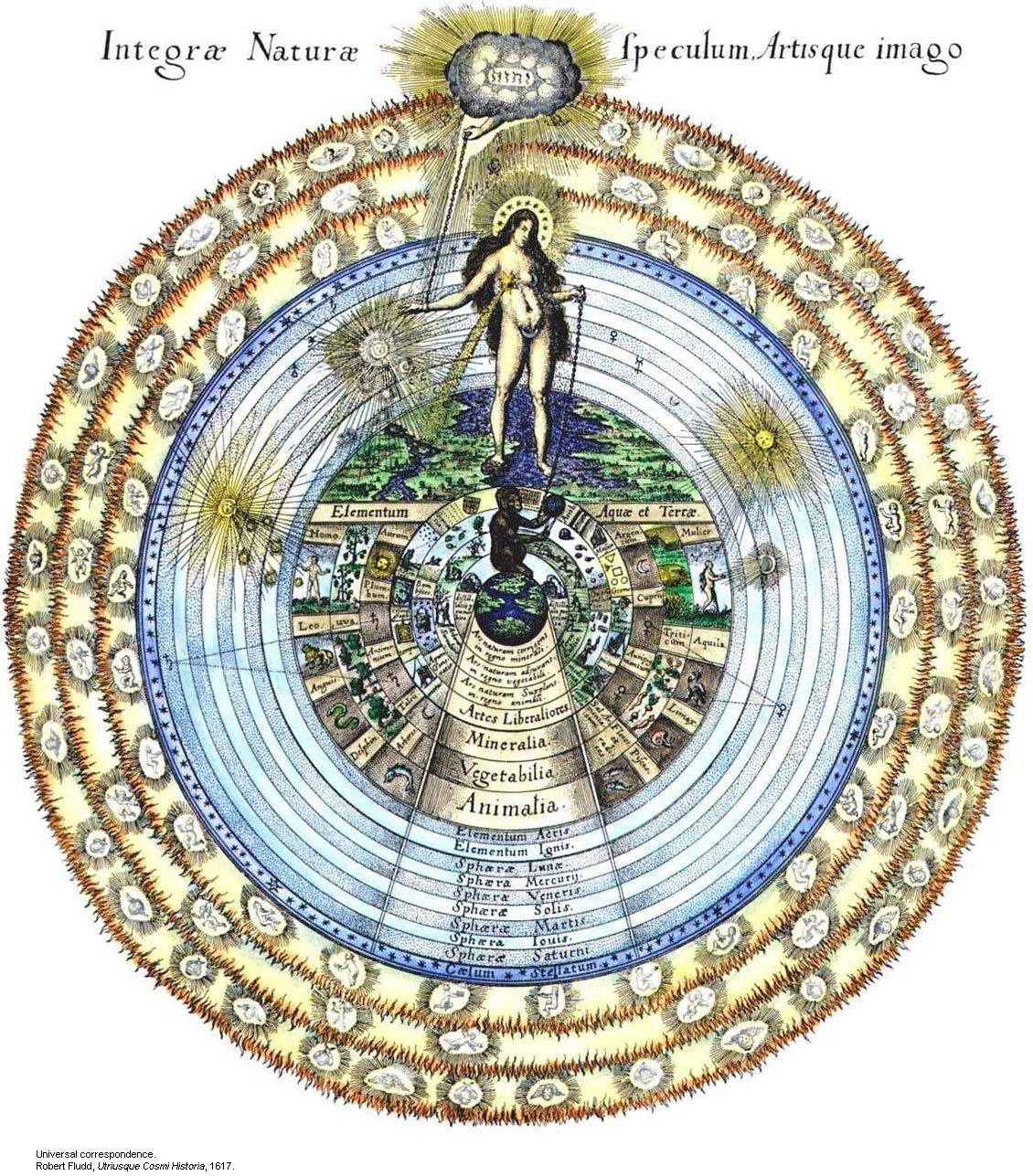
Related to the other post about medieval geography, I started Googling cosmological diagrams and came up with this one. This is cited as being from Robert Fludd's Utriusque Cosmi Historia, 1617. I recognize the crown of twelve stars as indicating that this woman is Mary, the mother of Jesus. I also recognize the general concept of the Great Chain of Being.
But what's going on with the other symbols in the image? Why does Mary have a boob ray zapping some portion of the Earth? And why does she have a chained up monkey (who is at the center and not the "Animalia" sphere)?
I'm studying for my general exams (one topic of which is "Renaissance gardens, landscape, and nature") and I just recently encountered an article that discussed this image. I believe it was Katharine Park's "Nature in Person: Medieval and Renaissance Allegories and Emblems" in The Moral Authority of Nature edited by Lorraine Daston, but unfortunately, I'm at an academic conference for the next few days and my copy of the book is at home over 2000 miles away. (Perhaps someone else here has the book and can help provide a citation?)
The naked female figure is not the Virgin; an artist in the early 17th cebtury would NEVER depict the Virgin naked, unless maybe if she was shown as a newborn. The figure is actually Nature, who was increasingly depicted from the late 15th/early 16th century onward as a naked (or at least bare-breasted) woman either in the act of breastfeeding children or freely lactating as a symbol of the fertility, fecundity, benevolence, and nourishing qualities of nature. The shackled monkey is meant to represent Art/Artifice, which attempts to "ape" nature yet ultimately proves inferior and subservient to her... at least in this cosmography. A mid-sixteenth century Italian engraver steeped in Florentine art theory might actually have been inclined to reverse the figures' positioning, with Art superceding--or better yet, perfecting--that which Nature has only adumbrated.
Odd side question - on the lower part of OP's first image, it looks like the cosmos is laid out like a layered onion, with concentric rings for each planet and the sun. I can understand "elemental air" perhaps being the atmosphere, but what is the "elemental fire" above it? Am I misreading (I don't speak Latin, only Spanish), or was this a part of Christian cosmology at the time?