Wouldn't they have all rotted away?
(to specify: Celtic/Germanic shields from Antiquity)
We have in fact found a number of shields from antiquity: the Clounoura shield preserved in a co. Tipperary bog (with damage from weapons interestingly enough) and the Fayyum shield from Egypt (where it never rains), which is likely Roman, as the deep curve is known from art of Roman shields, but not Celtic, and about 150 shields and partial shields from the Hjortspring boat (also found in a bog). In addition, shield components have been found from places with less unusual climates, mostly fittings (boss, rims etc) from graves. If they're in their original position it's completely possible to work out the shape of the shields.
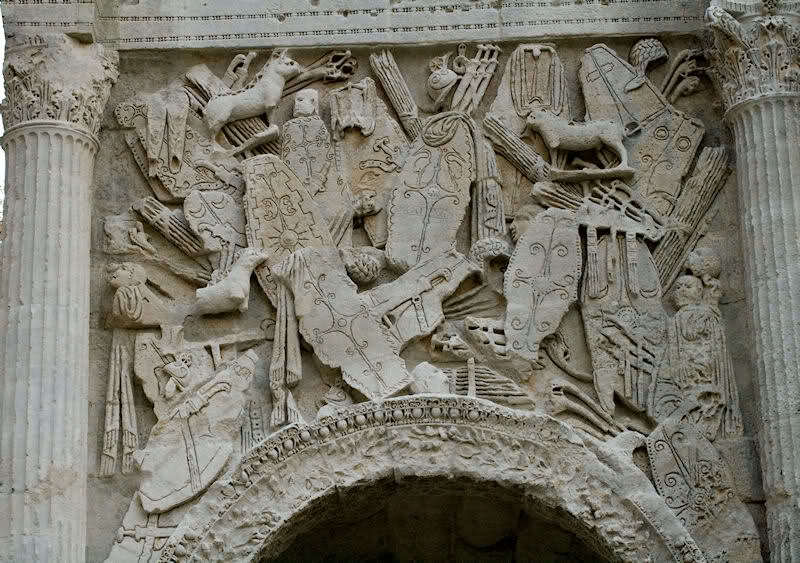
Artwork is still fairly important to our understanding of shield types. There were a few broad types: a long oval shield, as seen in Iberian, Celt-Iberian, and Celtic subjects, such as the Roman arch at Orange. From a similar geographic region (though not from Iberia) and time period there are a number of depictions of hexagonal shields. Some of them can be found on the arch at orange, but also from this Gaulish figure of a warrior, and, though considerably less clearly, on the Gundestrup cauldron, which is a rather cosmopolitan artefact: found in a Danish bog, the workmanship is Thracian, and the themes seem mostly to be what we would call Celtic.
Three Iron Age bronze shields have been found in Britain. One, the Chertsey shield is a miniature version, entirely in bronze, of the kind of shields that are found on the continent. The other two are bronze shield covers, the extremely famous Battersea shield and the Witham shield. All three were deposited as votive offerings, and the Chertsey shield was likely made specifically as one. Another particularly British design was the 'hide' shaped shield, known from miniature votive pieces and from surviving rims.
Ireland and Scotland likely used small rectangular shields during the Iron Age. Two Iron Age shields have been found in Ireland: the Clonoura shield I linked above, and the boss of a more typical large oval design, however this was almost certainly owned by a British immigrant. Evidence for Scotland is a bit thinner on the ground, but Tacitus mentions the Britons of Caledonia's 'huge swords and small shields', and a Roman distance marker from Bridgness shows Picts with small square shields. It would be dangerous to take either Roman source at face value (the Roman riding down naked barbarians was an extremely generic image used in Roman art from around the empire), but taken together, and also bearing in mind the Irish shield, and the early medieval Pictish art showing small square shields it seems fairly likely.
My main sources were 'the Celts' by Barry Cunliffe, and 'Pagan Celtic Ireland' by Barry Raftery.