Logistically, going from a near exclusive German to near exclusive Polish city within a year seems near impossible. Coupled with a bombed out city and new border it's hard to wrap my head around how the transition happened.
The transformation of Breslau into a Polish city was emblematic of the vast population transfers that shaped the postwar makeup of Eastern Europe. The city, which had been majority German and a long pedigree as a Germanic city, became Wrocław and by the late 1940s its residents were almost exclusively Polish. This change though was not peaceful nor slow, but rather the cumulative effect of official and unofficial policies to make this area Polish.
Although many expellees rightly hold the Polish and Soviet authorities for the expulsion of the German population, the exodus from Breslau had actually begun as early as late 1944. A large number of civilians and refugees left the city and their homes in defiance of official bans as the Red Army began to cross the Oder and it was clear that German arms would not stop them. On 19 January 1945, the Gauleiter of Lower Silesia Karl Hanke ordered the official evacuation of Breslau and only a little more than a quarter of the late-1944 population remained in the city by the time it was surrounded in February. The vicious streetfighting of Festung-Breslau further destroyed the city's infrastructure and killed a large number of the remaining population. The end of the war added a further voluntary exodus from the city as damage inflicted in the siege made a return to normalcy quite difficult.
Yet these voluntary or German state-led evacuations though were usually done in the hope that the German population would return after the fighting or when things had settled down. The Allied governments though had decided differently. The wartime Allies had come to a consensus at Yalta and Potsdam that the German populations were to be "unmixed" from the postwar Poland and Czechoslovakia. The Allies sanctioned a mass population transfer that would leave Eastern Europe more ethnically homogeneous and nip any future German irredentism in the bud.
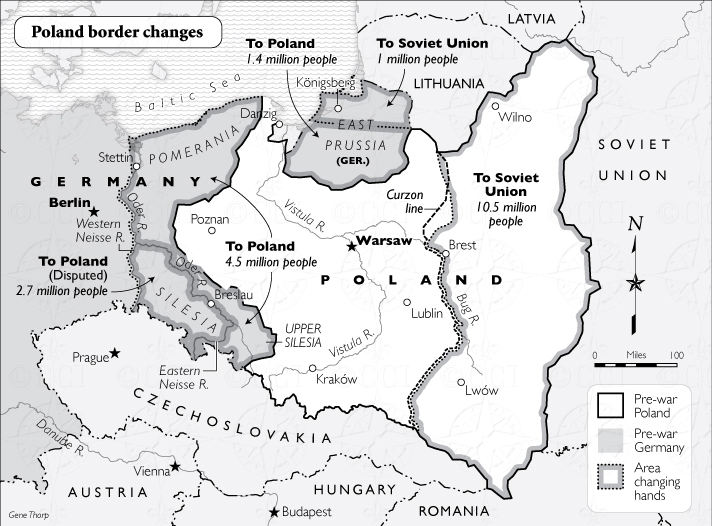
The two most powerful voices for expulsions in the Allied camp were the Soviets and their allies among the Polish Communists. Stalin had pushed for, and received large chunks of pre-1939 Poland and East Prussia as Soviet territory- see in this map. Stalin recognized that Poland would not be a strong satellite state if it were not compensated and also used the idea of compensating Poland with Silesian and Pomeranian territory as a means to sell Soviet territorial gains to the UK and US. The Poles, both Communists and the Polish prewar government in exile, also pushed for German territory during the war.
Although the Polish government in exile was apoplectic over the Western Allies' ceding eastern Poland to the USSR, there was really not much they could do about it. Stalin had the initiative to rework the borders of Eastern Europe because the Red Army had such overwhelming force in Eastern Europe by 1944/45. And despite various postwar hand-wringing about the UK and US betraying Poland during the Cold War, there was relatively little interest among the Western Allied leadership in these borders. One interesting bit of evidence is that when Stalin proposed the new Western border for Poland, he framed it along the rivers Oder and Neisse. The problem for negotiations is there are two Neisse Rivers, the Lusatian Neisse and the Glatzer Neisse. A map recently found in the Soviet archives shows Stalin's initially conceived of the Neisse border as the Glatzer, leaving postwar Germany approximately half of Silesia, but Western negotiators simply assumed that the Neisse in question was simply the more well-known Lusatian Neisse, which meant ceding most of Silesia to Poland. Western Allied negotiators realized their mistake later, but Stalin was not one to give up an already-agreed upon concession, so the postwar border became the Oder-Lusatian Neisse. Within this context, it became a given among all parties that Poland would receive German territory as compensation.
What this diplomatic consensus meant for Breslau was that the city would lose its remaining German inhabitants. The Communist-dominated Polish provisional government was quick to dissolve Breslau's German interim municipal government in August 1945 and the Soviet military government facilitated the removal of all German municipal authorities by the end of 1945. Official expulsions of the German population began in the winter of 1945 and continued for a little under two years. The Soviet military government and the Polish provisional government ordered Germans to carry their belongings and report to rail depots where they would be shipped to either the Soviet or British zones of Germany. In tandem with these official expulsions were wildcat expulsion in which Polish and Soviet authorities pushed out reluctant Germans through violence or the threat of violence. The Polish provisional government also started a policy of stringently enforcing the new Polish-German border so that any expelles would not return.
The expulsions worked in conjunction with a mass transfer of Poles within the new borders of the Polish state. Stalin's "unmixings" were not just limited to Germans; Poles from areas absorbed into the USSR were often expelled into the new Polish state. One of the natural places for these groups to end up was in Pomerania and Silesia as these areas were now vacant. The Polish provisional government was also keen on having Poles settle within the new Polish territories. Many within the provisional government were aware that the westwards expansion of Poland was the result of an Allied fiat pushed by Stalin. Just as a diplomatic negotiation had changed borders, so to could these decisions be reversed, especially since the final matter of German territorial borders remained up in the air until a formal peace treaty ending the war. The Polish communists may have been Marxist-Leninists, but they also appreciated that Stalin was a mercurial master. It was not entirely out of the realm of possibility that he could reverse Poland's westward gains to buy the loyalty of a future united Germany. So just as the Red Army's boots on the ground gave Stalin an edge over territorial revision, the Polish provisional government had an incentive to create a demographic reality to keep the Oder-Neisse line.
Not all of the Polish settlement of Breslau and Silesia was high politics though. The war and German occupation had created a large number of internal Polish refugees. Many forced laborers within Germany and Breslau itself found that it was much easier to settle in these regions than in the remaining areas of pre-1939 Poland. The cumulative effect of these policies was that the newly-renamed Wrocław gained some 12000 Polish inhabitants per month in 1946 while the German population shrank. Outside of those Germans deemed important specialists, most the of the German population had been removed from the city by 1948. These measures made the city overwhelmingly Polish in a very short time, albeit Wrocław would only regain Breslau's prewar population numbers in 1981.
The Allied agreements on population transfers explicitly called for them to be "orderly and humane," however Breslau's evacuation and the rest of the Western provinces was anything but that. Even the official evacuations were done under duress and with the threat of violence. Wildcat expulsions were even more chaotic. While it certainly served the needs of both the Polish and Soviet governments to make Wrocław Polish in a short amount of time, the traumatic experience underscores that such population transfers are inherently violent and the politics behind them care little for the actual people being expelled.
Sources
Kenney, Padraic. Rebuilding Poland: Workers and Communists, 1945-1950. Ithaca, N.Y.: Cornell University Press, 2012.
Thum, Gregor. Uprooted: How Breslau Became Wrocław During the Century of Explusions. Princeton: Princeton University Press, 2011.