Apologies for the rather specific question. Im writing about the Korean poem "The Turkish Bakery" for a class.
The Turkish Bakery
I go to the Turkish shop, buy a bun, An old Turk grasps me by the hand. If this story is spread abroad, you alone are to blame, little actor. I will go, yes, go to his bower: A narrow place, sultry and dark.
I go to the Samjang Temple, light the lantern, A chief priest grasps me by the hand. If this story is spread abroad, you alone are to blame, little altar boy. I will go, yes, go to his bower: A narrow place, sultry and dark.
I go to the village well, draw the water, A dragon within grasps me by the hand. If this story is spread abroad, you alone are to blame, o scooper. I will go, yes, go to his bower: A narrow place, sultry and dark.
I go to the tavern, buy the wine, An innkeeper grasps me by the hand. If this story is spread abroad, you alone are to blame, o wine jug. I will go, yes, go to his bower: A narrow place, sultry and dark.
It's mostly pretty straight forward, but for the life of me I cannot figure out what the "dragon in the well" is supposed to mean. Does it have some sort of symbolic meaning? Is it just fanciful imagery?
Any help is greatly appreciated :)
This is a fantastic question.
On the surface, "The Turkish Bakery" appears to portray the sexual depravity and licentiousness of two unnamed women.^1 From this perspective, the dragon just adds a supernatural element to the women's exploits. Not only are they sleeping with strange foreigners and high-ranking clerics, even gods like the dragon kings are engaging in these orgies. How sacrilegious!
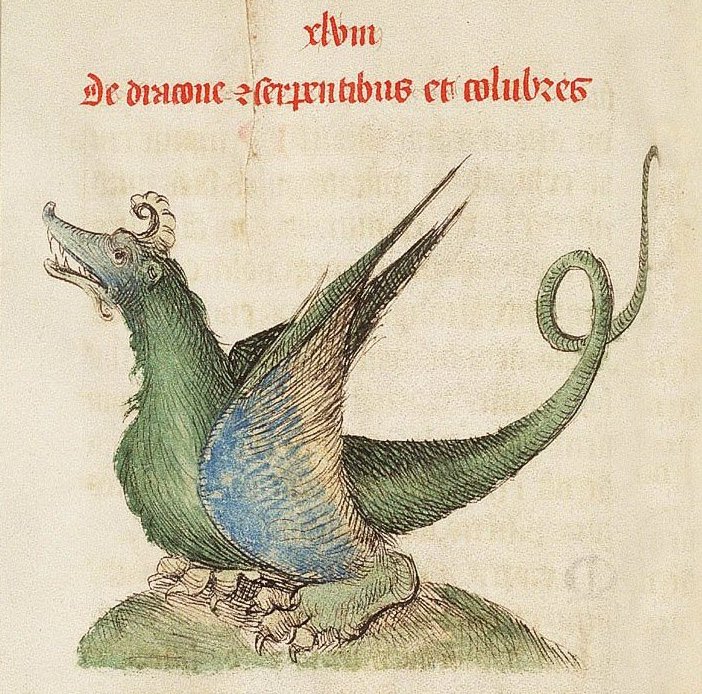
Now, why is the dragon in a well? This is the sort of dragon most Westerners conceive, breathing fire and being generally rather unpleasant. The East Asian dragon is quite different, and in the context of this poem (though not always) it's essentially a water spirit. Water – from little springs and wells to the vastness of the Eastern Ocean – was occupied by Dragon Kings, controlling the course of the rivers and the waves of the seas and sending the clouds and rains that feed humanity. Consider the following edict by the Qianlong emperor in 1738, which sums up quite well the role of local dragons in East Asian cosmology:
The dragon god of the Black Dragon Pool [a pond near Beijing] favors the people... whenever the capital district needs rain, prayers here are answered. The ordinary people believe in the merit of this enlightened deity in moistening the fields and permitting the crops to ripen.^2
As in China, so in Korea. The Dragon God is quite common in Korean folk religion as a spirit living in the ponds and wells. In the little Korean village of Chilgok, for instance, old townsmen still gather in communal prayer every year besides the local stream and well to pray, "O Dragon Kings! [...] Let our children be rich and their wishes come true, and let our families be peaceful."^3
So it's only natural that the dragon is in a well; it's where dragons normally live.
Of course, this poem isn't just about sex and mass orgies. The standard interpretation is that this poem reveals the corruption and moral decadence rampant in the thirteenth-century Korean elite.^4
The first stanza discusses an affair between the narrator and a Turk, presumably part of the occupying Mongol army or at least tied to the Mongol overlords. The implication is that the Mongol occupation is a corrupt and salacious entity, debasing the morality of the Korean elite who are its subjects. Yet the Korean women are no simple victims, but participants in their own corruption (consider Narrator 2's lust to enter sexual contact with the Turk). The overall theme, then, would be the moral decline of the Koryŏ elite.
The second stanza discusses an affair between a high-ranking cleric and the narrator(s). The topic turns to another source of authority, the Buddhist clergy. Just like the Mongol occupiers – but more ironically, insofar as such decadence would be expected from the Mongols but never from the pious sangha (and even more by the fact that this affair is initiated by the highest-ranking monk in the temple) – the Buddhist clergy is debasing public morality by openly satiating their lust. The sangha, and the wider elite they represent, is thus exposed as corrupt.
So if each of the men represent a part of society, what's the dragon? Consider the following fifteenth-century Korean poem, "Songs of Dragons Flying in Heaven":
海東 六龍이 나라샤 일마다 天福이시니
--
Six dragons fly east of the sea, all their acts are of celestial fortune
But as it happens, this poem is not about the deeds of six imaginary reptiles, but about the deeds of six ancestors of the royal dynasty. This reveals a key motif in understanding "The Turkish Bakery": in East Asia, the dragon is a symbol of the king.
We could then say that the dragon in the well that grasps the woman's wrist is the King himself, and by extension the royal court. The sexual and moral depravity in Korean society does not emanate only from the occupiers and the clergy; it comes even from the royal court, the highest-ranking authority in the entire nation. The court, too, is a site of decadence, corruption, and exploitation. Something is rotten in the state of Korea, and the rot reaches to the very top.
This interpretation of the dragon being the king (and by extension, the scooper being the corrupt eunuchs surrounding the king) is the majority opinion.
But remember that "The Turkish Bakery" was sung in the Korean court and may have been penned in the court itself.^5 Could a court song really have been that critical of the establishment? So some historians argue that the dragon is not the king, but just a metaphor for a very handsome stranger that the narrator encounters by the well. She has sex with this stranger, of course, and this one-night stand demonstrates the general trend of moral depravity that most agree to be the theme of the poem. But in this interpretation, the poem is just an erotic story for His Majesty to enjoy^6 or perhaps an illustration of the depravity of commoners, who, caught in the political and economic turmoil of the thirteenth century, resort to momentary pleasures of the flesh.^7
Finally, kudos to you for doing work on Korean poetry! It's a fascinating topic, and one that's sadly much too understudied.
^1 You might have known this already, but it is widely agreed that two different women are speaking. This is completely obfuscated in the English translations of the poem, which have preferred lyricism -- preserving the spirit of the work -- as opposed to a precise translation of the Korean text. In the original Korean, the fifth line in each stanza is this (translated as "I will go, yes, go to his bower"):
긔 자리예 나도 자라 가리라
--
Kuy cali yey na two cala kalila [using Yale Romanization]
My word-to-word translation:
I too will go sleep at that place
Note the "too." Narrator 1 is the woman who goes to the shop, the temple, and so on and enters into all these liaisons. Narrator 2, who speaks in the fifth line, is another woman who lusts to be as amorously successful as Narrator 1. There is some dispute over which of the two are speaking in line 6.
^2 Gardens of a Chinese Emperor: Imperial Creations of the Qianlong Era, 1736–1796 by Victoria M. Siu, p. 182
^3 See Encyclopedia of Korean Culture, "Well Ritual"
^4 For this standard interpretation by Korean scholars, see 정병욱's chapter 「쌍화점고」 in his 1977 book 『한국고전시가론』.
^5 Whether "The Turkish Bakery" is just a folk song that luckily entered royal circles, whether it was entirely written by one courtier or another, or whether it was a folk song edited by a courtier is a very controversial topic. 박노줌's 1990 book 『고려가요의 연구』, arguing that "The Turkish Bakery" was ultimately a folk song "collected" by the Korean court, remains the majority theory, but there are strong arguments that it was composed by court musicians at the behest of certain courtiers (see 김상철, 「고려시대 시가의 탐색」, 2004).
^6 See 여증동, 「쌍화점 노래 연구」, p. 90-108 『高麗時代의 가요 문학』 for an illustration of this idea. This interpretation might seem excessively shallow, but it's not that unlikely. The official History of Koryŏ remarks:
[This song] was composed in the reign of King Ch'ungnyŏl [r. 1274-1308]. The king favored many petty people and liked to keep in contact with them... Saying that the expert musicians from the Kwanhyŏnbang [the royal institute responsible for training musicians] were not enough, [these petty people] sent favored courtiers to many regions, choosing the beautiful and talented among the local courtesans and, in the capital, selecting talented singers and dancers among the shamans and female government slaves. These were registered in the court [to sing "The Turkish Bakery."]
No surprise, then, that the uptight Confucian dynasty that succeeded Koryŏ eventually banned it from being performed in the court along with various other love songs that had been current in the Koryŏ palaces.
^7 See 이격주's 1993 article <쌍화점>고.