Today:
You know the drill: this is the thread for all your history-related outpourings that are not necessarily questions. Minor questions that you feel don't need or merit their own threads are welcome too. Discovered a great new book, documentary, article or blog? Has your Ph.D. application been successful? Have you made an archaeological discovery in your back yard? Did you find an anecdote about the Doge of Venice telling a joke to Michel Foucault? Tell us all about it.
As usual, moderation in this thread will be relatively non-existent -- jokes, anecdotes and light-hearted banter are welcome.
I'm making a final pass through my book manuscript 'The Folklore of Cornwall: The Traditions of a Celtic Nation' - due out next summer from the U of Exeter Press. The final chapter deals with tommyknockers and employs information gathered from /r/AskHistorians during an AMA I did in 2013. Thanks to this great subreddit and to /u/AlfredoEinsteino, here's the passage:
Testimony gathered on the internet in 2013 provides the following:
'My great-great grandfather was a Cornish miner and came to the US West as a miner. I remember my grandfather telling me that his father who grew up as a kid in mining camps told him about tommyknockers and that they'd knock on the walls to warn of cave ins and that they also stole tools. He also said that they'd try to steal the boots of men who fell down mine shafts--he said that when a miner took a bad fall, that often the poor guy would be found with his boots half pulled off and it was attributed to tommyknockers trying to steal them.' endnote - see below
This recollection was from a miner born in 1858 who worked near Perranporth, Cornwall. He immigrated with his father and brother, and they all found employment at the Horn Silver Mine in Frisco, Beaver County, Utah, between 1883 and 1888. Although the internet must be treated with caution, this account is of interest because it provides a window into immigrant family traditions: the account came from the son of the miner in question who told his grandson, the informant, who in turn maintained he heard the stories when he was fourteen or fifteen years old while ‘doing a project on folklore … in high school.’ Some of the motifs are recognisable, including the theft of tools and the warning of danger, but the idea that the tommyknockers sought to steal the boots of the dead is apparently unique. The information must be considered with source criticism, but the fact that the idea of the tommyknocker continued to reverberate into the twenty-first century as a family tradition is an important point.
endnote: This material was gathered on 9 November 2013 from the website known as reddit (i.e. www.reddit.com), specifically from the ‘subreddit’ known as AskHistorians. The informant referred to himself as ‘AlfredoEinsteino’; posts on the site are typically anonymous.
Thanks to all here for allowing me to play in this great sandbox. I enjoy my time here, and I receive far more than I give.
I got my MA dissertation grade, and it's way better than I even wanted to hope for. I'm actually factually getting my MA!
I swear this is the first time I've felt good about turning something in and not been disappointed by what I get back. Thanks to everyone here and this sub for being such a great place to learn and organize my own thoughts. :D
I submitted an early application to the University of Texas San Antonio, so that's exciting.
For my birthday yesterday I made an 18th century fruit cake. The bottom was a little burned, but otherwise it came out great.
And I finished some Phase II work in Wisconsin this week. We didn't find a ton of stuff, but found some neat artifacts. It was super cold though. I thought working in 40F weather wouldn't be too bad, but when you're standing around waiting to screen dirt, filling out level forms, or even just sitting down for lunch the cold just seeps into your hands and feet. I'll have to be better prepared next time I work in such cold weather.
So apparently I can't just request a copy of The dissertation written ~on my thesis subject because when the guy submitted it to the university library he left out a few pages here and there, so they just threw it out. Now my major professor has to think of a tactful way to broach the subject to his friend so he'll pass on a few chapters for me to read.
I also got a whang of Benedictine wine, that was possibly a hundred and fifty years old. It was thick as honey, and about the same color. A glass of that would make an Orangemen vote for de Valera.
This confused me for a few minutes when I ran across it, but from the description of its thickness and color it sounds like bénédictine, an herbal liqueur invented in 1863 (which would provide the “possibly a hundred and fifty years old” datum when Howard encountered it in 1932). There's a funny story about the origin - supposedly a Benedictine monk found the recipe in an old grimoire; which might be true and might just be marketing.
Week 2
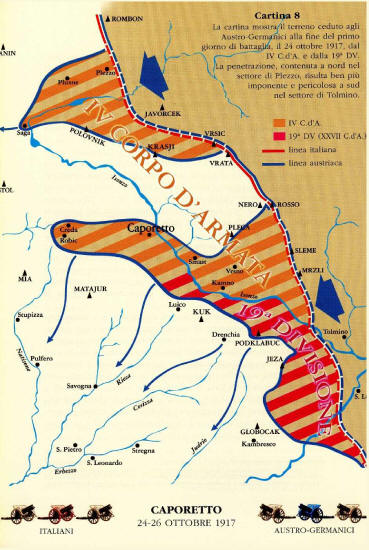
On the 26^th the Italians were retreating on the entire front – an attempt to salvage a defensive line from Montemaggiore to Mount Jelenik, north of Cividale, had proven unfeasible, as the line was broken by both the Natisone and Judrio rivers, and the High Command had begun preparations for a general retreat behind the line of the river Piave.
Meanwhile the issue was securing the bridges on the Tagliamento River to allow the crossing of the II and III Army before the Austrian could catch up on them. The IV Army (lt. General Mario di Robilant), previously on the mountains of Cadore on the northern front, now the extreme left of the retreating oriental front, had been instructed to make preparations to retreat as well.
The II Army (now under command of lt. General Montuori, who had replaced Luigi Capello, seriously ill) had to retreat while still split in two halves, the North one, pressed by the Germans retreated across the River Torre, east of Udine; the South one, mostly made up of the XXIV Army Corp and leftovers of the XXVII had to wait south of Cividale to protect the flank of the III. The Austro-Germans (Krauss and Stein Army Groups) kept moving north-west, probably unaware of the gap between the two halves of the II Army.
On the 27^th Cividale fell and the Italian troops began the crossing of the Tagliamento. Meanwhile in the north the Germans met with significant resistance on the way to Tolmezzo, where the XII Army Corp was attempting to hold together the IV and II Armies. The Germans began moving south, along the east bank of the Tagliamento, in a belated attempt to cut the retreat line for the III. The Army Corps Stein and Krauss pushed against the bridgehead of Pinzano, held by the “Bologna” Brigade, while the Army Corp LI (now under mj. General Hofacker who had replaced lt. General Albert von Berrer, shot in the outskirts of Udine on the 28^th ) attempted to force the Italian line west-to-east shielding the Codroipo bridge.
The first half of the II Army had again crossed the river in Pinzano, so this task fell to the XXIV Army Corp, until the III Army had crossed South of them (on the bridges of Madrisio and Latisana), under moderate pressure by the Austrian II Army (Borojevich)
By the 31^st the crossing had been completed and the Italian Army had two days of relative quiet behind the new line. The Chief of Staff, Luigi Cadorna, had not lost entirely the hope to stop the enemy on the unfavorable front – the River, as the Isonzo did, bent backwards – and had asked the XII Army Corp to stop on the Northernmost point of the new line on their way towards the planned retreat to the Piave.
Between the 2^nd and 3^rd of November though, the front was forced again on the bridge of Cornino and the Italians had to resume their retreat in full.
The political front wasn't static either. On the 28^th Luigi Cadorna, the Italian Army Chief of Staff, had sent his usual bulletin, informing of the state of military operations. This poorly worded piece was going to be, for the Supreme Commander, a decisive blunder.
The lack of resistance of units of the II Army, that cowardly retreated without fighting, or shamefully surrendered to the enemy, allowed the Austro-Hungarian forces to break our left wing on the Julian front. The valiant efforts of the other troops could not manage to prevent the enemy from penetrating into the sacred soil of the Motherland. Our line is withdrawing according to the pre-established plan. Depots and storage buildings in the evacuated lands have been destroyed. The value of our soldiers, proven in many memorable battles fought and won over two and a half years of war, reassures the Supreme Command that the army, to whom the honor and salvation of the Country are entrusted, will, in this time as well, be up to its duty.
Those lines were apparently sent out without anybody in the Executive taking notice (possibly because the Prime Minister had resigned on the 26^th and no new Government had been appointed yet^1 ), so that they were printed in the early hours newspapers on the 29^th and distributed in a few cities; given their obvious depressing effect on public opinion, they were modified on order of soon to become Prime Minister Vittorio Emanuele Orlando, who had the first line replaced with: The strength of the attack and the inadequate resistance of some units of the II Army allowed...
Cadorna would have probably used different words in a less stressful situation; yet they betrayed a central limitation of his character, that inspired his whole war conduction. As E. Caviglia noted – in a closing embellished with genuine praise^2 for his former Commander – [Cadorna] looked at the war as a mechanism, and tactical units were to him abstract numbers […] as cogs or wheels, working until they wore out. He had no concern for the soldier's soul, nor interest in giving them those moral satisfactions that help forget the pains, the dangers and the sacrifices imposed on themselves.
The following day, Vittorio Emanuele Orlando, former Ministry of Interior in the Boselli Government, became Prime Minister – the new Ministries were sworn in on the 30^th – keeping also the Interior Office. The Foreign Office remained occupied by Sidney Sonnino. The liberal Francesco Saverio Nitti^3 took charge of Finances. Notable were also the promotion of Vittorio Alfieri (who had been appointed General Commissioner for Consumption and Supplies a couple of weeks before) to the Ministry of War and the appointment of the interventionist Leonida Bissolati to the new Ministry for Military [Social] Assistance and War Pensions (yes, there was no governing body with this purpose before).
Outside the Government, the “nation” - those who left us something to read, at least – was also reacting to the unprecedented defeat. On October 30^th Benito Mussolini wrote to fellow interventionist^4 and volunteer, also press correspondent for Il Popolo d'Italia, Silvano Fasulo, describing his thought on the dramatic state of the Country:
Our most severe and unforgivable mistake was to leave our war to the care of people who had no feeling for it, who did not want it, did not accept it, and suffered it as a corvee fraught and heavier than others. We were foolish. I agree with you that, as soon as this tragic time has passed, it is necessary to put firmly under scrutiny the way we have conducted the war and the men, none excluded, even the highest.
It is tempting to look back at the war with our eyes and see a dreadful mist of horrors, imposed to a generation of young men, many – I assume – of the same age of those who are reading now. Yet this is not entirely fair, as long as we are interested in how the war was lived and experienced at the time, and not on how it had been retold and recollected later. Mussolini's war was not a war of the establishment, imposed on the people; it was a war of the people, imposed on a reluctant establishment. And while this was, after all, the point of view of a self proclaimed interventionist elite, it was an influential point of view nonetheless; one that would became even more influential and more common in the following months.
Mariano Melgarejo (Ruler of Bolivia 1864-1871)
his complete ignorance is delightfully revealed by his reported debate with one of his ministers over the question as to whether Napoleon or Bonaparte was the greater general
I've been reading a collection of Lincoln's letters, writings, and speeches, and I wasn't expecting them to be nearly so laugh-out-loud funny.
Specifically, his increasingly passive aggressive letters to McClellan are great:
I have just read your despatch about sore tongued and fatigued horses. Will you pardon me for asking what the horses of your army have done since the battle of Antietam that fatigue anything?
I also really enjoyed his reference to the Navy as "Uncle Sam's webbed feet."
This is a really neat newsreel from 1930 showing Portsmouth Harbour during Navy Week. It's got some good views of HMS Hood and a few subs and light cruisers (including a demonstration of a torpedo being launched from one of the cruisers), but what makes it really amazing comes at a minute in - a tiny, quarter-sized model of HMS Victory. (/u/jschooltiger, you'll probably want to see this)
Did anyone actually find an anecdote about the Doge of Venice telling a joke to Michel Foucault?
Has anyone who's seen the Scythian exhibit currently at the British Museum also read through the book they put out? I'm going to buy the book, but can't fly to England to see the exhibit itself. I'm wondering what particulars might be left out.
Not sure whether to put this here or a new question, but I understand that after the French and Indian War Washington, and many others, sent out surveyors into the Ohio River Valley and claimed large swaths of land for speculation. Why did these claims have any force? Why exactly would anybody care if Washington said he owned x land given that the claim was legally unenforceable due to the Proclamation of 1763?
Can someone recommend a good general biography on Theodore Roosevelt?
Also perhaps some reading on his forest conservation efforts?
I don't know how many people will be interested by this, but - in the most recent edition of The Times Literary Supplement's Philosophy section, there is an exchange between the English philosophers Roger Scruton and Timothy Williamson on the question of what kind of work philosophy as a discipline ought to be doing - and in particular, whether philosophy ought to be 'scientific' in nature. This exchange sort of becomes a reflection/disagreement about the nature of the humanities, and history as a discipline becomes a focal point for the exchange. I'd love to hear what some of the historians here think about this. Some of the history-relevant extracts are as below (plus a little context to start):
SCRUTON: Philosophy is, and ought especially to be, a handmaiden to the humanities. It should use its best endeavours to show why the attempts to rewrite religion, politics, musicology, architecture, literary criticism and art history as branches of evolutionary psychology (or still worse, branches of applied neuroscience) are destined to fail. It should be intent on distinguishing the human world from the order of nature, and the concepts through which we understand appearances from those used in explaining them.
WILLIAMSON: Roger Scruton wants philosophy to protect the humanities from overweening science. The humanities aim to understand human subjects, who have points of view; Scruton announces that “the subject is in principle unobservable to science” because “it is not part of the empirical world”.
History is one of the humanities if anything is. Historians study human subjects, whose points of view they try to understand. Consequently, on Scruton’s view, the subject matter of history is not part of the empirical world. This may come as news to historians.
... On this broader conception, many parts of the humanities have a good claim to be scientific. If you want to understand the causes of the English Civil War, what better methodology is available than using the sorts of evidence historians use, and assessing its bearings in the ways they do? Since most of the relevant evidence is documentary, that requires very different specific methods from those of the natural sciences, but there is nothing unscientific about adapting one’s methods to the nature of the problem and the available evidence. It would not be more scientific to ignore the points of view of Charles I, John Hampden, and their contemporaries, and rely instead on speculative evolutionary psychology and anatomical analyses of skeletons from the 1640s; it would just be stupid.
S: Of course, the humanities, as currently practised, often contain first steps towards causal explanations and scientific theories. Nevertheless, I wish to reflect a little on Williamson’s assertion that “history is one of the humanities if anything is”. For history is more than one thing, and exemplifies the very danger that philosophy should diagnose and warn against: the danger of “scientism”. It is true that historians collect facts, including facts about the opinions and emotions of people. But they also try to understand societies, civilizations and epochs “from within”, in terms of the spirit that prevails in them, the “what it was like”, and the sense of value and meaning that held a community together. In other words they set out to understand past communities in the way we set out to understand present persons. Such is the history presented in Jacob Burckhardt’s The Civilization of the Renaissance in Italy (1860), and in my view historians of art and civilization who have followed Burckhardt’s example – Heinrich Wölfflin, Rudolf Wittkower, yes and Friedrich Nietzsche too – have established their kind of history at the centre of our modern self-understanding.
Moreover it is precisely their kind of history that has suffered most from the incursions of pseudo-science. Marx’s “science”, which purports to identify the “laws of motion” of history, sees Geist as an epiphenomenon, the by-product of economic processes, and describes those processes in terms that wipe away the face of human communities, so as to show “the skull beneath the skin”. History, in the Marxist view, is not a matter of individual decisions, communal understanding, morality, religion, law and the day-to-day relations of accountability whereby people come to understand each other as subjects. It is not what it appears to itself to be, since there is a hidden reality that explains how it appears. The underlying reality of modern communities is class war, the division of people into bourgeoisie and proletariat, the relation of “wage slavery”.
... And this takes me back to my original point, which is that philosophy has a role to play in protecting the human world from the growing assaults of pseudo-science. There are concepts that play an organizing role in our experience but which belong to no scientific theory, because they divide the world into the wrong kinds of kind – concepts like those of ornament, melody, duty, freedom, purity, which divide up the world in a way that no natural science could countenance.
W: In calling those disciplines sciences, I do not mean that they are natural sciences. As I have already made clear, not all science is natural science. A disappointing feature of Scruton’s response is that he continues to ignore the distinction, using the terms “science” and “natural science” as if they were equivalent.
One consequence of Scruton’s narrow understanding of “science” is that when he comes to discuss whether history is a science, he merely attacks the fatuous view that history is a natural science like physics and chemistry. He engages only with anonymous straw men. Mainly, he fulminates against the sort of pseudo-scientific vulgar Marxist history produced by Communist Party hacks in the Stalinist period, but provides no evidence that reputable contemporary historians are similarly benighted. When he names historians who write in the spirit of which he approves, their average date of birth is 1857. He shows no interest in what contemporary historians are actually doing. That is a shaky basis on which to tell them what they ought to be doing.
S: My aim has been to remind philosophers that their subject, whether or not “handmaiden to the sciences”, ought to be handmaiden also to the humanities, which are in constant danger of losing sight of the distinctive nature of inter-personal understanding and succumbing to fashionable forms of scientism. History is part of the humanities of course, but my point was not to tell historians what they ought to do, only to suggest that history, too, can be vulnerable to scientistic misunderstanding, and this can have significant effects on the humanities. For this reason, I disagree with Williamson’s suggestion that it is only vulgar Marxists of the Stalin era who wish to dismiss inter-personal understanding as mere “ideology”, to be explained, and explained away, by the underlying “class struggle”. Perhaps the most influential work of historical analysis in recent times has been Foucault’s Les Mots et les choses, the thesis of which is that the concepts and classifications through which we understand our social condition are parts of the episteme of the ruling class, to be understood as instruments of “bourgeois” domination, due to be replaced as the underlying historical forces reshape the human world. The habit of setting aside what is merely “subjective” in favour of the “objective” history of class conflict is there in Eric Hobsbawm, Perry Anderson, Raphael Samuel, Christopher Hill and many more, and among Marxist historians only E. P. Thompson, in The Making of the English Working Class, stopped to remind his readers that history emerges from the self-conception of rational subjects, who may be influenced by the “material” forces of production, but cannot be reduced to them. For that observation Thompson has never been forgiven.
W: Philosophy is no one’s handmaiden. Like every other intellectual discipline, it has its own questions: about the nature and structure of necessity, morality, knowledge . . . . Its theories concern all possible instances of their subject matter, not just those that happen to have evolved in our species or on our planet. It has its own ways of answering its questions, for example by imaginative thought experiments and by mathematically rigorous formal models. Despite underlying similarities, it cannot be reduced to other disciplines – mathematics, physics, biology, psychology, linguistics, history – though it can learn from them all and at times has also contributed to them.
When non-philosophers make philosophical mistakes, philosophers can lecture them on it. But how much credibility has a philosopher telling physicists (or historians) that they are doing physics (or history) the wrong way? Methodologies are judged by their fruits, not by transcendental deduction. If philosophy establishes that “history emerges from the self-conception of rational subjects”, it is only in a broad sense compatible with many different historiographical methodologies, inspired by different theoretical perspectives, some from the Left, some from the Right, some from neither. Quite how rational the self-conceiving subjects of history are, recent events make one wonder.
The full link exchange, plus a helpful introduction by the philosopher Tim Crane, is here: https://www.the-tls.co.uk/articles/public/roger-scruton-timothy-williamson-philosophy/
Can anyone recommend a book on the automation/ man-machine interface in the Soviet space program? Essentially what I'm after is basically Digital Apollo, but for the USSR.
I have a number of WW1 and WW2 (Canadian) medals from my great grandfather and grandparents but their significance has been lost through the years. I would like to research them but don't know where to start. Could someone point me in the direction of a comprehensive resource for them?
Hello guys, I wanted to start learning about Ancient Egypt and i dont know any good books or documentaries. I am asking you if you can recommend me any book to read about it or any movies to watch.