I've read in numerous sources that apparently the IJN "Shotai" formation was more effective then the traditional V formation which it replaced.
Is this an accurate statement? How was the Shotai formation actually unique? Did it have any particular attributes that would have made it superior to other contemporary aerial formations?
Finally, was the Shotai formation primarily employed by Naval Aviation, or was it also used by Land Based Aviation?
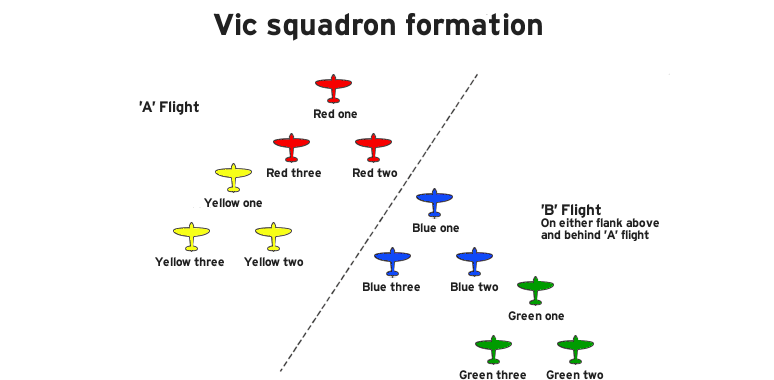
The three-plane fighter formation did not enjoy an auspicious war. Exemplified by the RAF's vic formation, the three planes' pilots were too focused on formation flying to keep situational awareness. The formation was also clumsy to maneuver and the clustering of flights of three aircraft presented a distant visual signature that allowed an enemy to adapt an optimal firing or escape position. The vic became a synonym for backwards thinking in popular novels like Derek Robinson's Piece of Cake and in various popular literature on the air war. All of this opprobrium against the vic makes the Japanese success with their three-plane fighter formation, the shotai, appear to be an anomaly. But the shotai used by both the IJA and IJN was quite a bit different than other three-plane formations used by other air forces.
For one thing, the typical shotai was much more strung out than the vics used by the RAF. For one thing, the Japanese used a much looser formation than the tight vics. This image conveys the clustered nature of a vic. The Japanese shotai was more ragged than the vic. This diagram from Sunburst illustrates the differences between the shotai and the vic. The two wingmen usually flew at different altitudes than the shotai's leader or in a line astern and there was less attention to maintaining a symmetrical v. The height differences between shotai sections ranged from 600 feet to a thousand feet. The two wingmen were also able to keep a greater degree of situational awareness as they did not have to devote as much time to formation-keeping to avoid collision. Unlike the vic, the shotai allowed pilots to retain a degree of initiative.
There were two other, interrelated, factors working in the shotai's favor. One, early war Japanese fighter tactics relied upon maneuverability and Japanese aircraft like the A6M and Ki-43 were exceptionally maneuverable. The IJN's hineri-komi maneuver- seen here in this scanned excerpt from Sunburst- was one of several tactics that Japanese aviators used while flying in their shotais. Japanese fighter tactics stressed that on the offensive that the wingmen form up behind the leader, and while defensively, the Japanese pilots would use their maneuverability in either Immelmans or corkscrews to regain initiative. The looseness of the three-plane shotai allowed for this.
But it was not just the looseness of the shotai that allowed the Japanese to be effective. The high degree of pilot training and flight hours of the early war Japanese units created what some IJN and IJA veterans called a "sixth sense" in terms of teamwork. The breaking up and reforming of the shotai in a melee was possible because the pilots knew both the capabilities of their planes and their wingmen.
The three-plane shotai though was not nearly as effective by the middle of the war. For one thing, attritional losses and poor training regimens meant that the Japanese pilots were nowhere near the caliber of pilots they were in 1941/42. This lack of plot skill brought the vulnerabilities of the shotai to the forefront in aerial combat as pilots were now more dependent on following their leader and less able keep formation. But the decline in pilot standards was only one factor at work. American and Commonwealth fighter tactics began to emphasize slashing and diving attacks on Japanese fighters. The Japanese preferences to devolve into single-plane fighting while on the defensive became a liability as the Allies learned not to engage Japanese fighters in a horizontal maneuver fight and use superior speed, climb, and formations to defeat tactics like the hineri-komi.
The Japanese seemed to recognize the need for newer formations more akin to the finger-four by 1943, called the kutai or butai. There was also a greater emphasis upon hit and run tactics over older dogfighting. USN and USMC reports did note that Japanese fighter tactics grew more professional in late 1944 and 45. But even these adjustments could not reverse the catastrophic decline in pilot skill as well as the inability of the Japanese aviation industry to stay competitive against their enemies. The IJN and IJA might have been flying four-plane formations by 1945, but the odds were always stacked against them.
Sources
Lundstrom, John B. First Team And The Guadalcanal Campaign: Naval Fighter Combat From August To November 1942. New York: Naval Institute Press, 2013.
Peattie, Mark R. Sunburst: The Rise of Japanese Naval Air Power, 1909-1941. Annapolis: USNI Press, 2001.
Young, Edward M. F6F Hellcat Vs A6M Zero-Sen: Pacific Theater 1943-44. Oxford: Osprey, 2014.