Couldn't seem to find an answer online, but did the B-29's face any resistance flying over the two cities? From the videos online, it appears that there was no anti-aircraft or other fighters intercepting the bombers, allowing them to simply fly over the destination. Apologies if I missed a previous post on this subject or it just being a dumb question in general.
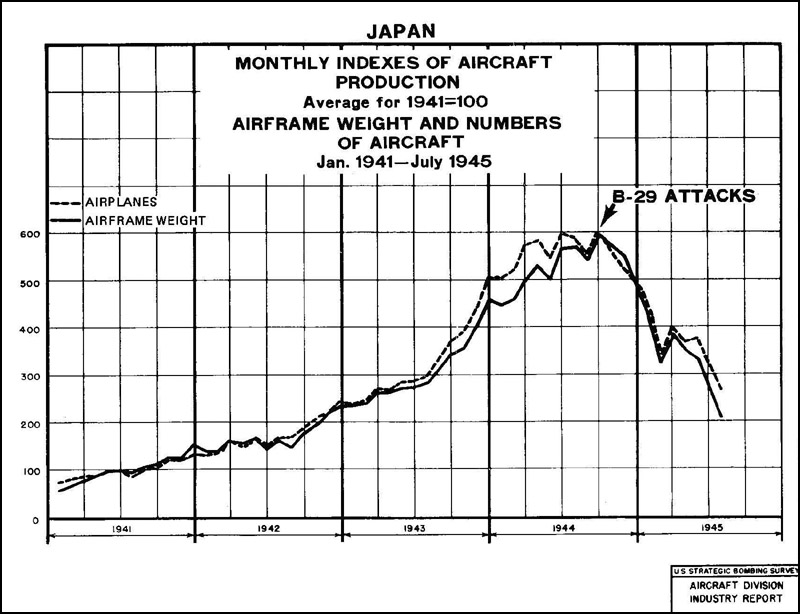
Japanese air defences had been ground down from the start of the US strategic bombing campaign in November 1944. In common with the strategy employed against Germany the Japanese aircraft industry was targeted from the beginning, and though early raids were not always accurate or successful they did force the dispersal of aircraft manufacture, and production fell as raids continued with increasing intensity (The Strategic Air War Against Germany and Japan: A Memoir, Haywood S. Hansell, Jr; he includes [a Strategic Bombing Survey graph of aircraft production] (http://www.ibiblio.org/hyperwar/AAF/Hansell/img/p226.jpg)). The high altitude and strong defences of the B-29 made them a challenging target for Japanese fighters even at the height of Japanese air strength.
The capture of Iwo Jima in March 1945 allowed long range fighters to escort the B-29s, but by this time the attrition suffered both in home defence and across the Pacific and CBI theatres had severely weakened the Japanese air forces; "... by late spring and summer Japanese air strength in the home islands deteriorated so rapidly that bomber formations again went out unescorted" (The Army Air Forces in World War II: Volume V). Unable to sustain the losses, resources were husbanded to prepare for the expected invasion of mainland Japan: "After June 26, Japanese fighters were rarely encountered in numbers (...) The JAAF was virtually powerless to react against the invaders, and it was told to keep its remaining aircraft in reserve for the final battle, expected in the autumn. Japan's industrial power had been weakened, and the means to defend its airspace was lacking." (B-29 Hunters of the JAAF, Takaki & Sakaida).
In terms of anti-aircraft artillery the Japanese armed forces placed little emphasis on defence of the Home Islands until the Doolittle raid of April 1942, and though this prompted an expansion of air defences they were still not strong by the time of the B-29 raids. The most common weapon was the Type 88 7.5cm gun with a practical ceiling of around 15,000ft, half the altitude that B-29s could attack from. The 8.8cm Type 29 and 12cm Type 3 were more of a threat but were in short supply, especially the latter, with only 154 produced during the war. Fire control was also lacking with a shortage of radar sets meaning many batteries still relied on sound locators. (Defense of Japan 1945, Steven J Zaloga).
The first practice missions of the 509th Composite Group, the unit formed to drop the atomic weapons, were flown in July after the JAAF had effectively stopped contesting US air attacks; there were 18 bombing sorties against targets in Japan using "pumpkin" bombs that simulated the size and weight of the Fat Man atomic bomb and the 509th suffered no losses during these missions, only one B-29 suffered minor damage.
Here's a previous thread that covers a lot of what you were asking, it's near the bottom of the top answer. /u/eternalkerri is responsible for the answer
Aside from the fact that the US had air superiority over Japan by August 1945, it should be noted that the B-29s for the bomb run were flying in small numbers (no more than three near the target at any time). This meant that they would look like reconnaissance or weather aircraft, not like a bombing run (which always had larger numbers). By August 1945 it was common for dozens of B-29s to be flying around various cities and areas of Japan doing things like noting weather conditions, taking photographs of damage, etc. (Indeed, this is what the Enola Gay did on the day of the Nagasaki run — it was responsible for the weather report over Kokura, another target.) Japanese anti-air defenses were far too lean to try and hit every stray B-29 at that point.
Follow up question: What would have happened if they were shot down? Would the bomb have exploded? Were there reserve planes with additional nuclear bombs as backup?
I asked a similar question a while back and had some really good answers. https://www.reddit.com/r/AskHistorians/comments/5xm7pz/was_there_a_large_risk_that_the_enola_gay_could/?st=J9O80W8A&sh=6197ddd0https://www.reddit.com/r/AskHistorians/comments/5xm7pz/was_there_a_large_risk_that_the_enola_gay_could/?st=J9O80W8A&sh=6197ddd0 Here is the thread.
/r/kieslowskifan with the credit on this answer.