For reference, he compares poets to roaches "an annoyance but easily dealt with", is pretty much a douche to the Egyptian protagonist and gets angry at the (male) protagonist for letting the (female) protagonist go on an important mission because he thinks a woman would screw it up. In his death scene he also says to the half-Greek half-Egyptian protagonist that Rome will never fall to "one of your kind" in what's definitely a "you people" kinda way which surprised because I thought he was pretty open to foreigners by Roman standards.
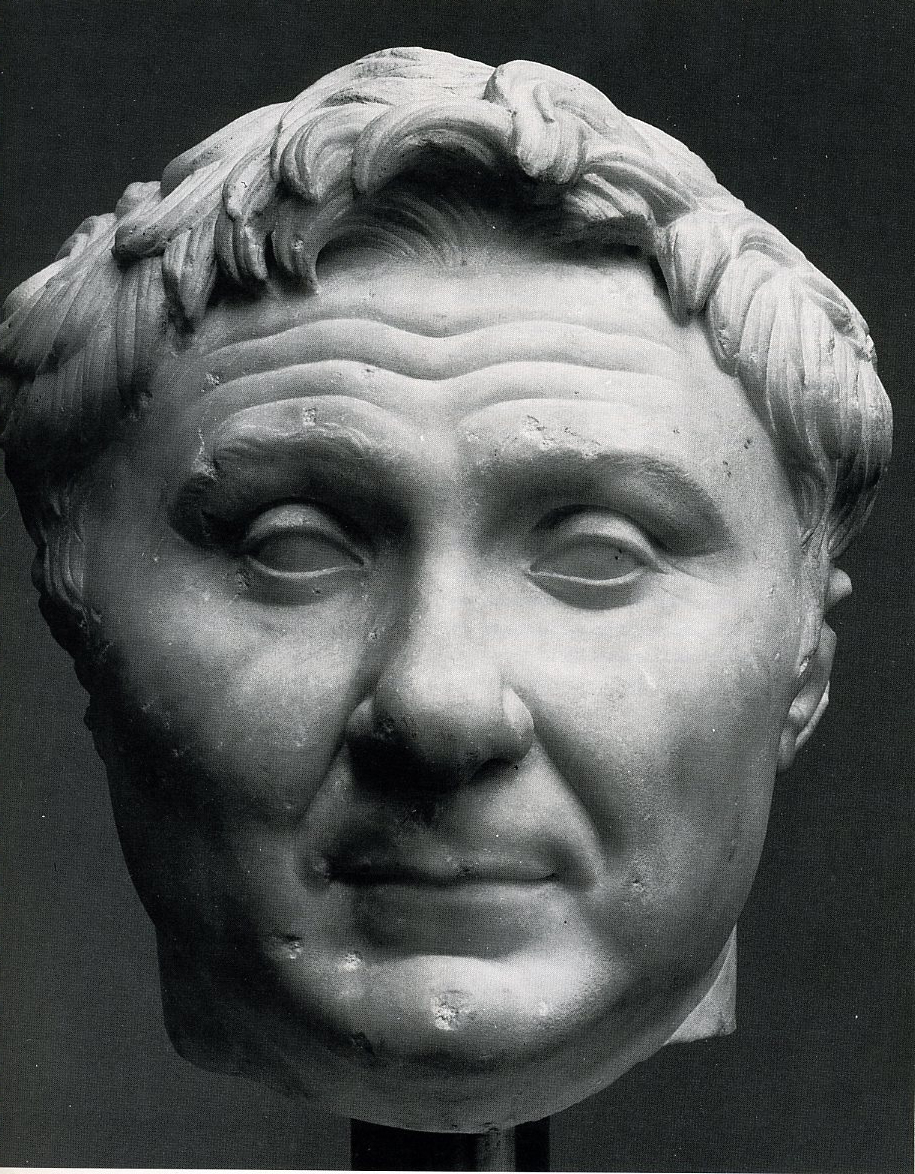
Also has a raging hardon for Alexander btw because he conquered the world, that much I know is accurate. This is what he looks like.
Also has a raging hardon for Alexander btw because he conquered the world, that much I know is accurate
Less accurate than you might suppose. While Plutarch and Suetonius both relate the incident of Caesar's depression during his propraetorship in Spain (Suetonius relating its being caused by a statue, Plutarch by a history of Alexander's life), and Plutarch of course paired the life of Alexander with that of Caesar, not much reference to Alexander can be found during Caesar's lifetime. It would have been fairly inappropriate, in that Pompey, not Caesar, was compared to Alexander and explicitly adopted Alexandrian imagery. Pompey was the second conqueror of the east, for which he also received the title Magnus, and Pompey's meteoric career at a young age and his youthful good looks resulted in numerous portrait busts adopting Alexandrian imagery, in particular that funny curl that Alexander's hair had in the front, and that even older portraits of Pompey exhibit. Plutarch even mentions it, with the slightly derisive note that people talked about the similarity in their hair more than there was actual similarity. According to Plutarch, people even called Pompey Alexander openly, including the orator L. Philippus (cos. 91, not the husband of Caesar's niece Atia, cos. 56), who joked about being Philip to Pompey's Alexander when he defended him in court. By comparison, although there was some appropriation of Pompeian imagery by Caesar at the start of the civil war (Nousek makes the case, for example, of Caesar's elephant denarius, although since Pompey never explicitly minted an elephant coin the case is tighter with her assertion that it is an appropriation of Metellan imagery), Caesar's life was relatively removed from associations with Alexander in the same way.
This characterization of Caesar falls flat to me, although naturally you'd have to ask Caesar himself. If one managed to ask Caesar's ghost about gloria rei publicae or something like that no doubt he'd recite back the same lines every Roman nobilis knew, but he was hardly notable in that respect. Lucan famously stated Caesar's and Pompey's personalities beautifully when he said that Nec quemquam iam ferre potest Caesarve priorem/ Pompeiusve parem: Caesar could bear no one before himself, nor could Pompeius bear an equal. The obsession Caesar had with his dignitas is quite abundantly clear from the texts, and even Sallust speaking through Caesar's mouth during Caesar's great speech in B.C. 51 has him mention several times the dignitas of the Roman state and the senate, which must remain untainted by an execution against Roman law. Still, at the same time Caesar described his civil war as beginning from the mistreatment of the tribunes of the plebs: there was simultaneously a reduction in his own dignitas and one of the Roman state itself, both of which had to be corrected. The attribution of a distinctly anti-Egyptian, or perhaps more generally jingoistic attitude to Caesar does not sit particularly well, however. Caesar was an instrument of Roman imperialism, to be sure, and his planned Parthian campaign makes it clear that foreign wars were still very much on his radar at the end of his life. At the same time he was generous to the Gauls that sided with him (although Diviciacus, for example, notably disappears from sight partway through the Gallic war--Cicero apparently knew him, though), and Suetonius claims he admitted naturalized Gallic citizens to the senate. He certainly treated Transpadanes as citizens in a way that others, notably Cicero, did not. A hatred of Egyptians and women seems especially misplaced. Caesar was surely as misogynistic as most men of his time, although he was on excellent terms with the women he knew, and he spoke in glowing terms of Cleopatra when she was in Rome, although Cicero notably (especially in Att. 15.15) couldn't stand her, complaining of her arrogance (including that she had dared to live in Caesar's trans-Tiberine villa!) and amusingly that she had failed to give him the gift she had promised. Like all Roman nobiles Caesar implicitly understood the Romans as existing at the summit of the universe, with his own dignitas preeminent even among that exclusive club, but in this he was not especially unusual.
I hesitate to say anything more without having played the game (which likely isn't gonna happen), but just from what you've written there are other problems. That Caesar, himself a notable poet, would denigrate poets doesn't really make a lot of sense. Moreover, while Caesar clearly implicitly understood his own dignitas as necessarily existing as a more important entity than anything or anyone else, his haughtiness is rather out of character. Plutarch, Suetonius, Cassius Dio, etc. mention anecdotes, almost all at the end of Caesar's life, of an increasingly hubristic individual, but these are also literary tropes of the haughty tyrant proceeding towards his inevitable end. It's hard to see where reality begins and moralizing ends. Certainly prior to the civil war and in its immediate aftermath Caesar is described--notably by Cicero--as quite charming. Clearly it was very hard to dislike Caesar personally, which was a key part of his persona. In December of 45 Cicero was speaking of Caesar as an excellent dinner guest, one who mercifully talked about σπουδαῖον οὐδὲν, "nothing serious" (i.e. politics) but who was very learned and talked about literary matters. Cicero complains about the troops which Caesar, recently arrived in Italy (he had returned only in September), still maintained, but could only describe Caesar as periucunde, "exceedingly pleasant." This was more in tune with the face that Caesar presented to the world, the persona of the charming aristocrat.