I watched this video of Adolf Hitler speeches and, at 1:44 he is translated as saying:
A new community is being built in Germany and it is our most beautiful goal and aim. Those who can not see past their own nose deserve our pity more than anything else. It is the luck to help which rewards those who commit themselves to this socialist state, and this commitment must happen every new winter. Our social welfare system is so much more than just charity because we do not say to the rich people "Please, give something to the poor." Instead we say "German people, help yourself!" Everyone must help, whether you are rich or poor. Everyone must have the belief that there's always someone in a much worse situation than I am, and this person I want to help as a comrade. If one should say, "Yes, but do I have to sacrifice a lot?" That is the glory of giving! When you sacrifice for your community, then you can walk with your head held up high.
Did he actually say this? If so, which speech is it from?
I have tried searching through archives (like here and here) but can't find anything using English keywords. Is the translation inaccurate or fabricated?
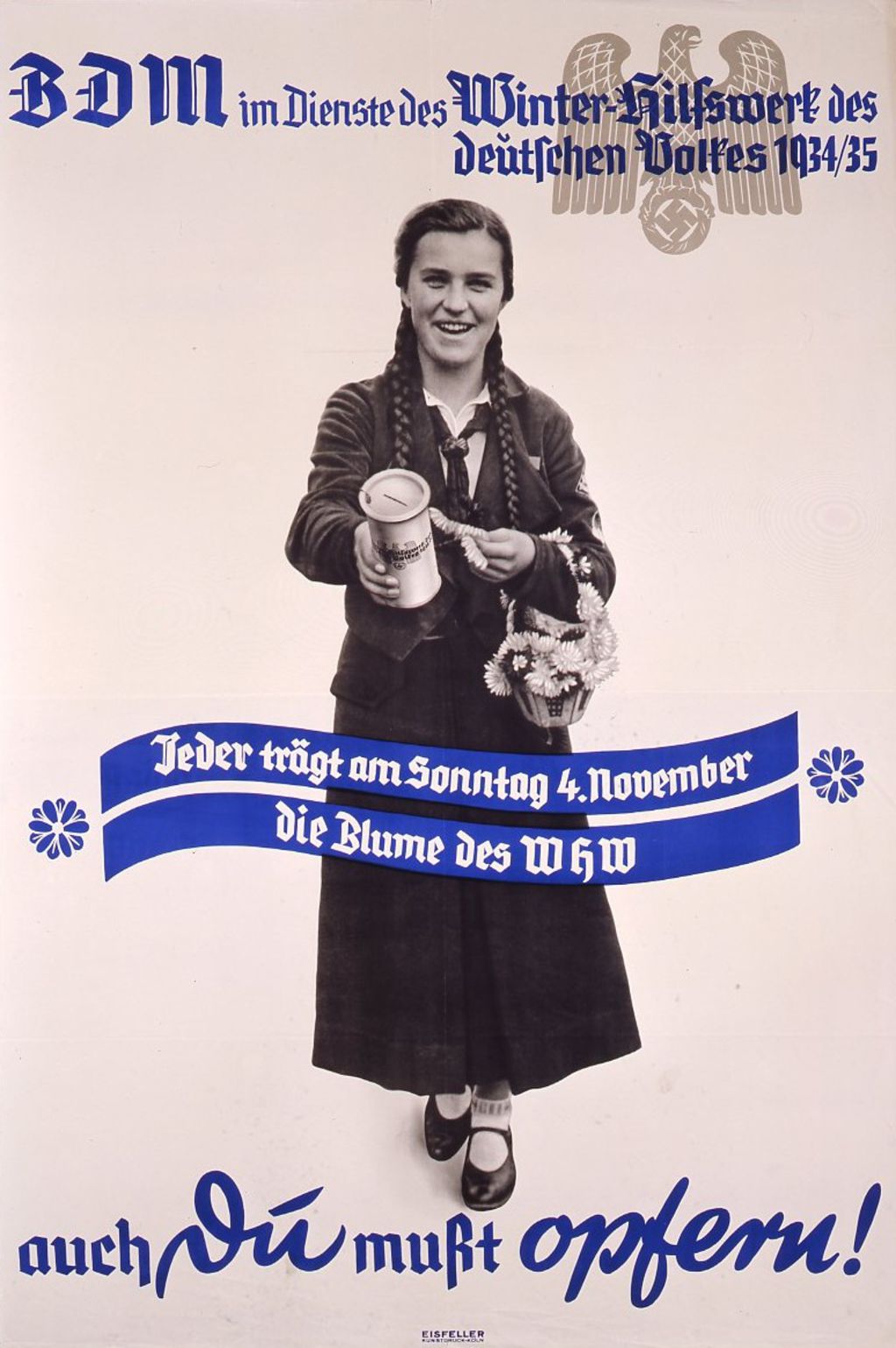
The program Hitler is referencing is the Winterhilfswerk (Winter Relief Organization/WHW), which was one of the more visible programs of the NS-Volkswohlfahrt (National Socialist People's Welfare Agency). The Winterhilfswerk was a program of the NSDAP predicated on helping alleviating the impact of the Depression. The agency's volunteers soon became ubiquitous within the Third Reich, with volunteers from National Socialist organizations soliciting donations for the WHW, as seen in this propaganda poster. Donations entitled givers to wear badges like this one or display WHW plaques on their homes and businesses. Despite its title, WHW operated from October to March, but the apex of its activities was during the December holiday seasons. The WHW encouraged both restaurants and private homes to have hot-soup Sundays in which all Germans were to eat a simple stew and donate the savings to the WHW. Workers were expected to donate part of their wages to the WHW as well as old clothes and other material items.
Taken in isolation, the WHW appears to be one of the more progressive features of the NSDAP's dictatorship. The whole idea behind the WHW was that it was trying to foster a Volksgemeinschaft in which Germans would be united through collective activity that erased class distinctions. Some of the WHW contributions did filter down to German poor and cushioned the negative impacts of the economic recovery under Hitler in which wages were stagnant and consumer choice limited. But the WHW did not exist within a vacuum. Hitler had inherited a large state-funded social welfare legislation from Weimar, which in turn was a legacy that dated back to Bismarck. These programs ranged from national health insurance, injury insurance, and old-age pensions. The Depression strained these programs, but did not break them. The Nazis did entertain some notions of centralizing and streamlining the social insurance system, but the entrenched bureaucracies coupled with the Nazis' general disinterest in carrying through a complicated overhaul of the state meant little reform was accomplished aside from Aryanizing the system's beneficiaries (German Jews still had to pay into the system, and later so too did forced laborers). So the WHW existed as a form of parallel social welfare structure within Germany, and a highly ideological one to boot.
This parallel structure was the source of a a good deal of disgruntlement within Germany. One of the more common words to describe WHW collection drives is Duddelkram, which has no real English translation but generally means annoying and useless busywork. Germans were expected to contribute to the WHW even though state media like Hitler's speech stressed it was voluntary. There was a danger that refusal to contribute would be noted and the WHW's use by NSDAP organizations was a measure of social control. Party block wardens would use the WHW as a pretext to intrude on their neighborhoods with the justification that they were insuring that Germans were not shirking their duties to the Volksgemeinschaft. Hot soup days and other WHW initiatives represented an intrusion of the Party and the state into the private sphere. Workers in particular resented the garnishing of their wages for WHW activities as they were already paying into the health cooperatives and other forms of taxation for the state social safety net.
Another problem of the WHW was that the large amounts of cash and goods flowing to the organization was just inviting corruption. As early as 1935, there were over a dozen cases brought in the open of Party embezzlement of WHW donations and there was undoubtedly a good deal of fraud at lower levels. One Party Kreisleiter actually committed suicide in 1934 after there was an exposure of his embezzlement. The WHW may have collected a large donations of cash and goods, but it was often inefficiently distributed and many Party officials skimmed off the top at all levels of the WHW.
Despite these problems, the WHW did have a degree of popularity among the wider German public. While Germans may have resented the intrusions and solicitations, there was a form of negative integration at work that divided the German national community into those who belonged and those who did not. Complaints about the WHW were usually framed around the narrative of "I have given my all, but my neighbors were shirking." The WHW functioned partly because of the system of informing and denunciation created a sort of community of fear in which voluntary actions became compulsory. The WHW and other charitable drives also worked in conjunction with various police crackdowns on the homeless and beggars who were allegedly work-shy and thus not a part of the Volksgemeinschaft.
Circling back to Hitler's speech, his recourse to the WHW underscores its ideological nature. WHW materials such as this one invariably stressed how voluntary donations were different than the cold and unGerman Marxist forms of redistribution of wealth under Weimar. The system of voluntaristic relief, coupled with a stern moralism encapsulated in the slogan he who does not work shall not eat, meshed well with existing bourgeois and German elite discourses on how to resolve the social problem. Hitler's stress on volunteerism also fit within the wider trend of muzzling and removing the NSDAP's so-called left wing that had begun at the Bamberg Conference. The WHW did not fundamentally alter German socioeconomic relations and class structures. The very idea and tactics of the WHW were grounded on the concept that socioeconomic difference was irrelevant to German society; all Germans- whether rich or poor- were to enjoy the same hot soup Sunday. The actual truth was that these declarations of an ideologically classless society were at odds with the reality most Germans experienced under the Third Reich in which class still existed and mattered.
Sources
De Witt, Thomas E. "“The Struggle Against Hunger and Cold”: Winter Relief in Nazi Germany, 1933-1939." Canadian Journal of History 12, no. 3 (1978): 361-382.
Fritzsche, Peter. Life and Death in the Third Reich. Cambridge, Mass: Belknap Press of Harvard University Press, 2009.
Ross, Corey, Pamela E. Swett, and Fabrice d' Almeida. Pleasure and Power in Nazi Germany. Houndmills, Basingstoke, Hampshire: Palgrave Macmillan, 2011.