I was playing Day of Infamy, a game set in WWII, and someone was complaining that they could not hit anyone. I told him to aim a little lower, and then made up that it was military practice to have your sights set at a farther range than expected. I made up that it was better that way since you can always lower your gun if an enemy was closer, but if you needed to aim higher, the sights of the gun would obscure the target, making it more difficult to shoot.
What I am asking is, was this done in WWII? Did any military do this practice? What were the doctrines that soldiers set their sights to during WWII?
Given that this is /r/askhistorians, not /r/guns, I'm not going to get too far off in the weeds about ballistics. For the sake of simplicity, I'm going to use the various 7.62-7.92mm bolt-action and semi-automatic rifles as a baseline; these were the most common firearms, and submachine guns and machine guns are a bit trickier to explain.
Basically, the way a bullet works is that it travels in an arc, and the farther the bullet must go the more dramatic the arc must be. All the time that a bullet is in flight, gravity is dragging it down. For very long range shooting, the gun must be held significantly above the target. The faster and more ballistically efficient the bullet is, and the closer the range, the flatter the arc.
The standard infantryman's weapon of the world war era was a roughly .27-.32-caliber rifle. These rifles used high velocity cartridges and pointed bullets that performed much better at range than 19th century rifles. They were equipped with adjustable iron sights, either of the post-and-notch or the aperture style. Adjusting them meant simply raising the rear sight, so that the user had to hold the rifle at a higher angle; if you need to shoot at a longer range without adjusting the sights, you do the same damn thing, except you have to guess how high to hold. These sights adjusted from a base of about 200-300 meters/yards in 100 meter increments to as far as 2,000 meters.
But the difference between where you hold at 200 (or even 100) meters and 300 meters is pretty minimal, as are its effects. An M1 rifle zeroed at 200 meters will shoot about 2 inches high at 100 meters and about 8 inches low at 300 meters; for combat purposes, in which soldiers were taught to shoot at torsos, that's a minimal difference, and at point blank video game ranges, it matters even less. Whereas, a rifle zeroed at 1000 meters may completely miss a target only 500 meters away. There's just no good reason to run around a combat zone with a rifle adjusted to shoot at 400 or 500 meters.
The funny thing is, when we look at the vast majority of infantry engagements from WWII, they took place at ranges at which no adjustment would be necessary. Beyond 300 meters it becomes necessary to adjust for precise shooting, but firefights at that range involving riflemen were both rare and generally ineffective, with about 200 meters being considered the maximum range at which rifle fire was really effective. The average rifleman of the period was just not a very good shot.
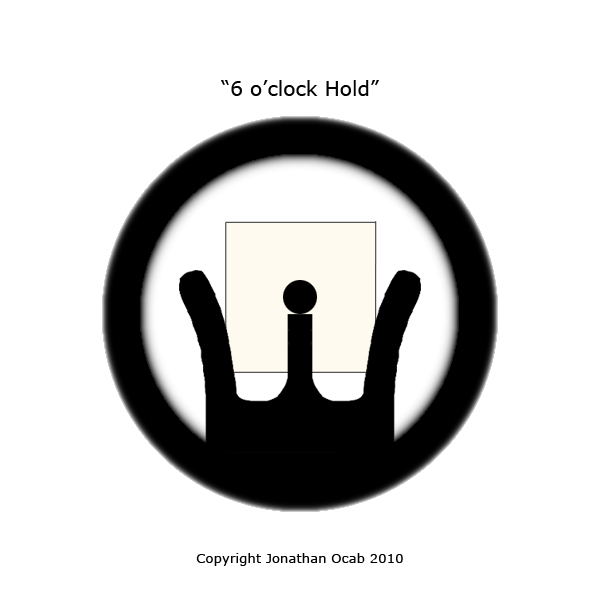
Now, as a side note, the WW2-era US Army did train soldiers to use what is called a six o'clock sight picture (think of an analogue clock). That is, you place the blade of your front sight just beneath the center of the target, so the sight doesn't obscure the target. (For reference.) But at the kind of ranges involved in a video game (or, indeed, combat), the difference is going to be minimal, a matter of inches, and if the shooter misses he's more likely to miss low than high.