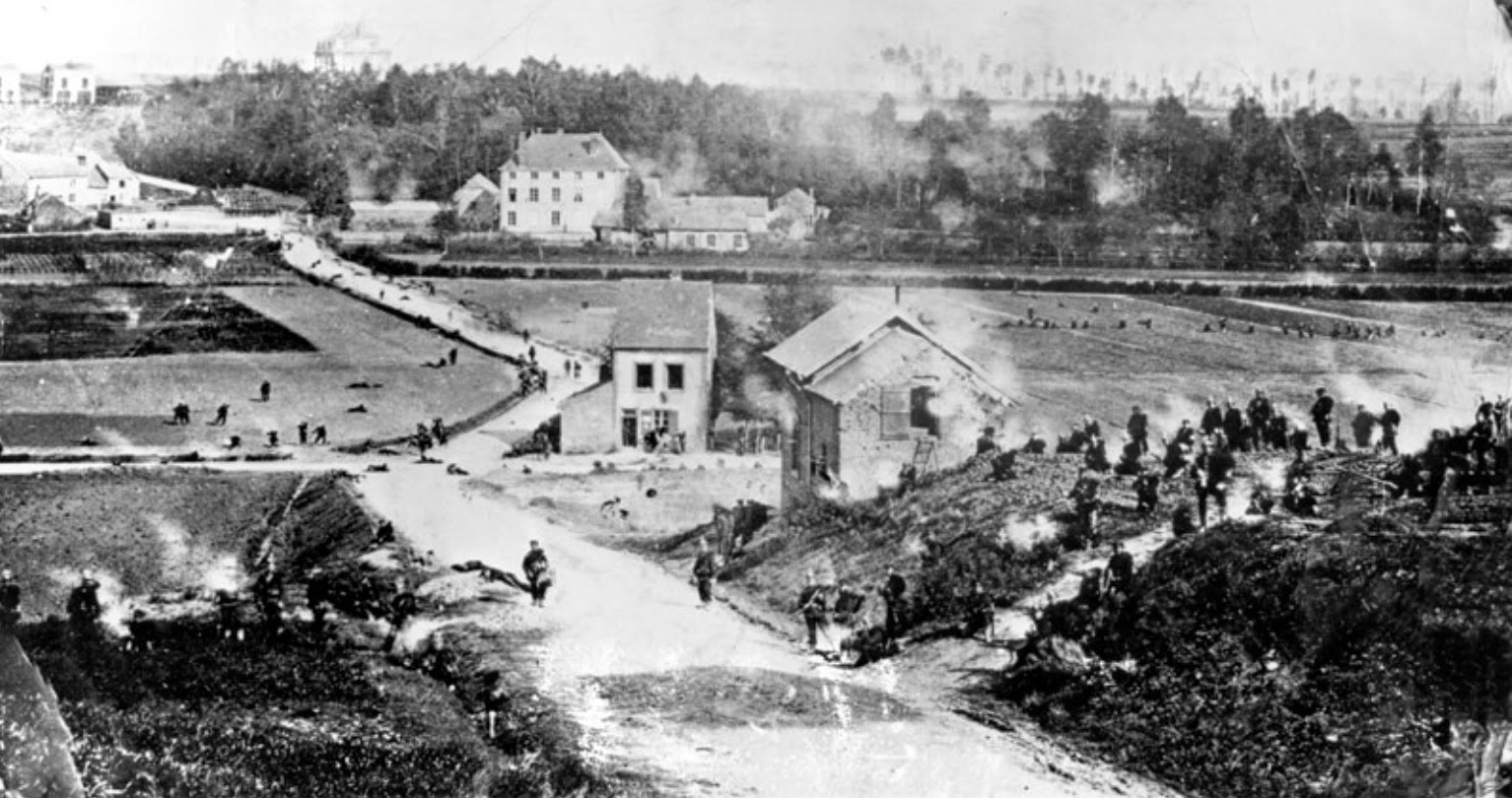
Note: I don't think this breaks the rules since it concerns something public, not some item/artifact I found.
Photograph number one: cropped and uncropped (less detailed).
Photograph number two: cropped and uncropped (less detailed).
Photograph number three: cropped and uncropped (less detailed).
If they are real, they may very well be the only photographs of real line formation combat, and if so they deserve to be much more well known.
This comment in this thread does what I think it's an excellent analysis of the precise event, time and location of what is happening. If it's real, it shows a part of the famous Battle of Sedan; at this location (google maps) in the village of La Moncelle, near Bazeilles; and in the 1st of September 1870. There seems to be confusion as to what troops (French or German) are pictured in each photograph. The thread does not seem to reach a conclusion on wether it's real or not.
This blog post (the source of the photos I linked above) reaches the conclusion that it's some sort of elaborate recreation, but the main reasoning seems weak to me:
There doesn't seem to be any blurring in the photographs caused by movement of the soldiers which was a common trait in photos of the era and could be a sign that the photographs are posed. Cameras with fast exposure times which would minimize any blurring existed at the time but their use was not very widespread.
We may not reach a definitive conclusion here, but any answer to the following questions would help to eventually reach a verdict. Feel free to only answer the questions of your expertise/interests.
From the uniforms, formations and purposed events depicted, are those German troops, French ones, or both firing at one another? Does the conclusion make sense, knowing what really happened that day in that location (see the comment already linked above)?
Do you see signs that it may be a reenactment or military exercise? Are the formations accurate for active combat in that time?
Is the photographic technology consistent with the supposed date? If it's a real battle, why isn't there more blurring?
Do you detect signs of doctoring that may have transformed a simple photograph of troop movement into a fake combat situation?
Can you find out the original photographer/studio? No one seems to have done that yet.
I need to know if they're real!
Hey, so I wasn't able to find very much, French google is showing very little info. There is this photo taken, according to the description, by a Dufour in Dijon around 1860. Dijon is close to Reims in the East of France, I don't want to get into speculation BUT if the photos are correctly labelled it could be the same person who took this and the 3rd photo.
There is also a Marc Dufour who has posted a lot of stuff on pininterest about his family and the Franco-Prussian War, but one needs to sign up for the site and I'm not doing it.
As you probably aware the writing is in French.
I think the best bet is to try and track down this L. Dufour (Reims) from the 3rd photo, no idea how to do that.
You could try asking at /r/France as well.
Good luck and if you need any help with French (beyond what google translate can do for you) feel free to shoot me a pm.
I can see why one would be suspicious. If these photos were from 1880 or so they'd be much more plausible, but 1870 was just before the invention of dry plate photography, and wet plate photography was a cumbersome process that had long exposure times. Any movement would tend to lose the figure or make it a motion blur. This photograph from Louis Daguerre in 1838, purported to be the first photo with a person in it, is of a crowded city street during the day. You only see the people at the shoe shine stand because they didn't move enough during the exposure of the photograph, and even they are blurred.
But while the early daguerreotypes, as seen above, may have taken several minutes, there was advancement in wet plate technology between 1838 and 1870. A tintype in bright daylight would take only several seconds, and that technique would have been well-known and well-practiced in 1870. But even so they are not known for action photography.
The scene in question appears to be a bright day somewhere within a few hours of noon, which would have been good conditions. But even so you'd expect some blurring over 2-5 seconds, and I don't see any indication of that, even in those figures in odd poses or supposedly on the move. But really the resolution on these scans isn't high enough to be sure. Someone familiar with period photography would need to look at the original artifacts to have a better idea.
Another odd feature is that, especially in the second and third photos, most of the figures seem to be looking at the camera. This context makes me suspicious that what you see may be a posed photograph. It may be a later recreation, or may simply be from shortly after an engagement. We do seem to see puffs of smoke, but those are just as likely to be "special effects" as real. I'd rate the possibility that it's a photo of a live engagement from a very lucky photographer to be low based on this evidence.