In Mike Duncan's podcast Revolutions while talking about the French Revolution he goes into Austria controlling Belgium. He explains that the British wanted to keep it out of the hands of the French. What's the story here? If the Austrians didn't want it, and the British wanted it out of the hands of the French, why not the British just take it?
It was not the Austrians that controlled Belgium, it was the Habsburg family. This is an important distinction for the early modern period.
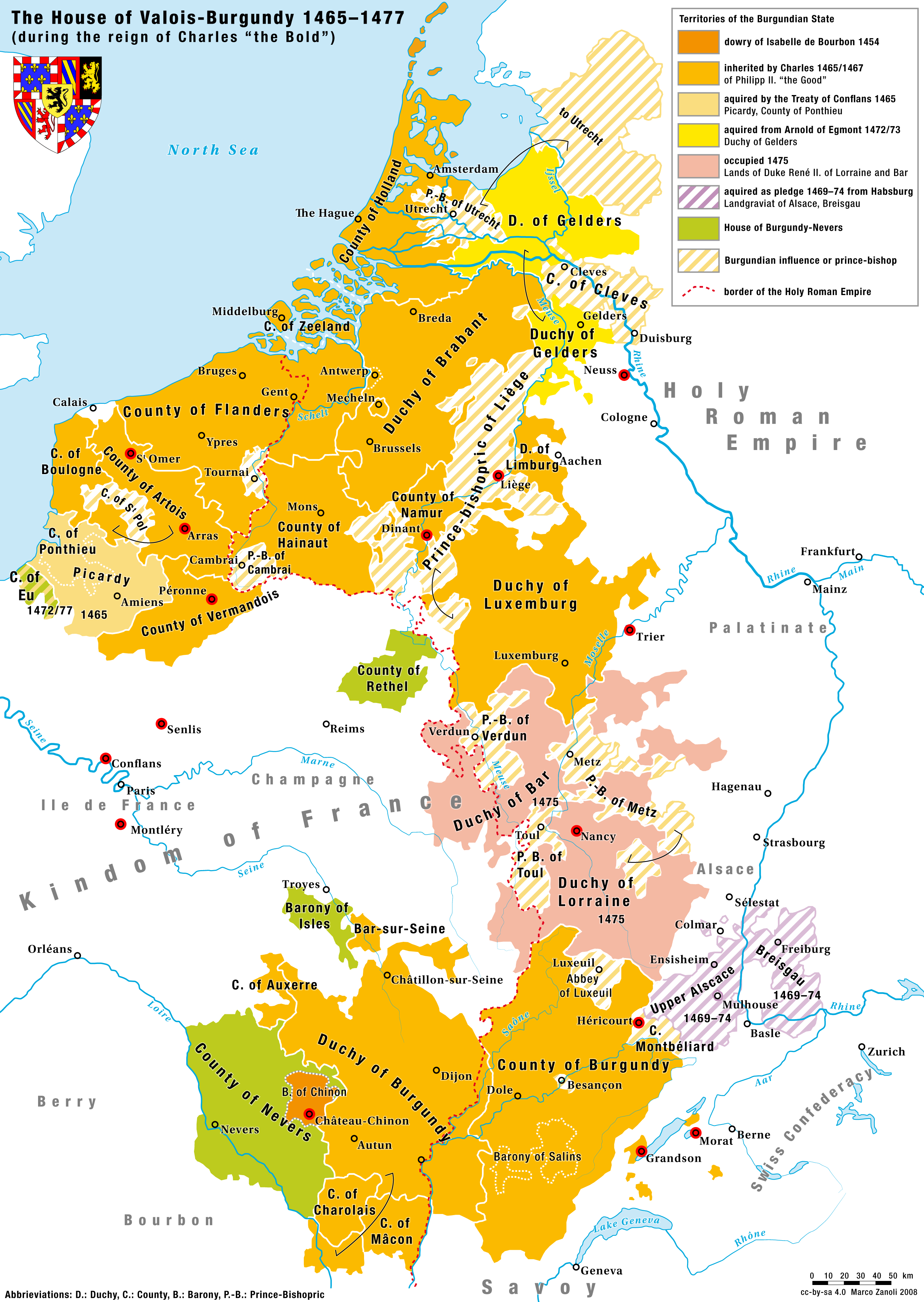
The Low Countries had been the patrimony of the Dukes of Burgundy- see this map and the Habsburgs came into their possession through the marriage of Mary of Burgundy to the HRE Emperor Maximilian I in 1477. Their son Philip the Handsome married Juana of Castile, so that Spain now entered the picture. Their issue Charles V was not only HRE, but also ruled over Spain and the Low Countries as seen in this map. Charles V divided his patrimony between his relations, giving his brother Central Europe with its imperial title and his son Philip II the Low Countries and Spain along with a degree of control over Italy. The transition was not smooth though and it is likely that Charles V intended for a greater division between the Habsburg clan with Philip II taking possession of the Low Countries and marrying the Henry VIII's daughter Mary I while Charles's grandson Carlos controlled Spain and its empire. But the mental instability of Carlos and the failure of the English marriage meant that these plans fell apart and Philip II retained control of both Spain and the Low Countries. Confessional politics in addition to very blockheaded responses by Philip II's servitors eventually led to the Netherlands declaring its independence from Spain and the onset of the Eighty-Years War in 1568. This war proved to be an endless sink for Spain's resources and the Dutch rebels were successful in setting up their own independent state. The Dutch Republic was never able to conquer the remaining Low Countries though and this area soon became recognized in diplomatic circles as the Spanish Netherlands.
The Spanish Habsburgs retained control of this area, which approximates modern Belgium, until the War of Spanish Succession. Spain's imperial decline coupled with the end of the Spanish Habsburg line with the very inbred Carlos II led to a general European war over the fate of Spain and its various dominions. To make a long story short, the territory was transferred to the Austrian Habsburgs both as a compensation for their failed claims to the vacant Spanish throne and to serve as a counterbalance to Bourbon France. The idea was partly the brainchild of British diplomats who wanted two strong European powers, Austria and the Netherlands, to be united together against France. British control would not accomplish this, but Austrian control would. Allowing the Dutch the whole of the country would give the Orangist Stadtholders too much power, but keeping the Austrians on the French border would ensure that the Habsburgs had a direct land connection to France.
These balance of power schemes did not exactly play out as intended. The Austrian Habsburgs did not invest that much time in the Low Countries and Joseph II even schemed to gift them to the Wittelsbachs in exchange for Bavaria, a move that would greatly strengthen Austria's position in the HRE vis-a-via Prussia. Austrian centralizing policies further alienated the local population and there was little love between the Habsburg sovereigns and their Low Country subjects. The result was that the region was pretty ripe for French invasion and the assumption of control.
This (very simplified) story of who rules Belgium reflects one of the difficulties of trying to square geopolitics with a political order conducive for stable rule. Handing off this corner of the Low Countries to the families of various great powers seldom took the opinions of the people into account. Some of the absentee rulers managed to craft something of a compact between local elites and their sovereigns. The Spanish Habsburgs were able to cobble together something of a stable polity during the Eighty-Years War. But this order was fleeting and subject to shifts in the geopolitical powers. Handing off control to another family invited problems as the process of local political compacts and relationships had to be started all over again.