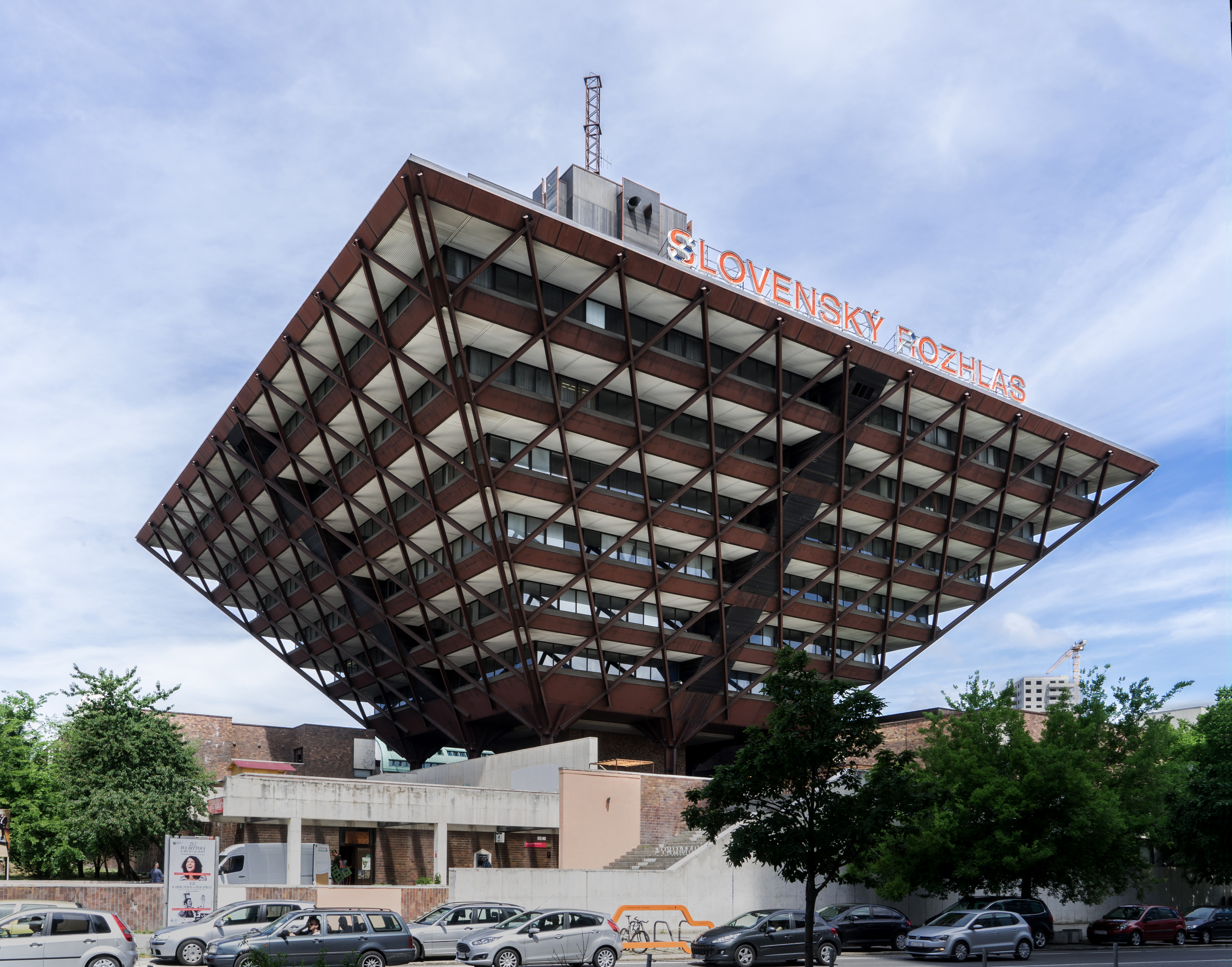
I'm not talking about the endless rows of Brutalist panelaks here, but landmarks that seem designed with an eye to aesthetics, buildings where form plays at least as much a role as function. They seem distinctly...Eastern Bloc.
Examples are: Georgia's Ministry of Highways Slovak radio building Zizkov Tower in Prague
I've seen the Zizkov Tower and the Slovak radio building in person and both seemed to my untrained eye inhumanly oppressive and sharing some aesthetic principles. Am I projecting or cherry picking here, or is there a particular "school" unique to Soviet non-prefab landmark architecture? Whether there is or is not, what are the roots of this particular style?
To properly answer this question, it's important to take a step back to understand the evolution of the modernist movement in architecture and the doctrinal difference in pre-war and post-war modernism.
Fall of Modernism and birth of Brutalism.
Since the start of the century through works of proto-modernists, like Behrens and Loos, culminating with the bold designs of Le Corbusier and the Weimar Republic's Bauhaus, modernism's main doctrine was raw honesty, breaking apart with the Beaux-arts approach of applying historical elements outside of their context. The idea behind this honesty of form, raw functionality without any redundant decorative elements was that by building a better spacial context for the future's society, we can influence the society itself, making it better organized, more just, less wasteful in all aspects of life.
The naivete of pre-war modernism has culminated at the CIAM (Congres internationaux d'architecture moderne) 10, held in Dubrovnik in 1956., where a vocal group of dissenters challenged the dogmas of modernism, later to be shaped into so called Team X (10), most prominent members being Allison and Peter Smithson, Jacob Bakema and Aldo van Eyck. They insisted that modernism's doctrine was naive and flawed, that we can't simply ignore the cultural productions of bygone eras, and that making things seem better won't actually make them better; in a theoretical sense, is modernism any different from the Beaux-arts it opposes?
Bakema and van Eyck giving doctrinal birth and writing the manifesto of Structuralism are not so relevant in our topic; the Smithsons however ushered the formation of what we today call Brutalism – modernism that's more honest than modernism itself, showing the building for what it really is, not trying to hide any of its notions, whether it's construction, service elements such as plumbing and heating, or try to clad the facade in a pleasing material – Brutalism is honest, it shows things as it is; in that sense it's radical, but that's its point – there can be no truth but the absolute truth, and everything else is wishful thinking. As such, brutalist architecture is often called 'ugly' by the layman audience, but that's where its beauty stems from – rawness and dialectic of form.
Evolution of style behind the iron curtain
Now let's take a look at the Eastern Bloc; namely its cultural development and production since 1917. onwards. Right after the October Revolution, the new socialist ideas being applied in the general society influenced the formation of new artistic movements as well – specifically, futurism and suprematism, characterized by abstract geometric forms in both painting and architecture. This was seen as a way of breaking off from the decadent historicist styles of Tsarist Russia, and forming a new art style based on a new, just, equal society (one can draw some parallel with modernist movements in central europe we discussed earlier).
However, after Stalin's rise to power after Lenin's death in 1924., suprematism was deemed as dangerous free-thinking, and the new cabinet reinstated a new policy where the official Party style (meaning getting actual funding) is socialist realism. Suprematism was labeled as bourgeois art, not connected with the layman and their aesthetic sensibilities, whereas socialist realism responded better to the masses, and served as a good propaganda tool.
At some time after the war, eastern bloc cultural production evolved further – there were no longer any 'counter-revolutionary' elements that socialist realism had to keep in check, and another threat appeared as the Cold War started – the decadent, consumer, hedonistic bourgeois of the west. As such, the brutalist style that Smithsons ushered in United Kingdom has found, both in its doctrine as sensibilities, a lot of ground in intellectual and architectural circles of eastern bloc countries – primarily USSR, which was robbed of its 'modernism' period by Stalin's cultural policies. Not to mention that given the economic growth and need to rebuild after the war, there were a lot of housing developments planned in the coming years, which necessitated things like uniform, prefabricated construction, minimalist aesthetics, and little to no modulation in order to minimize costs – brutalism fitted the bill perfectly. Yugoslavia's a bit of an oddball here, since its tense and hostile political relationship with USSR has made it go a different direction and create its own form of post-war modernism.
Brutalism in an eastern europe socialist context mostly ushers pictures of endless, repeating columns of concrete habitation buildings; ironically more akin to the structuralist sensibilities of Bakema and van Eyck than the Smithsons, but as such it's important to note that this is mostly a picture we see taken through a political context – mindless repetition of form, implying a western understanding of a 'threat' of socialism. All planning was made by trained intellectual professionals, architects, and as such common urban planning sensibilities are present. Kevin Lynch, in his book The Image of the City states that every urban unit, no matter how big or small can be analyzed and divided onto 5 basic elements that form the urban landscape – paths, edges, districts, nodes, and landmarks.
Now we finally come to the answer to the question you've asked – why were those buildings you linked so bold and unique in their design, while still utilizing the brutalist aesthetic doctrine? Because, when we look at them in the wider context of the city itself, they serve as landmarks, both on an emotional/psychological scale, by housing an important community element ( Ministry, Radio, TV tower ), and by having a form that stands out from its surrondings, so they can communicate their significance in the public space. All this while not awkwardly standing out from the overall rational brutalist style of its urban surroundings.
EDIT: Another example, Central building of the Communist Party of Croatia by Ivan Vitić. See how the Yugoslavian post-war modernist style is much less brutalist by nature and looks more like an evolutionary development of pre-war modernism instead.
Sources :
Kevin Lynch : Image of the City , 1960.
Reyner Banham, Phillip Johnson : Allison and Peter Smithson, a critical anthology , 2011.
Vladimir Kulic, Maroje Mrduljaš, Wolfgang Thaler : Modernism in-between, the mediatory architecture of socialist Yugoslavia , 2012.
P.S.
If you're interested in architectural production of post-war modernism in socialist europe, I'd advise you to check out some publications from the Venezia Architecture Biennale of 2014 – with the yearly topic of main curator Rem Koolhaas being 'rethinking modernity', a number of the ex-socialist countries like Albania, Croatia, and Macedonia took an effort to look back and reevaluate their post-war modernist architectural production.