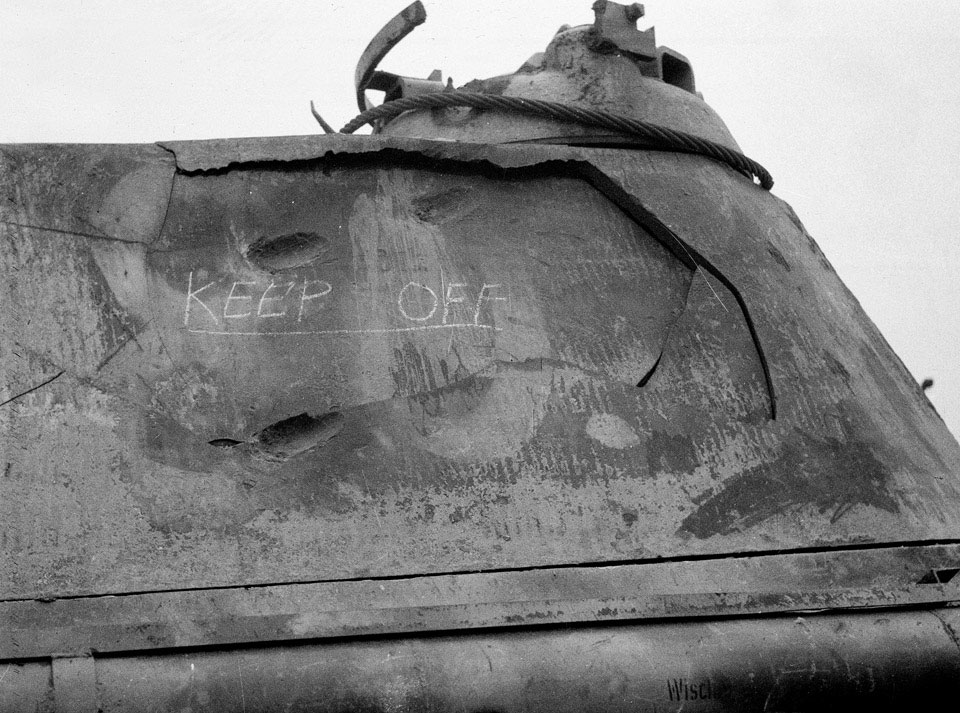
Particularly from non-penetrating hits or explosions. Could little flakes of steel chipped off the inside walls be enough to seriously injure crew or disable the tank?
Spalling or general displacement of armor plate was enough to kill or injure crew members of tanks and damage internal systems. Steel that has improper proportions of metals is more likely to fail catastrophically when exposed to high explosive concussion or projectile penetration. Spalling could be minimized by using an armor steel that had a lower Brinell hardness number (BHN). One Brinell hardness number is calculated by using a spherical penetrator made of steel to press against a piece of material. The equation to come up with the number is;
( 2 * P ) / ( pi * D ( D - sqrt ( D^2 - d^2 ) ) )
Where;
P = applied load in kilograms force
D = diameter of indenting tool in mm
d = diameter of indentation in mm
Another equation using a spherical penetrator made of tungsten carbide is;
( 0.102 ) x ( ( 2 * F ) / ( pi * D ( D - sqrt ( D^2 - d^2 ) ) ) )
Where;
F = applied load in newtons
D = diameter of indenting tool in mm
d = diameter of indentation in mm
German armor steel was generally quite "hard" (or, had a high Brinell hardness number), and its quality was already deteriorating by 1942 as Germany gradually ran out of or lost access to critical metals that are used to make an acceptable shatter-resistant and easy to weld armor steel, such as molybdenum (found in Norway, and lost in fall 1943 because of the bombing and destruction of the Knaben mine) or nickel (found in Finland, and lost in fall 1944 because of the Petsamo-Kirkenes Offensive). Less suitable metals such as vanadium had to be substituted, and the carbon content increased, making the steel more brittle. Quality control also took a hit. Different Brinell hardness number ranges were specified for different thicknesses of armor plate, and varied over time;
| Armor Type | Year | Schürzen plates | 5-15 mm | 16-30 mm | 35-50 mm | 55-80 mm | 85-120 mm | 125-160 mm | 165-200 mm |
|---|---|---|---|---|---|---|---|---|---|
| RHA | Before 1937 | 529-560 | ? | ||||||
| RHA | 1937-1938 | 435-465 | 353-382 | ||||||
| RHA | 1939 | 435-465 | 353-382 | 309-353 | |||||
| RHA | 1940 | 435-465 | 353-382 | 309-353 | 294-338 | ||||
| RHA | 1941 | 435-465 | 353-382 | 309-353 | 294-338 | 279-309 | |||
| RHA | 1942 | 435-465 | 324-370 | 309-353 | 294-338 | 279-309 | 266-302 | ||
| RHA | 1943 | 105 | 435-465 | 353-382 | 309-353 | 266-311 | 220-265 | 220-265 | 220-265 |
| RHA | 1944 | 105 | 435-465 | 324-370 | 279-324 | 266-311 | 220-265 | 220-265 | 220-265 |
| RHA | 1945 | 105 | 435-465 | 324-370 | 279-324 | 252-295 | 220-265 | 220-265 | 220-265 |
| Cast | 1942-1945 | 220-266 | 220-266 | 220-266 | 220-266 |
German face-hardened armor maintained an overall front hardness of 555 BHN.
Having armor with too high of a Brinell hardness can have fatal consequences. The turret side of this Panther caved in after three glancing blows with 75 mm high explosive shells; the three turret crew were killed. The glacis plate of this Panther, which was fired on as a part of a test at Isigny, France, in August 1944 caved in after several consecutive hits, including one from a 17-pounder gun. The 152 mm Soviet howitzer mounted on the SU-152 and ISU-152 assault guns also proved to be a good anti-tank weapon, even though it was not originally intended as such. The sheer high explosive power of the 152 mm shells could demolish a German Tiger or Panther, and the SU assault guns were nicknamed "beast killer."
Some Soviet-produced armor plate displayed similar hardness characteristics to German plate, and was sometimes noted as being prone to spalling. The United States shipped over 2.3 million tons of steel to the Soviet Union via Lend-Lease. Soviet tank crews were more complimentary of T-34s that were built with the softer American steel, as well as Lend-Lease M4 Sherman tanks.
From the beginning of the Great Patriotic War, the Soviet government was faced with the enourmous problem of evacuating countless indistrial enterprises from the country's western regions to its eastern regions. The relocated defense plants, as the chairman of the Council of Ministers [J.V. Stalin] reported, "began production at their new sites some seven or eight months later. This [lapse in production] has led to a weakening of our defense capability and has placed the Soviet Union in mortal danger."
The Red Army's failures during the initial period of the war allowed the enemy to capture a number of mineral-rich regions of Ukraine and Belorussia. As a result of the Soviets having lost control of these regions, a complicated situation developed in the plants that manufactured the armor for their tanks. Because these factories had recieved insufficient quantities of some of the smelted metals required to ensure the necessary toughness of armor, the armor plate they produced turned out to be somewhat brittle in its composition - and, of course, there were negative consequences on the battlefield.
The T-34s assembled with this defective armor arrived as equipment for units of 45th Brigade, 4th Tank Corps, in June 1942. They were brand-new tanks, just off the assembly line, still bearing factory paint.
The brittle-armored tanks of the brigade fought their first battle in the defense of Voronezh the month following their delivery. It was a fierce engagement with the enemy. Almost immediately the unit commander had begun to receive radio messages with strange contents. Despite the failure of enemy shells to penetrate the T-34 tanks' armor, crew members were being wounded inside their turrets, primarily in the exposed areas of the body- the hands and arms, the face, and, in the case of some commander-gunners, the eyes.
With the first lull in the battle, the Soviet troops began to investigate these mysterious wounds. It soon became clear to them that the steep slope angle of the T-34 turret's exterior surfaces was allowing enemy solid-shot rounds generally to ricochet when they struck that area. But when such a round did indeed hit the turret's outer wall, pieces of the tank's armor itself flew off the inner wall at extremely high velocities- a rate that seemed to vary according to the kinetic energy of round at the monemt of impact. In general, if the enemy round struck on the left side of the tank, the commander-gunner- whose crew position was closest to the left inner wall of the turret- was being injured by the fragmenting armor of the vehicle wall. If the round hit on the right side, the armor spalling was striking the loader, whose crew position was on that side. The size of the fragments ranged from microscopic to several millimeters in diameter.
American armor steel was generally softer, or, had a lower BHN. It is important to note that until 1943, a large percentage of American cast and rolled armor was deduced to be defective due to poor quality control, resisting anywhere from 5 to 50 percent less than it should have.
| Armor Type | Year | 6-13 mm | 22-31 mm | 32-38 mm | 51 mm | 64 mm | 76 mm | 102-127 mm | 128-152 mm | 152 mm + |
|---|---|---|---|---|---|---|---|---|---|---|
| RHA | 1941/2-1945 | 320-390 | 310-350 | 280-320 | 260-290 | 240-275 | 240-260 | 240-260 | 220 | 220 |
| Cast | 1940-1941/2 | 363-440 | 235-270 | 235-270 | 280 | |||||
| Cast | 1942/3-1945 | 302-325 | 302-325 | 235-269 | 235-269 | 235-269 | 235-260 | 220-250 | 220-250 | 200 |
An armor steel with a lower BHN that "flows" and bends after penetration results in a clean hole rather than jagged cracking or tearing and large fragments flying off the armor. Clean holes also simplify repair. If no other parts of the tank are damaged, the inside of the tank can be washed if necessary, the hole can be plugged, and the tank returned to the replacement pool for reissue.
Source:
Bird, Lorrin R., Robert D. Livingston. WWII Ballistics: Armor and Gunnery. Albany: Overmatch Press, 2001.
Loza, Dmitri, James F. Gebhardt. Fighting for the Soviet Motherland: Recollections from the Eastern Front. Lincoln: University of Nebraska Press, 1998.