Surely Belgium would have wanted to stay out of any future conflict, and wouldn't take kindly to France effectively forcing them to participate?
In short, what did Belgians think of the Maginot Line?
Generally speaking, Franco-Belgian relations were not terribly damaged by the construction of the Maginot Line nor were they harmed by the French General Staff considering Belgium to be France's "glacis" against Germany. The Franco-Belgian defense relationship built on both the First World War alliance as well as the gepolitical reality of Hitler. Relations between the two countries' governments and militaries were cordial on a day-to-day level. However, the situation was somewhat different when it came to Brussels's official stance on neutrality.
Belgium's official stance on its defense was that it was neutral in Europe's affairs. The idea that Belgium would side against any polity that violated its neutrality was one of the cornerstones of Belgian diplomacy. Thus in theory, Belgium would side with Germany if France invaded Belgium to reach the German heartland. But the German invasion of the First World War underscored how vulnerable this policy was after the fact. So the Belgium signed a mutual defense treaty with France in 1920, but with some sops to Belgian independence. This government seemingly reversed the 1920 accord with the 1936 decision by King Leopold III and the Belgian government to official repudiate Franco-Belgian military ties. This decree reified Belgium's neutrality in international affairs.
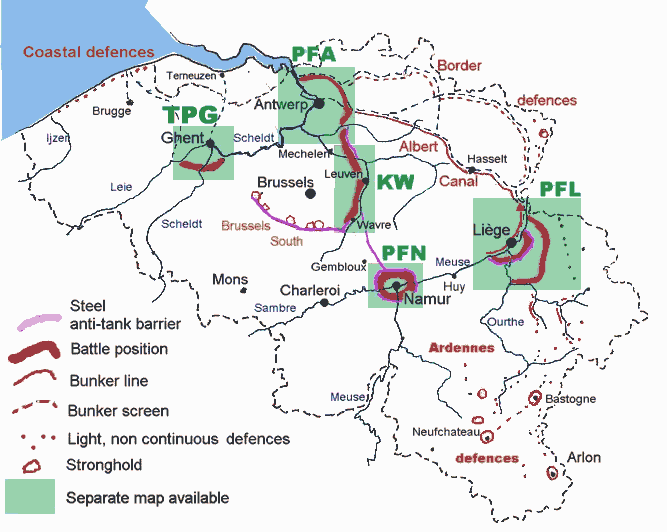
But the break with France was more apparent than real. The Belgian military remained a de facto ally of France; the French were privy to Belgian military developments and plans. This courtesy was not really extended to Germany. Belgian military planning almost exclusively anticipated a German invasion. The new round of fortifications and deployments were not terribly useful against a French invasion. The government built some fortresses in the Kester-Halle-Waterloo line - seen in this map, but the overwhelming bulk of its fortress complexes were arrayed against a German invasion, as this map illustrates. The 1936 repudiation was also part of a larger rearmament drive by Belgium. This increase in armaments was a dicey proposition for the Belgian Parliament in middle of the Great Depression. The 1920 French alliance was somewhat unpopular among the general public, especially among the Dutch-speaking Flemish population. Retaining a formal alliance with France would have opened up the government to criticism that the much larger France was expecting the much less populous and poorer Belgium to bear the costs of being at the frontlines for German aggression. The 1936 repudiation forced the issue of modernization and rearmament.
Belgian rearmament did not proceed smoothly from 1936 and the unspoken defense arrangements with France were not without their own frictions. Belgian intransigence over neutrality became one of the excuses bandied about by the French in the aftermath of 1940. This is an unfair charge. But as a small power, Belgium could not modernize its armed forces quickly, but it tried to do so with the means available to it. Relations between the two countries' general staffs could be tense, but not all of the problems emanated from Brussels. The French conceptualization of Belgium as a natural glacis may have reflected geographic realities, but it was not one that was easy for Belgians to stomach politically. Yet despite serious apprehensions about the emerging war, the Belgian state clearly saw Germany as its main threat to independence and France as the natural ally of the Belgium despite its stated neutrality.
Sources
Epstein, Jonathan A. Belgium's Dilemma The Formation of the Belgian Defense Policy, 1932-1940. Leiden, The Netherlands: Brill, 2014.
Klinkert, Wim. Small Powers in the Age of Total War: 1900-1940. Leiden: Brill, 2011.