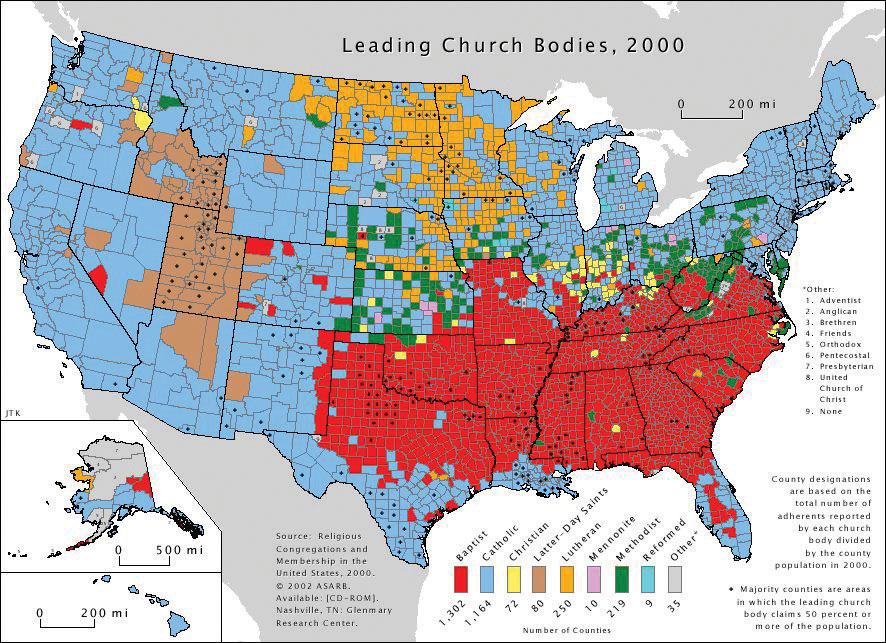
The South is known as the Bible Belt in the US and I was wondering why did it become more religious than the Northern US.
Edit:
Where I got the idea from:
https://en.wikipedia.org/wiki/List_of_U.S._states_by_religiosity
There’s an old post by /u/tayaravaknin (who since deleted his account) that answered:
It’s, I think, a good but incomplete picture. It doesn’t explain things that I’d like it to explain.
It mentions fundamentalists, but doesn’t plumb the Fundamentalist/Modernist split. This was one rupture, long brewing, that put the Northeast and the South on different trajectories. Boston, for example, was notoriously prudish for much of the 19th century.
It also doesn’t go into the relationship between religion and race—The Civil War as a theological crisis by Mark Noll is important in explaininga among other things the deep role that religion played in justifying (and opposing) Black chattel slavery. On the other side, Raboteau’s Slave Religion, which gave us the idea of the Black Church as the “invisible institution” undergirding much of African-American life from Slavery to Civil Rights, is also key to understanding religion in the South (we often think of “the South” as “White people in the South”, but obviously that’s not the case. Pretty much the whole South is 10-35% Black today, and before the Great Migration, the numbers were signifantly higher). Just as religion was key for providing parts of the language for the moral justification of slavery, it similarly provided the language for the moral justification of Jim Crow and segregation (though I don’t know as clear a book on that). Now, obviously, religion has little to do with racial caste systems, but it does give language and form to other moral systems.
One thing that sociologists have been arguing since the 80’s (Wuthnow’s Restructuring of American Religion) is that while religion was once largely divided by sect (especially Protestant, Catholic, Jew, but also the various Protestant denominations) are increasingly divided by attitudes towards religion. Orthodox Jews, Southern Baptists, and Conservative Catholics increasingly make common cause, just as Reform Jews, members of the United Church of Christ, and Liberal Catholics do (many Protestant demoninations, like Methodists, Lutherans, and Episcopalians are very divided between conservative and liberal factions). It’s wrong to say that political attitudes shape religious attitudes, but there’s certainly an interative interaction between the two that didn’t exist in the same way in the 1950’s. Though, a book I’m reading now, Schultz’s Tri-Faith America argues that the 1950’s was in many ways extra-ordinary in terms of religion, but it’s also worth remembering that before that period, religion was largely divided by Protestant vs. Catholic (vs. Jew) before any other division. Sure, there were flair ups like the Modernist/Fundamentalist Controversy, but the emergence/reemergence of Fundamentalist/Evangelical (not identical) Christianity as a major political force only since the 1980’s (Moral Majority was Founded in 1979) has a strong effect on contemporary perceptions of the South. I like Casanova’s Public Religion in the Modern World’s chapter on America for explaining this. One aspect of this, some demographers argue and I believe, is that this powerful conservative Christianity has seemingly led many liberals to say something along he lines of, “If this is religion, I want none of it.” Most of the post-1980 nationwide declines in religiosity have come among liberals. For a non-technical article on this, Claude Fisher’s article, “Can Liberals Get a Witness?” in the Boston Review is good. I think there has been a similar push for political conservatives to become increasingly religious conservatives. But the point is that politics and religion don’t exist walled off from each other; they’re mutually constitutive.
One big thing that I think matters but is hard to quantify or approach systematically is the effects of Catholic immigration. If you look at a map of Catholics in the US, you’ll see the non-Louisiana South and Mormon-majority Utah are the two places with lowest proportion of Catholics. I personally think that the number of Catholics (that is, heterogeneity) has an effect on the later character of Protestantism in the region, as we move through the 1930’s and especially into the Post-War era, brotherhood and religious tolerance (for Protestants, Catholics, and Jews) has a signicant effect. I would guess, without hard numbers, that areas that were less religiously diverse were less affected by these significant changes (remember, religion helped sink Al Smith’s presidential chances, and there were serious worries that Kennedy’s Catholicism would hurt him—though I should point out that the stress solidly Democratic South was actually the only region to vote for the Democrat Smith). This part is speculative but I think significant. Notice how much the South stands out on this map for their lack of any areas (outside of Louisiana and South Florida and South Texas) with large amounts of Catholics.
Lastly, I think if we go back to the beginning of the Republic, there were significant differences in how the Northeast was founded, and what people came there, compared with the South. That’s not controversial, but how exactly these effects carry across two or three centuries is inherently harder to argue. It’s the kind of thing people are explicitly taught not to do in graduate school, I feel. The best book making this argument is certainly Albion’s Seed. In his view the South was founded by conservative Episcopalian “Cavaliers” and revival-prone “Borderers” while the Northeast was deeply influenced, and culturally shaped by, Puritans and Quakers. For a deeper summary/review of Albion’s Seed, see this entry from the blog Slate Star Codex. This thesis I think removes a lot of important contingencies (there’s no particularly reason why the Northeast became more religiously liberal and the South became more religiously conservative), but it does give an important piece of the puzzle of varying regional American cultures.
One really last thing to consider is that social desirability bias probably push both regions’ of answers in opposite directions. Americans, for example, tend to overreport their church attendance in retrospective surveys (how often do you go to church?) compared to time use surveys (list everything you did by the hour). This is not true of Europe, as far as I can remember (Jose Casanova wrote about this somewhere, but not in his big book). Self-reported religiosity is in many ways aspirational, and other measures, like religious knowledge, holding to religious rules, or the participation in religious events, will certainly show the same differences but maybe less starkly (I’m not sure about this, but again I suspect it).
Ultimately, this is longer than I meant it to be. I meant it just to be a quick note to the original linked answer. But I wasn’t satisfied with that answer and I’m not satisfied with this answer. There is not a single clear answer, or even a set of separate but mutual reinforcing theories that I’m aware of. Compare that to the literature comparing religiosity in the US and Europe, where I think you can get three or four theories that all explain big parts of it. Some of these theories, I should add, can be used to explain the Southern/Northern differences. Most obviously the theory of religious economies (Finke wrote a lot about this in the specifically American context) about how competition between Protestant sects drove religiosity, but what it means to “be a good American” to, say, the modal Alabaman might imply a rather different religious identity (“our shared Judeo-Christian values”) from the modal New Yorker, where “being a good American” might not imply a religious identity at all (beyond some sort of “tolerance for religious differences”). Which is to say, when we add what we know about international comparisons to this comparison, we get another set of theories entirely that also seem to have explanatory value.
Which is all to say, this is very complicated question without one (or even three or four) satisfying answers. Four years later, I’m still pretty satisfied with that Europe vs. America religiosity answer I gave, and I don’t think I’ll every really be satisfied with a why is the South more religious than the Northeast answer.