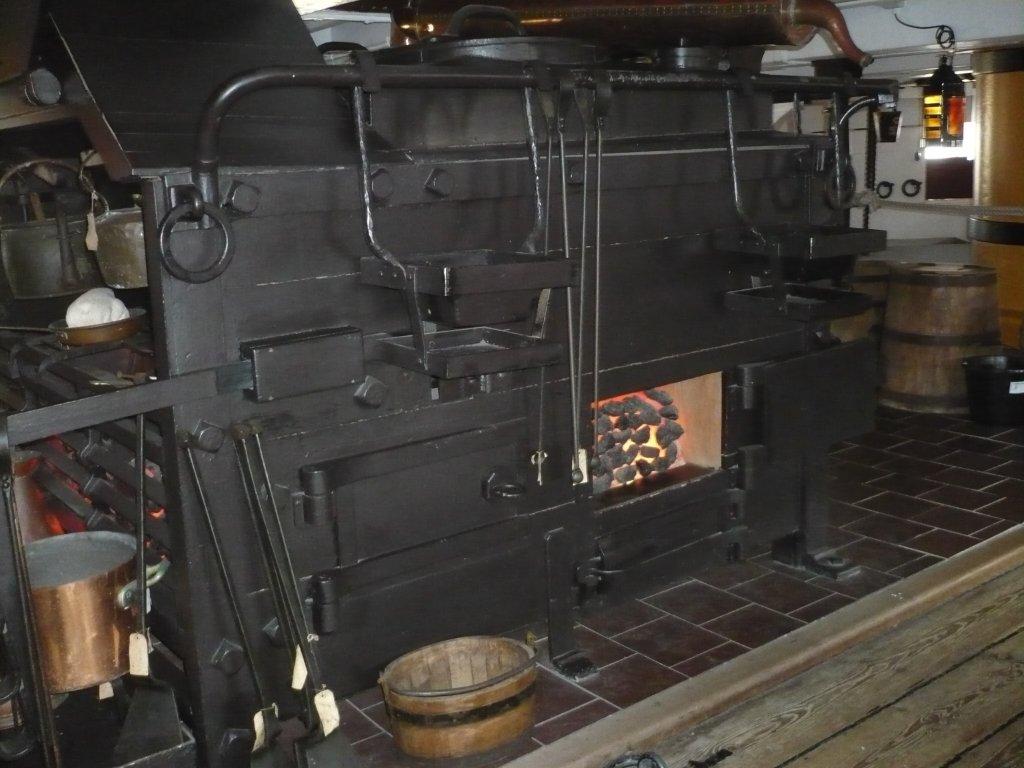
As you've guessed fire was a big fear aboard wooden sailing vessels - wood, canvas, hemp rope, and gunpowder were all staples of the daily working life and those are very flammable.
For cooking fire was kept central. During the Early Modern period (when larger, caravel-built, ships started spending longer durations at sea) we start to see the galley come into its own: Mary Rose's galley was found to have a large brick oven. Later these would evolve into cast iron stoves with separate compartments for cooking, heating, boiling water, and even distilling fresh water from the sea. All of these ovens were carefully designed to keep the fire inside, and most would only be extinguished in the event of battle - as lighting it was the most danger moment for the ship (but if a live oven was hit by cannon fire then you'd have a big problem...)
For lighting candles where the main source of light, both ashore and at sea (though many houses made the most of open fires.) For these glass lanterns would be used to keep the fire separate from the ship. This was taken a step further in powder rooms (an area deep in the ship for storing gun powder) which typically had windows to an adjacent room with a candle in it. This, combined with no natural light at all, made powder rooms exceptionally gloomy. But candle use was limited, they were expensive and awkward. For this reason, their use was limited in most navies and many private ships.
As for cannons, they were a big concern. Battle was when accidents are most likely, and fire combined with gunpowder is a horrible thing aboard a ship. The British Royal Navy instituted flint-lock operated cannons for just this reason (the army continued to use linstocks.) However, the RN did still use linstocks as a backup (in the form of a slowly burning rope), and the code of use required that they be kept smouldering in a bucket suspended in a larger vessel containing sand or water.
So the broad answer to your question is 'very carefully'! And with good reason, ships catching fire, or even even exploding, at sea was not at all unheard of.
So, this is a pretty broad-ranging question. "Wooden sailing ships" span a range from the era of classical galleys all the way through the mid-late 19th century, and across many nations and geographic regions. All of these time periods and locations had different, sometimes vastly different, approaches to cooking aboard ship.
For the sake of answering your question with more than just an Alex Trebek "can you be more specific?", however, regarding an era I know something about, let's take the Royal Navy during the Age of Sail.
Large sailing ships in the mid-late 18th and early 19th centuries had large stoves in their galleys (the place where meals were prepared and served, and also, by metonymy, a name for the stove itself). These stoves were typically made of metal, either sheet iron or cast iron, or both, often with copper finishes for exhaust pipes, handles, and other surfaces. Here is a photo of such a stove from HMS Victory's galley as preserved and recreated as she sits as a museum ship at the Portsmouth Historic Dockyard. Note the ovens in the lower portion in which wood (and on later ships coal) could be burned in order to heat the entire machine. Here is another photo showing how extensive these heating elements were, and how different types of cooking could be done simultaneously.
The fires were, as you can see, internally contained within the ovens, and cooking surfaces were not open flames, but heated, metal cooktops, similar to what we would use today. These stoves were quite advanced for the time, and could contain such amenities as hot water tanks for making tea on a moment's notice, large cauldrons and small pots for cooking, and baking ovens, as well as the cooktops.
Also important was that these stoves had chimneys that ran through the decks and out to the top decks of the ship. These chimneys were copper-clad and disposed of smoke, embers, and sparks (along with hot air) in such a way as to minimize fire risk from the galleys. You can see a more prominent example of a chimney going through a ceiling here in the photo of the galley of HMS Endeavor. Note also that the oven stands on bricks (though it is bolted to the deck through them), which themselves are placed atop a bed of sand. The sand and bricks are both good for the insulation of and dispersal of heat, are fireproof, and the sand helps act as a weight-shifting device and inertial dampener if the ship pitches or rolls in heavy seas. By placing the ovens on this type of bed, the risk of fires from an errant spark or dropped match were greatly minimized.
Smaller ships might still have galleys such as these, just scaled down (you can see that Endeavor, a much smaller vessel than Victory, has a smaller oven), or, especially in the 19th century, they might have a caboose (https://en.wikipedia.org/wiki/Caboose_(ship%27s_galley) -- apologies, Reddit doesn't do well with Wikipedia links that end in parenthesis), which is essentially a small, wood-fired oven that sits on the top deck of a ship, and was often a self-service device. Crew and especially passengers on merchants ships (where cabooses were more common) might well be expected to prepare their own meals. Otherwise, these devices worked much the same way as their larger cousins. Fire protections here were not nearly as robust -- there were usually no self-contained chimneys or brick decking -- but the scale of the cooking was smaller, and the cabooses being on deck were both more readily extinguishable and less likely to ignite the more heavily finished and resistant wood.
As for other precautions, a big one was the means by which food was commonly prepared in the Royal Navy at this time. Boiling food was far more common than, say, frying food, and boiling is far less likely to lead to fires than frying, since you're not dealing with hot oil jumping out of pans, and indeed, have a ready supply of water, just in case. Galleys did sometimes have toasters, and of course, baking was common, but there was little cooking over open flames, which, again, generally minimized the amount of danger.
Another big thing is when cooking was allowed. If the weather turned rough, or was thought to be turning rough, cooking fires would be ordered extinguished. Same if a potential enemy ship was sighted. Precautions were always taken to minimize any danger of fires from the galley whenever possible through protocols. Naval crews were also trained in fire-extinguishing techniques, including using bucket trains in earlier times, and hoses in later eras.
Of course, as wooden ships gave way to metal ships, and metal generally became less expensive and more shapeable, galleys were among the first areas to be ironclad. Here is a photo of a galley from a passenger ship that was built at the end of the 19th century. Notice that the entire room is clad in sheet metal to minimize fire risk.
Anyway, I'm sure others can discuss different eras and navies, but hopefully this gets you some sense of how things worked.
Sources:
J.H. Pryor, “Firewood at Sea,” from Mariner's Mirror, vol. 75 (1988)
A Naval Encyclopaedia - Lewis R. Hammersly & Co, Eds.
HMS Victory Museum
Daily Life in the Age of Sail - Volo, Dorothy Denneen and Volo, James