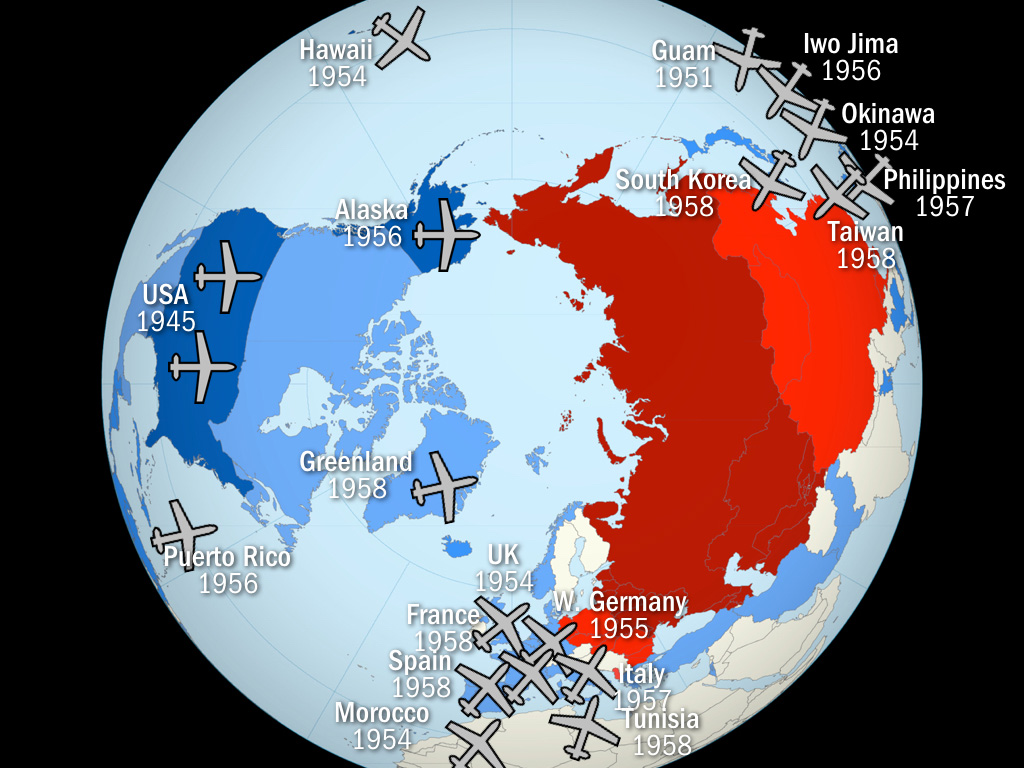
First, it's worth distinguishing between deterrence and MAD. Deterrence is the general strategy of saying, we make these weapons so that they will dissuade other from doing things that would force us to use them. Mutually Assured Destruction is a specific strategy that says, if nuclear weapons are used, they will be mutually suicidal or damaging. These are not the same thing. You can deter a non-nuclear power, and you can have non-nuclear deterrence, and you can have nuclear strategies that don't rely on MAD (e.g. ballistic missile defense is one approach to avoiding being mutually destroyed, as are first-strike attacks, and there are theories of tactical nuclear use that would involve very minimal use of nuclear weapons without "escalation", etc.).
From 1945-1949 the US was the only nation with nuclear weapons, and so there was no mutual assured destruction. There was only a minimal idea of deterrence, e.g., if the Soviets invade Western Europe war would begin, and it would include nuclear weapons (but it was not yet "push-button war" — it would not be some kind of instantaneous destruction because the US had very few nuclear weapons and had only very basic means of delivering them to targets).
From the period of 1950-1960 or so, the US had an overwhelming advantage over the USSR in terms of nuclear arms and delivery mechanisms. The USSR basically could only have reliably attacked Europe or East Asia, not the continental United States (they could try to send bombers over the pole but they would be detected and attacked). By contrast, the US had ringed the USSR with airbases armed with nuclear weapons, and had developed rudimentary intermediate-range ballistic missiles and submarine-launched missiles as well. The USSR's ability to attack American allies might have been a deterrent to a US first strike, but it was not Mutually Assured Destruction by any means.
In the 1960s, the USSR started to get the capability to inflict unacceptable damage on the US, when it started to deploy Intercontinental Ballistic Missiles (ICBMs), which could hit American cities from the USSR and not be defended against. Even then, the balance was still dramatically in favor of the USA — the US had a massive arsenal many times larger than the USSR did, and could inflict much more damage upon the USSR than the contrary. But by that point it became clear to US policymakers that the cost of a war with the USSR was obviously too high. This is around the time the term Mutually Assured Destruction was coined.
By the 1970s, the US and USSR were more or less at parity. They could equally destroy one another in ruinous ways. It is of note that Mutually Assured Destruction was not always the policy from this point onward — deterrence was seen as the framework in which strategic nuclear arms were kept but there were also many plans of what to do if deterrence failed, and there were explorations of things like missile defense that would deliberately throw off the "balance" (see e.g. Reagan's Strategic Defense Initiative which is essentially an anti-deterrence idea).
So from a capabilities and doctrine perspective these ideas took a long time to develop and harden. By the 1950s the basic idea of deterrence was around, by the 1960s these were clearly the facts on the ground.
Now if you are asking whether it was a natural consequence or not... it really depends on what one means by "natural." The US and USSR both pursued policies that led to their ability to inflict a lot of pain on the other. The US did not initially pursue anything like a deterrence policy — it was rather looking for an overwhelming force that it could use in the war that it thought was fated to come. It was only by the late 1950s that people began seeing war with the Soviet Union not as inevitable but as avoidable through something like deterrence. The Soviets, for their part, had various types of doctrines that shifted over time but their main goal in getting nuclear weapons was to avoid being in a helpless and threatenable situation. You could read this as a form of deterrence but they did not initially frame it as such (they did not frame it as, "if we get these weapons, war will be prevented").
I would not call anything relating to the nuclear arms race "natural" — these were the result of policies of two states in a very specific political and geopolitical situation, and their leaders chose these policies out of several possible alternatives. Once both states developed the means to inflict unacceptable harm upon one another, deterrence felt like the main way forward, but even then there were plenty of other options explored (like ballistic missile defense). Which is to say, even in the 1980s, when such a war looked pretty unsurvivable, there were top leaders (military and civilian) who thought that deterrence could be averted or avoided, because it was ultimately a very uncomfortable and unsatisfying doctrine (as it remains to many today, who don't like living in a state of constant risk).
Lawrence Freedman's The Evolution of Nuclear Strategy is the classic book on changing official attitudes towards the use (and non-use) of nuclear weapons, if one wants more details.