Cultural wise? Mythological wise?
As someone from the Far East with very little contact or knowledge about the European world, Greek and Roman just kinda blend into one for me. Like if you show me a picture of a Roman outfit/sculpture/painting or whatever and tell me it's Greek, I would have no idea that you're shitting me.
Are there any clear cuts between them? Also, why do they share so many similarities?
Probably a very broad question. I guess it's alright to not give intricate details in you answers; generalized answers are fine by me.
This is really hard to answer without slipping into broad generalities. Those tend to be more stereotypes than actual representations. So they are to be avoided. I’ve written 10,000 character posts comparing and contrasting the similarities between just their pantheons. So it’s hard to do a post on every aspect of their cultures.
One of the primary reasons they have so much in common is that they’re reasonably close. Rome is only 1,000 km from Athens. And other Greek cities were much closer. It’s only 400 km from Rome to Taras/Tarentum (modern Taranto). And both cities were founded within around 50 years of each other. So the Romans always knew the Greeks. The Greeks were just down the road, so to speak.
As an ethnicity the Greeks are likely (we don’t know for certain) an amalgam of pre-historic populations that lived by the Aegean and a mix of “sea-peoples” that invaded the area around 1200 BCE. It’s possible that the “sea-peoples” also came from around the Aegean Sea. They spoke a variety of Greek dialects, generally had a Mediterranean appearance (olive skin, dark wavy to curly hair), and had a shared culture of belief and practices.
The Romans came from native Italic populations, perhaps mixed with some Greek, Phoenician, and Central European populations. They spoke Latin, generally had a Mediterranean appearance, and had a culture that blended a variety of Italian (especially Etruscan) elements along with a lot of Greek elements. For example virtually every Greek god was eventually adopted into the Roman pantheon. But they never dropped their own original gods, the Romans never had a problem with offering the local Janus his due one day, then offering the Greek Dionysius his due the next, and finally the Egyptian goddess Isis her due the third day.
So in a lot of ways the Roman culture has elements of a lot of other cultures in it. Likewise once Rome conquered the Mediterranean large swaths of Roman culture was adopted by the conquered people including the Greeks. That’s the nature of things. If a man in Singapore eats a hamburger made from Kobe beef and washes it down with a sling, is that German (beef and beer), American (popularized the hamburger), Japanese (developed the ultra-marbled Kobe beef), or Singaporean culture (local variant of all the above).
Likewise the Romans loved the Greek culture. A well educated Roman in 100 CE generally would know Greek fluently and have a good understanding of Greek culture. He’d likely dress similarly to Greeks of his era, have a similar appearance. It’s unlikely that anyone except an expert from the modern era would be able to tell him apart from his Greek neighbors.
Which brings me to the next point... both the Romans and the Greeks changed over time. An early Roman Republicican empire army looked very little like the army of the mid-Republic or early Empire. Those looked fairly different from the armies of the late Empire. With over a thousand years of history, just about everything in Rome changed. At the same time Greece was undergoing its own changes. So we can’t say a Greek did this and a Roman did that. The differences between a Roman in 400 BCE and a Roman in 400 CE is probably greater than the difference between some Greeks in 50 CE and some Romans in 50 CE.
So to boil all this down and provide an example... let’s look at a standard military soldier in several places and times.
In 400 BCE the standard Greek soldier would have been semi-trained militia man. He would have fought in a hoplite formation with a long spear called a dory and a round shield called a apsis. He would have worn helmet and greaves. If he was well off he might have a breastplate made of bronze. He would have looked something like this
Around the same time the average Roman would have been equipped almost identically and looked something like this.
A century later a lot of Greek armies had begun to copy Alexander’s Macedonian army. They dropped the shield and adopted much longer spear, the sarisa. These armies looked like this. However the shorter spears never entirely fell out of use. So Greeks could be encountered with a variety of spears and shields. At the same time the used of cavalry especially in the Hellenic kingdoms expanded, resulting in a variety of horseman on the wings.
The Romans however switched to a mixed force of infantry. They started using a a lot more skirmishers like the javelin throwing velites. Their main battle lines would be composed of sword wielding hastati and principes. These would be backed up by spear wielding triarii, which were still much like the hoplites.
A couple centuries after that the Romans changed again. They adopted a mix of short throwing javelins backed up by a sword. Spears dropped out entirely. They developed two types of armor the lorica segmentata a shirt made of bands of iron strips and the lorica hamata a shirt made from iron rings.
I could go on. But I think the point is made. It’s hard to say X is Roman or Y is Greek. Both were neighboring civilizations and borrowed a lot from each other. They also both changed a fair amount over the millennia of their existence.
Ancient Greek(s) and ancient Roman(s) are two distinct historical peoples / cultures / societies / identities but they were culturally and historically very heavily interrelated. To generalize things a bit the Romans had adopted and adapted many elements from Greek culture for themselves while on the other hand the Greeks were living for centuries under Roman rule and integrated themselves over time very much into Roman imperial society. Both were so strongly connected with each other that modern academics that study one of them usually also study the other (in the form of Classics, Ancient History, Classical Archaeology etc.) and have to learn both their languages, ancient Greek as well as Latin. It is with good reason that people often talk about Greco-Roman culture as a whole. So it’s really no shame for an outsider to get a little confused about the two, and with outsiders I’m talking about people from the modern ‘West’ as well.
Things get a little tricky as we’re talking about quite a bit of history here. What it meant to be Greek in the times of Homer (9th to 7th centuries BC) was obviously something very different than centuries later in the High Imperial Age (2nd to 3rd centuries AD) or even Late Antiquity (4th to 7th centuries AD). Both identities also don’t need to be mutually exclusive. Take for example the case of Herodes Atticus, a proud and very wealthy native of the city of Athens, who also served as a Roman senator in the 2nd century AD. This was mostly possible because Roman identity was primarily a civic one, meaning it was never really determined by ones descent but by whether someone was a citizen of the Roman state. Acquiring that citizenship was theoretically open to anyone. Contrary to that Greek identity in the beginning was more ethnic in character and more exclusionary. It was determined by being borne into one of the many small Greek polities and gaining the citizenship of one of them was only seldom possible for outsiders. However those polities recognized each other as Greek because all of them took part in a set of common cultural practices like speaking the Greek language or worshipping the Greek pantheon of gods. In the Hellenistic era (3rd to 1st centuries BC) many of those practices spread to large parts of the populace in the eastern Mediterranean and being Greek began to mean mostly being a participant in Greek culture. At the very end of Antiquity Greek and Roman identity became virtually the same thing when several crises forced the Roman Empire to retreat from most of its territories except the majority Greek speaking ones. They coalesced into what is today usually called the Byzantine culture of the Middle Ages.
If we’re talking about differences then lets begin with chronology. Generally speaking Greek civilization is quite a bit older than the Roman one which is one reason why Greek culture could so heavily influence Rome from its infancy. In the Greek motherland around the Aegean Sea the first recognizable Greek city states (poleis) probably began to emerge between the 9th and 8th centuries BC and from there they spread throughout much of the Mediterranean and Black Sea region between the 8th and 6th centuries BC. Their relatively sophisticated cultural practices and widespread dissemination made them attractive role models for other Mediterranean societies. In Italy their presence was especially strong in the south of the peninsula and on the isle of Sicily, so strong in fact that the whole region became to be called Magna Grecia. Greek imports became highly coveted by Italian societies like for example the city states of the Etruscans in the northern half of the peninsula. In between the Etruscan north and the Greek south lay several small Latin speaking polities, the city of Rome one of them.
The Romans would later claim for themselves a long history almost rivalling that of the Greeks. Their foundation myth dates the origin of their city to the year 753 BC. However it is almost impossible to separate myth from reality in those early centuries of Roman history and involves a lot of guess work. Things get a little clearer from the 5th century BC when the Roman city state begins its expansion against the other Italian polities. By then its culture was already heavily influenced by the Greeks. For example around 450 BC Rome supposedly had given itself a kind of legal code modelled after examples from Greece, the so called Twelve Tables. The Romans began to identify their own native pantheon of gods with that of the Greeks. For example its head, the sky god Jupiter, was by now thought to be identical with the patriarch of the Greek gods, Zeus, and Greek myths about the later were also thought to refer to the former. Not all of those identifications were a perfect match. For example the Roman god of war, Mars, was a very dignified deity and stabilizing force for the Roman state, while his Greek equivalent, Ares, was depicted much mote negatively in Greek mythology as he mostly represented the destabilizing and destructive aspects of war. Other native Roman gods had no Greek equivalent at all, like the two faced god of beginnings, endings and transitions, Janus. As Roman expansion throughout Italy and the Mediterranean progressed those Greek cultural influences would only become more pronounced. More and more Greeks came directly under Roman rule, first in Magna Grecia and later also in the Greek states of the eastern Mediterranean. By the 2nd and first centuries BC, when the Roman Empire began to rule the whole Mediterranean, it had become normal for Greek artisans to work on the great public buildings and artworks of the city of Rome and for Roman aristocrats to speak Greek as a second language.
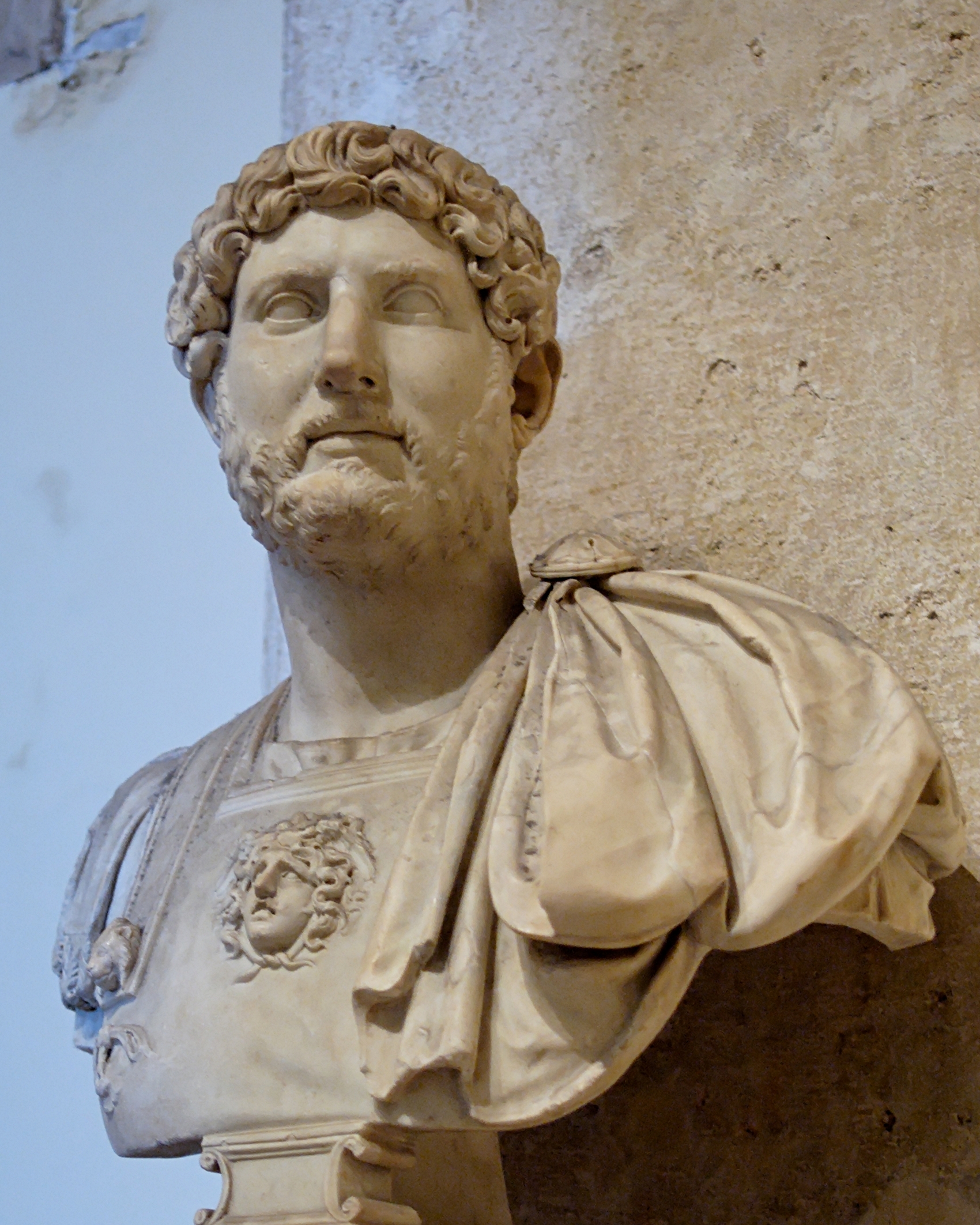
This process continued throughout the first centuries AD when the Roman Empire had become a monarchy. A common Greco-Roman culture began to establish itself among the provincial elites of the empire, be they ethnically Gaulish, Hispanic, North African, Egyptian or anything else. While Latin was the main language in the west of the empire and Greek in the east, the elites often spoke both. The Greek provinces had stopped to just be sources of cultural influences but would now also receive new impulses from the imperial centre. For example new building projects in the Greek east normally employed construction techniques originally developed in Roman Italy like the use of concrete which had been unknown to Greek architects of the Classical Age. This new cultural synthesis is embodied by people like Herodes Atticus or his contemporary, the emperor Hadrian. Much of his reign was spent on extensive travels through the Greek provinces. His official portraits often show him in the usual Roman military dress typical of the imperial office. His facial features are both naturalistic as well as highly idealized (he reigned for 21 years and hardly ages at all in his different surviving portrait types). Such idealized renditions of nature had been developed by Greek artists in the Classical Age (5th to 4th centuries BC) but were by now an integral part of Roman portraiture. Hadrian’s beard, an innovation to the imperial portrait which had been clean shaven before, signifies the emperor’s Greek education as it was normally an attribute of Greek philosophers. Those leanings were shared by some of his successors. Emperor Marcus Aurelius was even an accomplished philosopher of the stoic school himself and published his philosophical meditations in Greek. Hadrian’s extensive travels were also pioneering. Beginning from the 3rd century AD Roman emperors were ruling mostly by travelling through the provinces and only rarely visited Rome any more. This further increased the importance of the Romanized / Hellenized elites of the provinces. From the 4th century AD Christianization further increased the commonality between Greek east and Latin west. At the end of antiquity between the 5th and 7th centuries AD the Roman Empire had to face several severe crises and lost almost all its territory in the west and most in the east. In those regions Latin was rarely spoken and so Greek became the unrivalled main language of the empire. This thoroughly Hellenized as well as Christianized Roman Empire of the Middle Ages is usually called by a new (and ahistorical) name, the Byzantine Empire. Its citizens still called themselves Romans and looked back at the culture of the ancient Greeks and Romans as their historical heritage. It survived until the end of the Middle Ages when it was finally conquered in 1453 by the Ottoman Turks.