Ok so, depictions of warriors with some sort of attachment on their helmets are pretty damn ubiquitous. Vikings and the fictitious horns are perhaps the most well known example.
However as has now entered popular consciousness, the Vikings did not actually attach horns to their helmets.
So where did this representation come from? Medieval depictions of the Rus, Varangians, Vikings, and any other Scandinavia based group of raiders and conquerors are conspicuously missing them.
Archaeological evidence clearly shows no evidence of horns in helmets from the Norse or other closely related groups such as the Anglo-Saxons. Though literary and archeological sources do show boar crests were certainly sported. Their prevalence in Beowulf is also fairly well known.
I hope the mods will forgive me for the link to wikipedia, but its a pretty good picture....
It has been proposed that the empty slots in there were filled by horn sheets that have since decayed, which I suppose would make this a "horn" helmet, if not a horned helmet in the more traditional sense.
It is of note though, that despite the common cultural connections, this is not a Viking or Norse helmet, it is definitively Anglo-Saxon.
So if contemporary depictions do not depict the vikings with horns on their helmets, when does this particular trope start to become prevalent?
As in most things historically related, it is all the 19th century's fault. Specifically the confluence of opera, nationalism, and artistic license, as well as the conflation of continental history and Scandinavian.
A quick googling of vikings and horns on their helmets will eventually point you in the direction of 19th century opera as the locale where this was entered popular imagination. One of the first results to pop up will lead you to the Economist's article, and the author that they are citing has this to say on the topic.
For it was not until 1875 that humanist scholarship, misunderstood archae-ological finds, heraldic origin fantasies, and the Great God Wish (whom JacobGrimm was first to name) had worked their magic. A small herd of "viking"helmets was now on the move, led by an innocent-looking cow-horn modelcreated that year by Wagner's costume designer, Professor Carl Emil Doepler,for the first Bayreuth production (1876) of the full Ring des Nibelungen. Putting cow-horns on Nibelungenlied heads was a departure from tradition:until 1878 not a single illustrated version of that courtly south-German poem had depicted such headgear. Wagner's Ring commingled Old Norse and Middle High German motifs, creating an impression, which has endured, that valkyries and norns, Valhalla and the twilight of the gods, were timelessly German. When Doepler supplied Gunther's youthful retinue, Siegfried's funeral cortege, and Hunding himself with horned helmets, a piece of armour long attached to continental "barbarians" became part of this heady stew.
The article that I'm using can be found at https://www.scribd.com/doc/51267328/Frank-Invention-of-Horned-Helmet, and the quotation I used is from the free trial, but the rest of the article is behind a paywall.
I've researched this a bit out of my own curiosity, and it seems there's no academic study on the matter. As the whole 'viking' concept as it's known today is a product of 19th century romanticism, it's a good guess the helmet thing came out of that as well. Andrew Wawn's The Vikings and the Victorians: Inventing the Old North in Nineteenth-century Britain is very detailed on the phenomenon in general, but not so much on the visual representations, and doesn't give an answer on the helmet matter.
Frithiof's Saga by Tegnér was an important work in the whole viking-romanticism movement, both in Scandinavia and Britain. Now the first publications in Swedish (1820) and Stephens' translation to English (1839) didn't have illustrations, but later editions did. Here's the 1876 Swedish edition which had many engravings with many helments, none of which are horned, though. (It does however feature massively anachronistic Bronze Age lurs, so one should not doubt their lack of commitment to historical accuracy)
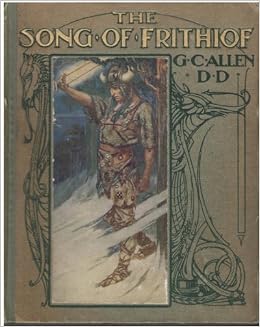
However the British reworking The song of Frithiof by G. C. Allen (1890) had illustrations by T. H.Robinson that prominently featured the now-'classic' viking horned-helmet, and seems to have been a quite popular book. Not long after that you have Dicksee's fairly well-known painting The Funeral of a Viking from 1893, which also has horned helmets in it. By 1902 it seems to have reached America where Viking Tales by Jennie Hall is published featuring horned vikings.
Meanwhile in Scandinavia though, Malmström's incomplete monumental painting of the Battle of Bråvalla has no horned helmets, nor do they feature among the ornate helmets in Carl Larsson's Midvinterblot from 1915. (but the lurs are there again) If there are any 19th century Scandinavian artists who depicted horned-helmeted vikings, I've failed to find them. (and I've looked quite a bit, this is just a selection)
So in short what I've arrived at was that the horned helmet more likely originated in British depictions than Scandinavian ones and no later than 1890. It makes sense really, since Britain's more culturally influential in general and their version of vikings was as well. (again, not to imply the version created by Scandinavian romantics was necessarily any more historically accurate)
Finally, I've seen a lot of people give Wagner credit, but I've been unable to find any images of horned helmets in 19th century Wagnerian costumes. Winged helmets a-plenty, but not horned ones.
Obviously it's impossible to go through all 19th century art, so if anyone's found any earlier examples you're welcome to help me out by posting them.