From what I understand, Bismark started universal healthcare in Germany in the late 19th century as a sort of add-on to german unification. I’m curious when and how other European nations started following suit. Which nation was the first after Germany?
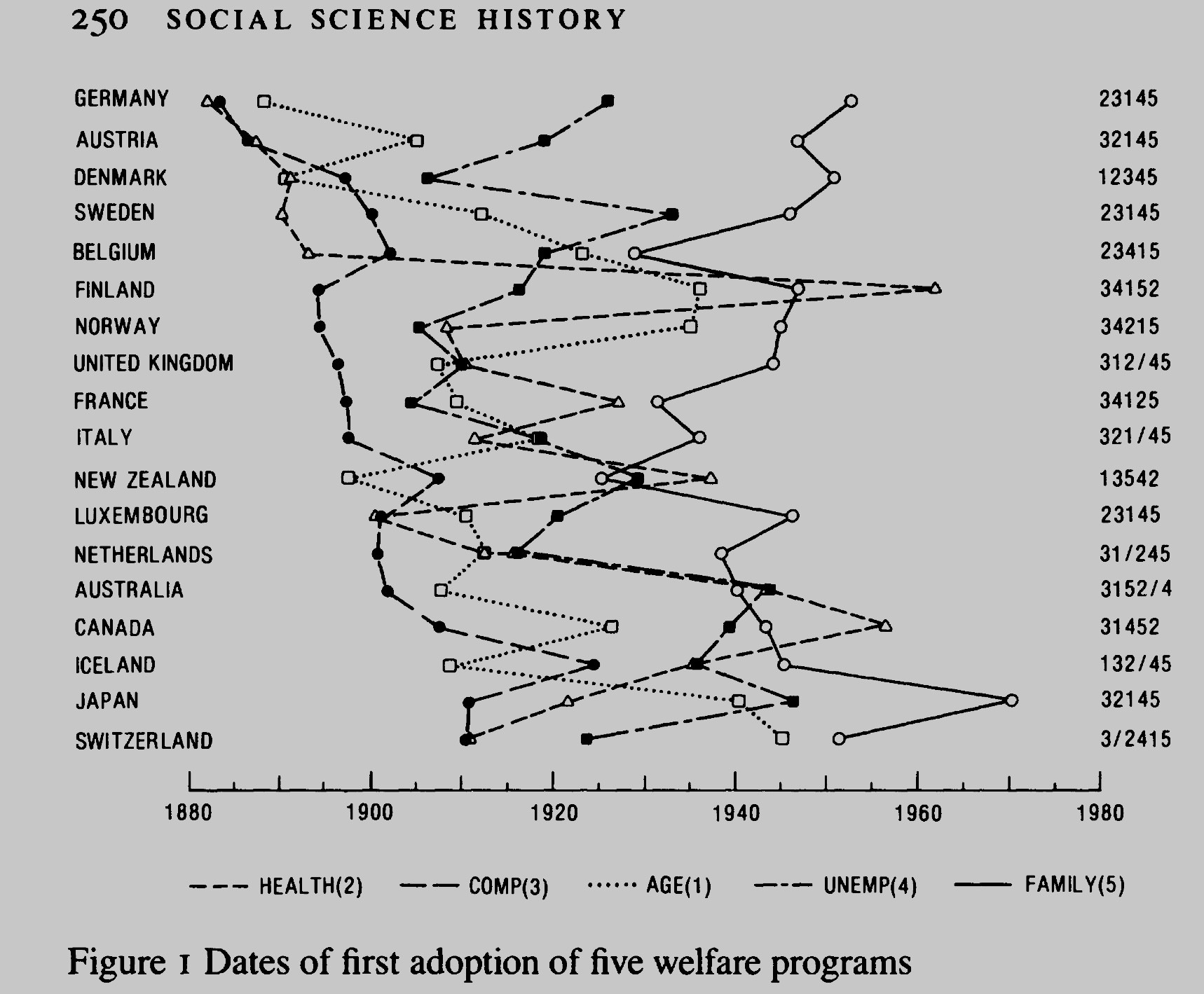
The sociologist Andrew Abbott has a paper called “The Welfare State as Transnational Event: Evidence from Sequences of Policy Adoption”. It doesn’t get much into your policy question, but it’s trying to look at the adoption of five major welfare policies in industrialized state several states (many Western European countries, plus Japan, Australia, and New Zealand). Here is his main chart, showing the different times each country in his sample passed these five welfare policies (including healthcare). He also has a table that shows the passage by welfare policy and year, for those who prefer seeing the data in that form.
Three of the policies show a clear pattern:
The picture seems complex, but certain underlying patterns are at once clear. In all but two worker's compensation, unemployment insurance, and family allowances fall in that order. In New Zealand and Australia, the last two are reversed by a small amount (four and three year, respectively).
Abbott thinks of these three programs as a single “period event”, as they are adopted not only in the same order, but over a period of less than 20-years in all the countries in the sample.
Two other major welfare state programs, health insurance (Abbot is not necessarily universal healthcare) and an old age/invalidity support (like American Social Security), show considerably more variation in sequencing. The standard theory (as articulated by Cutright 1965) argued countries go:
(1) workmen's compensation,
(2) sickness and maternity benefits (health insurance),
(3) old-age, invalidity, and death supports (pensions),
(4) family allowances, and
(5) unemployment insurance.
but Abbott finds that not to be the case.
Abbott argues there are clearly some similitaries between countries. For instance,
Diffusion models assume that countries that are close to one another ought to have similar adoption sequences. For example, national health insurance comes late in the former British colonies (Canada, New Zealand, and Australia, as in fact in the United States, to which it has never arrived). The explanation probably lies in the similarity of the medical professions involved, which are effective and autonomous bodies, unlike the quasi-civil-servant medical professions of the Continent, and which were willing and able to oppose national health insurance. This similarity in professions reflects direct "closeness," that of colonialism.
However, in terms of welfare adoption overall, Abbott found no statistical evidence of diffusion (he wasn’t using great measures and certainly there were, as he acknowledges, smaller, regional patterns). But the simple reality is looking at his chart, several countries adopted some form of national health insurance before 1900 and before all or most welfare state measures (Germany, Austria, Denmark, Sweden, Belgium) and others adopted national insurance much later, after 1930 or even after WWII and after adopting a wide slate of welfare state policies (Finland, New Zealand, Australia, Canada, Iceland).
Abbott’s hypothesis is this:
There remains the third possibility that adoption of welfare programs is essentially a world-historical process. On this view, each welfare program derives from an idea that has emerge out the developed world. First, a few countries try it perhaps a mass of countries adopt it, then stragglers finally take it up. Differences between countries arise either randomly (the world-polity view) or through some as yet unmeasured deciding a country's relation to this world-historical process (the reaction view).
[…]We may further examine these patterns by listing the c in order of adoption within the program, a listing given in Table 4. Each of the five events has a "spike," a short period within which large number of countries adopt the program. Moreover, certain countries—the Netherlands, the United Kingdom, Luxembourg —are nearly always found in the spike (four of narrowly missing the fifth in each case). Other countries, by contrast, are never in the spike; Germany, the original welfare state, and Japan, one of the last. (The United Stayes, like always but not shown here, is always after the spike). Here is evidence for the reaction view—some sort of unmeasured policy parameter characterizing each country as an adopter within the context of a world-historical process.
(Continued below)
Bismark started first with a governmental regulated pension insurance for the cases of age and invalidity in 1881 because of the Social Democrats, which were at that time the largest group of the workers movement in Germany. The Social Democrats were illegal since the laws against socialists of 1878, but they were very successful in the underground.
But this was not really something new. The first small unions had already organized insurances for workers since beginnings of the industrial revolution. The idea of having a sort of insurance originated from the guilds. The idea was always the same, collect money from everyone to cover for bad times. The framework of laws for welfare of Bismark was a systematic work to put this sector under governmental control and was a counter argument against socialists. It didn't worked well, because the conditions for workers were so bad the Social Democrats became a political important force until 1912 and the laws against socialists were removed in 1892.
Scandinavia has a different history, when the state became interested into supporting a small population. Norway had already in the early 1800s public physicians and in the 1900s governments in Scandinavia became protective. A factor was the growing support for a Social Democratic movement.
Nobody should consider Social Democrats as socialistic. Social Democrats wanted to build a national economy which is supporting workers in their struggle. Social Democratic governments were mostly protective and had sometimes patronizing traits. The common idea was, that it is impossible to avoid all risk in life, which is partial caused by the political order. Welfare or better a protective state is giving the people the idea the state is taking care in the case of an accident is happening, which gives a higher loyalty. Social Democrats in Germany didn't succeed very well in the 1930s, because of the economic problems, while the Scandinavian state of welfare began it's life in the 1930s.