It seems to me that almost all ancient drawings show the subjects from the side, without much 3 dimensional perspective. Some examples of what I mean:
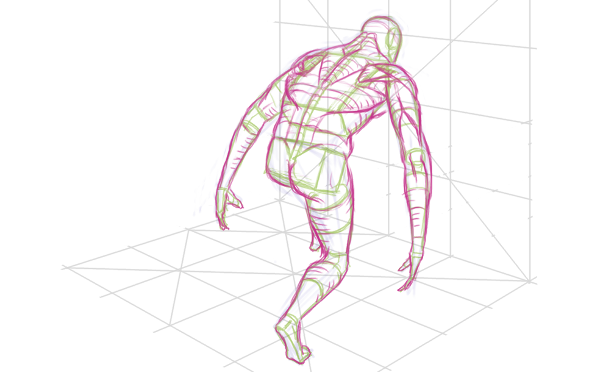
Do there exist any ancient drawings which depict their subject with realistic perspectives? For example:
https://mir-s3-cdn-cf.behance.net/project_modules/disp/126c0118109815.562c4069b96b6.jpg
http://artloader.net/wp-content/uploads/2016/07/PerspectiveGridImagination1B-600x372.png
Had ancient people simply not figured out how to do realistic perspective drawings? Or was it just not the 'style' at the time?
Disclaimer: Wow! So you bring in a number of examples from different time periods. I am not equally familiar with each of these civilizations so I will do my best to provide examples from cultures/periods that I am familiar with. I want to break down your question a bit more, not to be picky, but so that I can give an accurate answer.
Medium
In your initial question, you ask about ancient drawings but the examples you give are paintings and sculpture. I think this distinction is an important one as the medium you are interested in really helps to set some parameters for the response. For example, one of the major reasons why there aren’t many drawings depicting naturalistic subject matter is because drawings are a much more ephemeral medium and there simply aren’t enough ancient examples to give us a fair idea about stylistic choices in that particular medium.
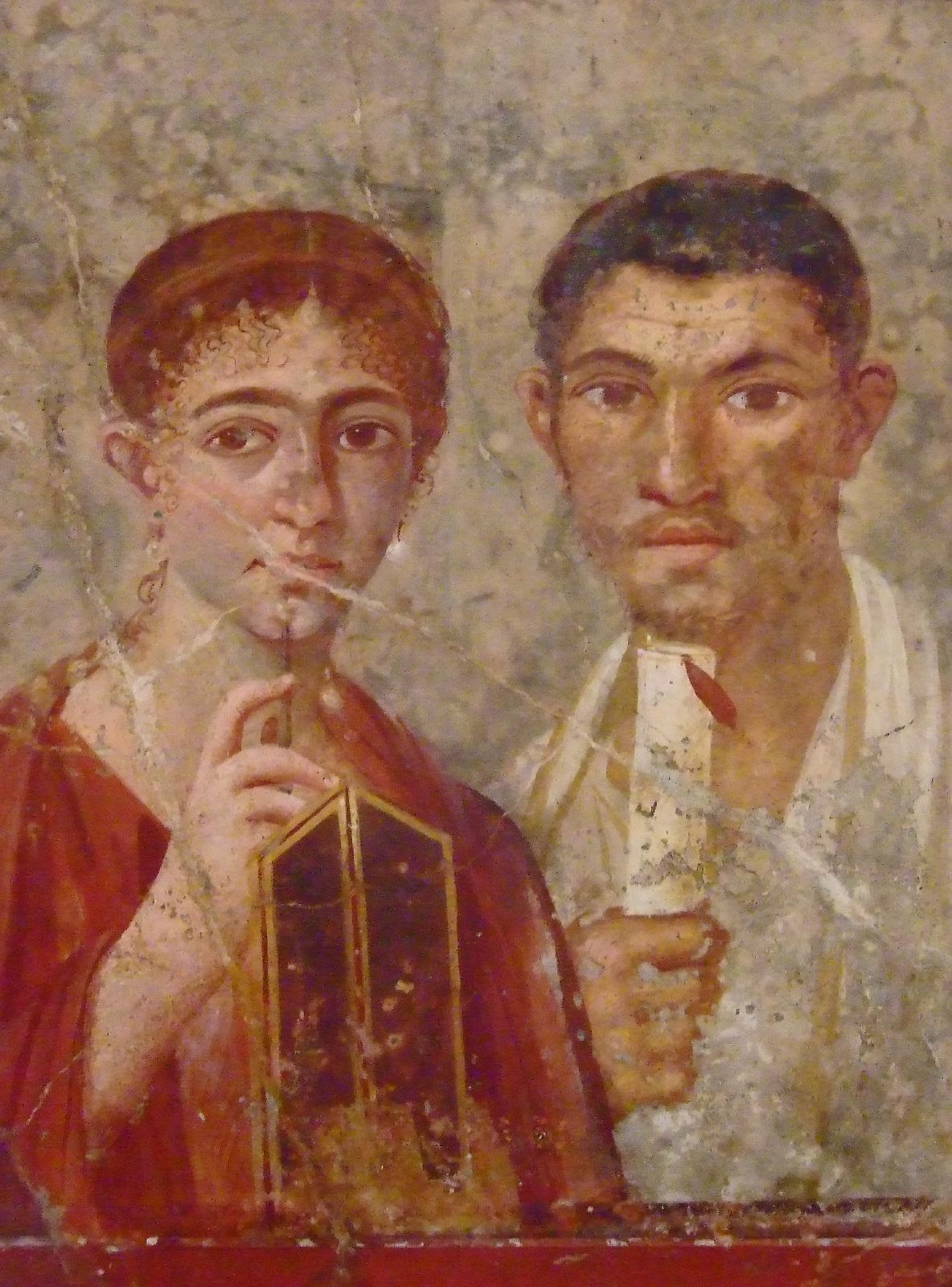
However, if you expand the criteria to, say, two-dimensional works of art, then there actually are a number of different examples of naturalistic or descriptive style. Off the top of my head, there are the Fayum mummy portraits which seem to give an individualized treatment to each of their subjects. The artists who made them also seemed to be interested in using light and shadow to give a naturalistic sense of depth. There are also a number of ancient Roman murals found at Pompeii and other sites which express a similar interest in not only naturalistic features in figures, still lives, and landscapes, but also in an intuitive perspective, especially in the cityscapes (more on this in a minute). Dating from 100 BCE, there is also the Alexander Mosaic which is thought to be a later copy of a Greek original. From these examples you can see that there are a number of examples from different cultures and time periods which illustrate an interest in.
Even more tantalizing are the stories of art that has disappeared over the course of history. In one legendary example described by Pliny the Elder, two artists named Zeuxis and Parrhasius participated in a contest to see who the greater artist was. Zeuxis painted some grapes so naturally that birds flew towards his picture and tried to eat them. His rival, Parrhasius, then painted a curtain so truthfully that when Zeuxis saw it, he asked that the curtain be drawn back so that he could see the painting. Upon realizing that the curtain was the painting, he admitted defeat. While there is likely some degree of exaggeration here, the important thing to remember is that artists have been interested in naturalism for centuries, but since painting and especially drawing are much more ephemeral than stone, we don’t always have as many examples to understand and reconstruct a given style.
Perspective
Another thing that I’ve seen pop up in questions about art and naturalism is the idea of “linear perspective.” You don’t specifically bring this up in your question but I want to talk about what it is and its relationship to naturalism. Linear perspective is defined as a specific type of perspective where an object’s size and shape is dependent on its position in relation to an imaginary point on a horizon line to which all lines converge. Linear perspective is important to mention here because it is often linked by scholars to the early modern period (although there are earlier examples) and is taken by many people to be a sort of “gold standard” in naturalistic representation. Because it is defined by a more rigid set of mathematical rules, you would be less likely to find works that meet this degree of mathematical refinement throughout history but, I would argue, that does not mean that there weren’t examples of realistic depth in the ancient world. Of the examples listed earlier, some of the paintings at Pompeii exhibit an “intuitive perspective,” which shows that the artist was painting an illusion of depth within a space, but did not necessarily use a mathematical formula. Rather, he intuited how the forms would recede in space in order to achieve a naturalistic final product.
Stylistic Choice
The “why” of your question is much more difficult to pin down. As I’ve shown, several ancient cultures did show an interest in naturalism in their two-dimensional works and we know that more works existed than we have now. It is also important to remember that the history of art is not a progression towards naturalism—it has a variety of purposes! Because of this, you should think about it not as an indicator of cultural progress but as a tool that is used for a specific artistic purpose. For example, in cultures as diverse as those of Egypt and Late Medieval Europe, it would not make sense to use purely naturalistic rendering when an artist had to denote who in the image was most important. In these cases, hierarchical proportions made more sense so that the viewer could quickly see who the central figure was. While this is by no means an all-encompassing response, it does show that the context and purpose of a work of art must be known in order to better understand when and why naturalism might be used.
u/ARHistChalAl gave a nice answer, but I'd also like to make you aware that we have a section of our FAQ that has several questions about "realism" in different periods of visual arts, which also may be of interest to you.