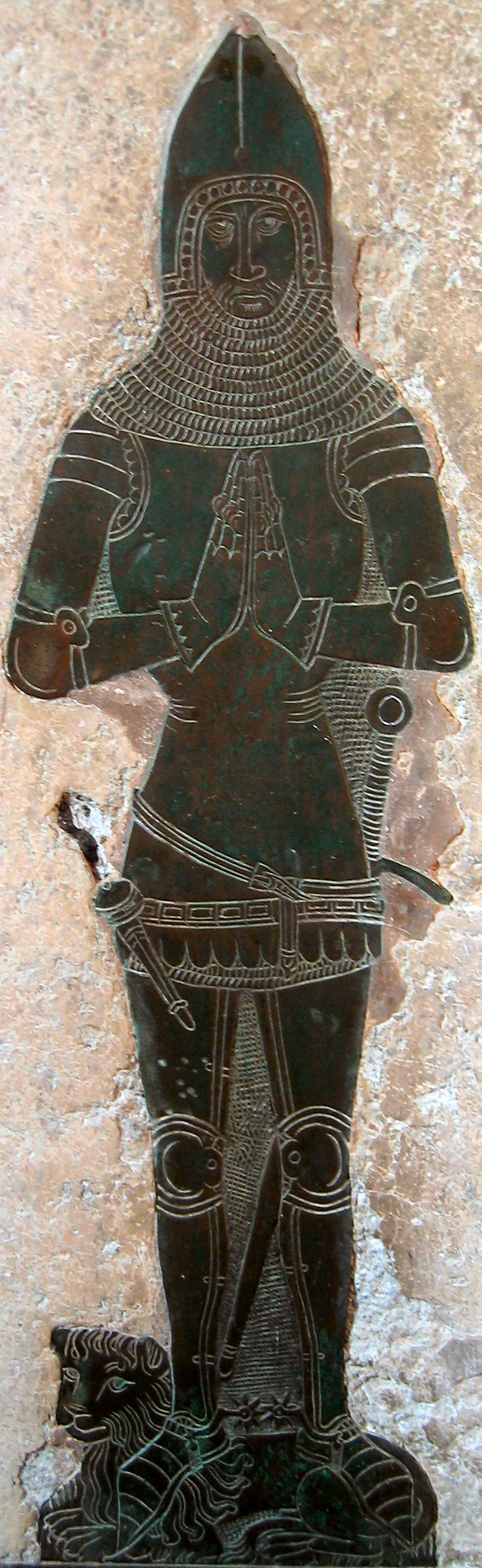
Told my girlfriend from Milan this only realising later it could be a bunch of bull as I got from a fiction book. Want to check if it's accurate or not.
Plate harnesses by the time of Agincourt were by and large very good at protecting their wearers from arrows. Note that I do not say "impervious," because no form of protection is truly "impervious" to anything in all circumstances. The visor of a helmet could be a weak point, as could perhaps the joints or other gaps. Even if an arrow had no ability to penetrate, the experience of being shot at without being able to respond is psychologically unnerving, especially for inexperienced troops. Arrows were also relatively effective at killing, wounding, and spooking horses, which could potentially take out a mounted soldier even if the man himself was never directly hurt by an arrow. The purpose of battlefield archery was not necessarily to cause immense casualties, but to disrupt the enemy line sufficiently to make their advance difficult, put them in a disadvantageous position, and ultimately enable your own battle line to win the main engagement. The English, contrary to later portrayals, did not view longbowmen as a battle-winning weapon in their own right, but used them as part of an overall combined arms approach that could, in the right circumstances, be highly effective.
As for Milanese armor in particular, /u/waritter can describe the nature of the medieval armor industry better than me. But I can say that Milanese armor in particular was not uniquely better protection against arrows than plate harnesses produced in other locations. Milan was a major production center for plate armor and its products enjoyed a high reputation, but was not the only place one could acquire armor from, nor was it the only armor capable of stopping longbow arrows.
/u/WARitter addressed something that could be helpful in this post.
Gambesons, cloth armor, may have been sufficient to resist a longbow's arrow.
I'm not a big fan of Bernard Cornwell, so I haven't read Agincourt and I don't know how he portrayed things. Based on some of his past work and his enjoyment of Robert Hardy's The Longbow, I suspect he over exaggerated the effectiveness of the longbow (I know he still believes in the ten arrows a minute myth). However, he is not the only person to argue for longbows penetrating plate armour, and there is still some controversy over this in academic circles as well.
Armour of the Early 15th Century
An important factor in working out whether or not an arrow could have penetrated armour at Agincourt is the quality and thickness of the available armour at the time. There was naturally a great deal of variety in this, but there are some general treds. Alan Williams concluded that breastplates in the late 15th/early 16th century were between 1.5mm and 3mm in thickness, while the one example of mid-15th century armour had a breastplate 2mm thick. Peter Jones, for his tests, similarly found that an Italian breastplate from circa 1470 had a thickness of between 2.03 and 2.79mm. He also examined some German and Italian bascinets from the 1370s-1380s. All four had thicknesses of 2.44-3.81mm at the top front, and three of the four had a thickness of 1.27-1.52mm on the side, back or visor. One example had a thickness of 2.54mm on the sides and back.
In terms of the other components of armour, the only examples of thickness I've found in Williams are from the 16th century.
Wallace Collection A.22 (South Germany, probably Augsburg, c 1510)
Breastplate 1.3 mm
Cuisses 0.7
Backplate 1.0 mm
Tassets 0.8
Helmet skull 1.5 mm
Collar 1.1
Legs 0.8 mm
Shoulders 1.1 mm
Estonian National Museum AM 5492/R663 (Innsbruck, 1563);
Breastplate (infantry) 1.9 mm
Backplate 1.2 mm
Helmet skull 1.4 mm
Tassets 0.9 mm
Added to this are the Italian cuisses from 1390 measured by Peter Jones, which came out at 1.27-1.7mm in thickness. In general, then, the arm and leg harnesses of early 15th century armour was likely under 1.5mm in average thickness. Clifford Rogers quotes some unpublished thicknesses of limb armour, including one from the 14th century, in the Oakeshott collection at 1-1.22mm
We also need to consider the quality of the metal used. According to Alan Williams, Italian armour of the period (1380-1440)was generally of low or medium carbon steel, and the armour was mostly hardened or there had been an attempt made to harden it. In comparison, German armour (as a stand in for Europe north of the Alps) was almost universally iron or low carbon steel, with almost no attempts at hardening it. The one composite suit of armour from the mid-15th century that can be reliably identified as German has an iron breastplate and fauld, with the arm and leg harnesses made from low and medium carbon steel, respectively. An attempt was made to harden all pieces, but only the arm harness was successfully hardened. This could indicate a special attention paid to the arm and leg harnesses to make up for their thinner nature, but it's probably just that the armour was not all originally one set.
Slag content is another important factor in determining the quality of the metal. In general, Italian armours of the late 14th had a slag content of 1-2%, while in the mid-15th century it was generally less than 1%. The one late 15th century German piece of armour that Williams has slag content for was 2.64%, but one Italian breastplate of approximately the same age had a slag content of 3.6%. So, the German armour might just have been an outlier like the Italian breastplate. However, given the predominance of iron and low carbon steel in the examples Williams has examined, I would estimate that the slag content of non-Italian armour of the early 15th century to have a slag content of 1.5-3%, probably centering around 2-2.5% average.
Finally, the way the armour was worn is also an important consideration. While breastplates and full leg and arm harnesses were in use more than sixty years before Agincourt, they were generally worn over a mail shirt. A very clear example from France from the 15th century can be seen here. It wasn't until the 1420s that we have good evidence of a solid, single piece backplate. Prior to that, armour often consisted only of a breastplate over the mail haubergeon. This means that an arrow will need to penetrate the breastplate or upper arm harness and the mail beneath before it can injure someone. The lower arms and the legs below the skirt of plates are more vulnerable, as they don't have mail underneath them, but they're also harder targets to hit and their surfaces have more curvature, so the chances of deflection would be higher.
But could arrows penetrate?
Probably not, but so far no one has performed an adequate trial.
Testing
The first significant test was published in 1991 by Peter Jones. He tested plates of "Victorian" wrought iron of 1mm, 2mm and 3mm thicknesses. These were derived from the measurements I've mentioned before. He conducted his test with a LM7/Jessop M8 long bodkin, made from Victorian wrought iron, case carburised and then hardened to ~350 VPH. This was done on the advice of Professor P. L. Pratt, whose private study had revealed that the LM16/Jessop M4 and the LM7/Jessop M7/8 arrowheads were the most common medieval arrowheads, and that the "blades" of the arrowheads tested were around 350 VPH. Whether this included the bodkins or was exclusively for the narrow broadheads is unclear, and may have been to Jones. Insufficient testing has been done to say for sure, but so far the majority of short and long bodkins have been found to be unhardened.
In his testing, Jones annealed the iron plates in order to reach a hardness more in line with what he considered the appropriate hardness (I haven't discussed his results in detail, but he believed that a hardness of under 200 VPH was appropriate based on his research) and did not supply a backing to simulate flesh, as he had been given advice that the ballistic resistance of flesh was minimal. The bow he used draw 70lbs @ 28" and his arrows, which were between 60 and 65g, all had approximately 46j at discharge. Jones found that only the 1mm plate could be penetrated more than 11mm, at 0 and 20 degrees of obliquity, but at 40 degrees penetration failed.
There have been criticisms of this test. Alan Williams was particularly critical of the use of "Victorian" wrought iron - which he took to mean "puddled" wrought iron - because of its high slag content. Depending on the direction in which it was rolled, the slag content was between 4.7% and 7.5%. This is considerably more than even the highest slag content of medieval armour found by Williams, and the low end Victorian wrought iron has perhaps twice the slag content of the average medieval piece of iron or steel. This puts the high end fracture toughness of the Victorian iron at 52% of 1.5% slag Swedish charcoal rolled wrought iron, and 70% that of the 2.2% slag Swedish wrought iron. This means that the iron used by Peter Jones was more easily penetrated than a medieval equivalent would be.
Another criticism of Peter Jones was the lack of a chest equivalent behind the plate of armour and the low draw weight of the bow he used. Paul Bourke and David Whetham conducted a series of experiments in 2005. They examined a larger body of literature and found that an unsupported plate will behave differently - in that it will be penetrated more easily - than a supported plate, and they used information from Professor Pratt's modelling of the draw weight of the Mary Rose longbows (using Dr Bob Kooi's mathematics) to conclude that the draw weight of English longbows of the medieval period were between 140 and 160lbs. Their testing used charcoal rolled iron, unannealed, in their tests, backed with ballistics clay, and used a 140lb longbow drawn by Mark Stretton. The bow had been "shot in", that is, used until the draw weight stabilised, and it had settled on 140lbs, down from 160lbs originally. The arrowheads used were made from iron unhardened, with the exception of the lozenge arrowhead, and weighed 71g (Jessop M8/long bodkin), 70g (Jessop M9/short bodkin) and 87g (Jessop M10/lozenge). The fact that the lozenge head was hardened is unusual, as the evidence in previous studies and unpublished tests by the authors themselves suggest that these heads were unhardened.
u/MI13 provides a great overview of the sharp end of this question - the performance of longbows in Agincourt, and the usefulness of plate armour in protecting against them (very useful, not foolproof, in no small part because not all of you is armoured in plate!).
In a few previous answers, I get at the other side of the question, the renown of Milan and its armourers. They were indeed famous at the time for good quality, and by St George and St Barbara did they produce armour in high volumes:
In later centuries and into the present day, the armourers of Milan are still famous. 19th century antiquarians and 20th century historians have admired the form and function of their armour, and early 21st century archaeometallurgists (namely Dr. Alan Williams) have found the Milanese armours bearing armourers marks were very frequently heat treated from the late 14th century onward. It is probably these later studies, and the contemporary fame of the armour for quality, that inspired Cornwall to insert this bit of dialog. Is it accurate? No. A breastplate need not be heat treated to stop a longbow arrow (see the comments from u/wotan_weevil and myself below) and anyway, it is quite possible that other armours from other places were heat treated as well - there are a couple of hardened late 14th century helms from britain, and a century after Agincourt the Neatherlandish armourers of Henry VIII bought a quenching trough for their Greenwich workshop, even though Williams implies that neatherlandish armourers didn't quench their armour - though in this case quenching may indeed have only come to the neatherlands in the later 15th century. Now, Williams doesn't find many 15th century hardened armours that aren't from Northern Italy (specifically Lombardy) or the southern German lands (Bavaria, Franconia, Tirol). But the sample sizes of armours from the rest of Europe in Williams' study are an order of magnitude smaller than the south German/North Italian armours that he surveys. So we can't completely count out the armourers of England or Flanders when it comes to high-quality metallurgy. What we can say is that in the non-representative sample of armours that we have, the Italian armours of the early 15th century have the best metallurgical quality - underlying quality of metal, carbon content and heat treatment - the German armourers don't catch up until after 1450.
In summary, Milanese armourer (of the better quality that carried a mark) was good, and people knew it was good. But it wasn't the only protection against a longbow arrow - indeed, a single longbow arrow wasn't the deadliest threat a fully armoured man at arms would face - the polearms of dismounted men-at-arms, the couched lances of charging men at arms and (probably) the bolts from the stronger crossbows are all more powerful and can penetrate armour more readily than the arrows from a bow.
If you want to know more about how medieval people tried to judge armour quality without having a good way to measure the hardness and purity of steel, I wrote about it here: The Importance and Illusiveness of 'Good Steel' in Medieval and Early Modern Armour