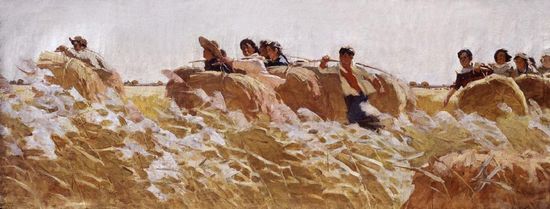
I listened to an audio lecture by historian/ political scientist Richard Baum in which he described a painting that ostensibly seemed to portray a happy harvest in the form of socialist realism but upon closer inspection was anything but: the "hills" in the background were the corpses of Lenin and Mao, a broken red flag lied on the ground which symbolized the failure of the people's communes, and "randomly" scattered wheat stalks in the foreground spelled out in Chinese "Long Live Jiang Jieshi".
Unfortunately, the artist is unnamed and I've tried searching for it online but with no success. Can anyone help me find this. I really want to add this picture to a powerpoint presentation I'm working on.
Mods, I understand that my comment is not necessarily in compliance with the policy of AskHistorians. Since what OP asks is really a niche topic, I suppose finding accurate scholarly sources in English is not an easy task. But please feel free to remove it.
I'd like to dispute the veracity of OP's claim.
The magazine OP refereed to is China Youth (中国青年). The artist's name is Li Zehao (李泽浩). The painting, titled Ni Zhui Wo Gan (你追我赶), can be found here.
While I wasn't able to find an English scholarly source, I did manage to find an article (in Chinese) written by Nie Chongzheng (聂崇正) 50 years after the affair. Nie claims that he witnessed the whole affair, and the article is based on his personal experience. Nie was a college student back then and a reader of the magazine. I also note that Nie's account seems to be consistent with other accounts in Chinese, which gives me confidence in its reliability.
According to Nie, soon after the publication of the painting, a rumour that the painting contained hidden anti-communist messages, allegedly uncovered by some military officer (possibly a reader of the China Youth), started circulating, and political witch hunt ensued. According to the Baidu Baike (a Chinese online encyclopedia similar to wikipedia) entry for the painting, the initial investigation concluded that the painting contained no hidden message whatsoever. However, after several CCP culture and propaganda tsars fell from grace in the Cultural Revolution, the verdict was reserved and the painting was banned. The ban was eventually lifted in 1978 when the Cultural Revolution was over.
What happens to the artist Li Zehao can be found from his biography (in Chinese). Li was a student at Lu Xun Academy of Fine Arts (鲁迅美术学院) when the painting was published. After graduation, he worked as an instructor and eventually became a professor there.
PS: English sources about the painting seem to believe it does contain anti-communist messages, which could be due to outdated information and a misunderstanding of the historical context.