Also, Pinochet opposed Argentina in the Falklands War. So how much did the SA military governments really ally with each other under "Operation Condor" or otherwise?
I am not a historian, so since I can't answer anything with too much detail I'll give you a brief rundown of the dictatorship in Brazil. After the end of World War II the world was split into two: East and West. This marked the beginning of the era called the Cold War. Brazil was naturally not only by geographical position but by historical affinity with the ideologies aligned with the capitalist block under the leadership of the U.S. After the war ended and the previous dictator Getúlio Vargas had been ousted from power.
Getúlio had come into power after the so-called 1930 revolution, a movement by the elites from the southern states, mainly Rio Grande do Sul, to end the stronghold that the southeastern elites of Minas Gerais, São Paulo and Rio de Janeiro had over the federal branch of government. After many revolts, including a civil war in São Paulo in 1932 against the federal forces, Getúlio decided to tighten his rule over the country and inspired by the new-fangled fascist regimes in Italy, Germany and Portugal turned his "revolutionary" government into a cult of personality, the Estado Novo or New State. His guiding principle, not unlike that of Péron, was of populism. He modernized the industries, shifting Brazil from a mostly agrarian economy to an industrialized one, introduced new rights for the working class, such as the 40-hours/week regime and granted women the vote. In spite of the popularity there also crackdowns on dissenting opinions. One of the most famous examples was the persecution of intellectuals associated with communist activities such as writer Graciliano Ramos, and the leader of the Communist Party of Brazil Luís Carlos Prestes, famous for his Prestes Column that traveled the impoverished northeast in the 1920s against the federal government fighting for education for all, the right to confidential vote among others. Anyway, Getúlio had personal affinities to the fascist movements and there was some speculation the Brazil might join the war with the Axis, but eventually through american pressure, Brazil joined the allies. Of course, the irony of a fascist-inspired dictatorship fighting against its inspirations was not lost on the home front and after the war ended Getúlio was ousted from power following a military coup, the second of Brazil's history.
So, following Getúlio's exit the country was divided on the issues of the capitalist/communist struggle. Obviously the elites and upper classes were interested in continuing to approach the US and developing its economy, however the intelectual class was very much aligned with communist ideology, many writers being members of the PCB such as Jorge Amado, others just expressing sympathy like Carlos Drummond de Andrade. This push and pull of forces eventually came to a head in 1960 with the election of Jânios Quadros for president and João Goulart of the opposing party for vice-president (If there is one thing brazilians like is to mimic the United States, and so just as the american republic began with different tickets for potus vpotus so did the United States of Brazil).
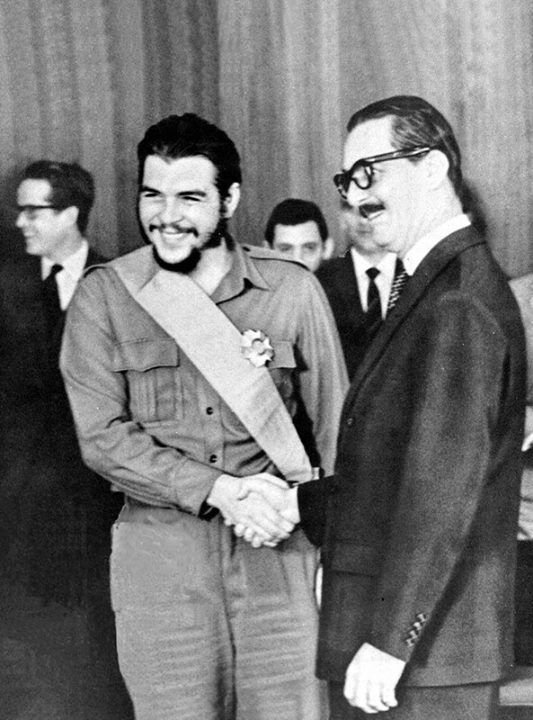
Jânio was a very strange man. He was an outsider, wasn't part of the established elites, was not a media mogul and despite being a conservative, outlawing gambling and forbidding bikinis, also established relations with the Soviet Union and gave Che Guevara a medal. In his famous jingle he vows to sweep away the corruption of government. Needless to say this weird mish-mash of politics pleased neither left nor right wing and Jânio resigned in 1962 citing "terrible forces" that worked against him. The rumour that persists is that Jânio thought he was so popular that the populace would demand he'd be reinstated and he would have a grand return, similar to Getúlio's when he was democratically elected after his coup, but it never happened. Instead João Goulart took office in 1962 and his left-leaning views would not please the conservative wings of society leading to the coup in March 31st, 1964.
So this was my quick rundown of the events leading to the longest military dictatorship in Brazil, I'll try to finish it later with the actual meat of your question. I'm sorry for the rambliness and incoherence but I don't have much experience answering things on this sub, and english is also not my first language. Thanks for reading so far.