I’m basing this question off of an unanswered post that I thought was interesting:
The painting /u/SevenSixTwoZeroSeven brought up, The Emperor Napoleon in His Study at the Tuileries by David, is not really emphasizing the Emperor's crotch. It might look like that to twenty-first century eyes, but such an interpretation of the painting runs counter to both eighteenth-century fashion and the actual political purposes of the painting.
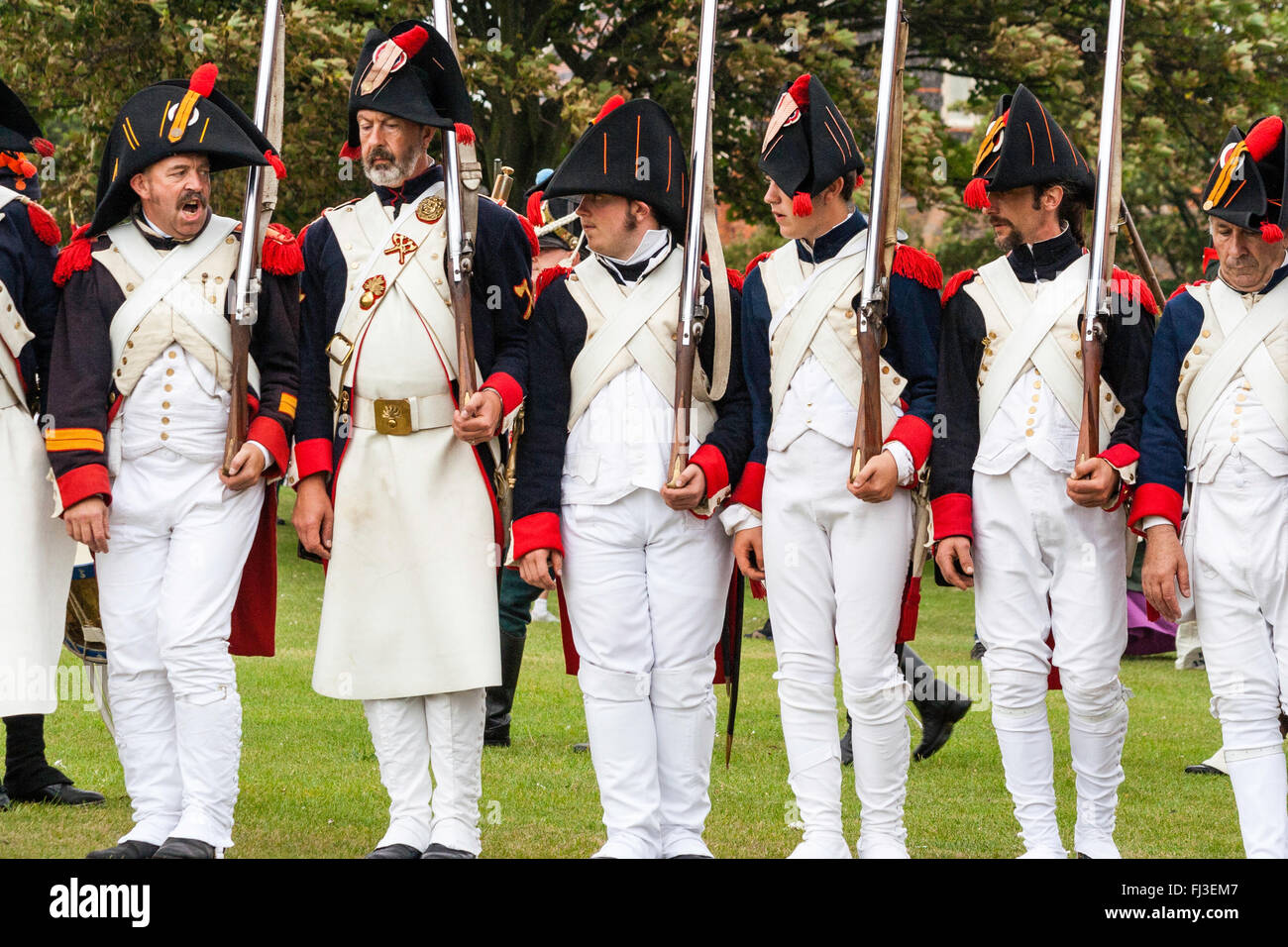
The military breeches of the Napoleonic era had a rather large area in the crotch with a very high waist (apologies in advance, I am not a fashion historian like the fantastic /u/chocolatepot so my terminology here is rather simplistic). This preserved example provides some idea of the military fashion in pants and this diagram of an 1809 French breeches imparts some idea how men of this era put on these pants. The design of the breeches makes it much easier to form a bulge if one leg is placed in front of the other. This is evident in a number of reenactor photos, such as this one of the Guards, or this marching photo. This rather pleasant reenactor photo has the benefit of mirroring Napoleon's pose in question and there is a bulge that starts at the bottom of the crotch. When the legs are parallel, the crotch region is rather nondescript as in this photo of Grenadier Burg, one of the last surviving veterans of the Napoleonic Wars. But when the legs are not parallel the design of the breeches makes the material form something of a bulge in front.
The visual language of the David painting also works against the idea of an enhanced crotch. The Emperor Napoleon in His Study at the Tuileries was not an idle vanity portrait but rather a painting that sent a political message. One of the central motifs in Napoleon's cult of personality was that the Emperor was a sober workaholic devoted to the running of the French state. This broadsheet comic from the Hundred Days illustrates this; a abstemious Napoleon takes a single egg for breakfast while his table is filled with paperwork while the corpulent Louis XVIII indulges in a gluttonous feast while ignoring the needs of the state.
David's painting fits into this genre of Napoleon's self-presentation. Much like the above cartoon, David shows Napoleon at work. His desk has the Code Napoleon, the law code Napoleon created, along with several other papers. Napoleon has put down his sword, seen on the chair, and taken up his quill pen, which is visible on the left side of the painting. The quill pen is no idle prop but has ink on it and it has been placed there almost absent-mindedly. Above the pen is another symbol of the Emperor's work habits. One of the desk's candles has burnt out and its compatriot is about to lose its wick. To reinforce the point, David has also painted Napoleon's clock as being at being a quarter after four in the morning. Napoleon would often emphasize that he was a working sovereign who began his mornings early and worked well into the night. Napoleon's own costume in the painting also shows a man at work. His cuff buttons on his left hand are unbuttoned and his leggings are wrinkled. Napoleon's hair is also disheveled and his overall pose is semi-formal. The overall message of The Emperor Napoleon in His Study at the Tuileries is that this is a monarch that means business.
This leads to the question of whether or not Napoleon was vain. Well, of course he was. Few people can rise to his heights and not have something of an ego about them. Napoleon the workaholic was only one genre of imperial portraiture. David's Napoleon Crissing the Alps had the young Consul following in the engraved footsteps of Hannibal and Charlemagne. Ingre's painting Napoleon on his Imperial Throne featured an ermine-clad Napoleon with the regalia of Charlemagne. Napoleonic propaganda drew explicit parallels between Charlemagne and Napoleon, ranging from Bertrand Andrieu's 1806 bronze medal showing the two in profile or the imperial coronation regalia (crown, the hand of justice, the scepter, and the sword) which were said to have been Charlemagne's or inspired by him. Despite the fact that Napoleon often emphasized how he rose to Emperor on his own talents, his status as a coming from a provincial Corsican noble family did make it hard to equate the Bonapartes' with the same level of prestige as a Habsburg or a Romanov. There was a notable effort to connect the Bonaparte family to the Merovingians and to Charlemagne. There also an attempt by the French state to elevate Emperor's divine namesake, the Saint Napoleon, into a major feast day in the Catholic liturgical calendar. Even though Saint Neopolus was an incredibly minor and obscure Egyptian martyr, Napoleon elevated to a level equivalent to major saints in Catholic theology. When Napoleon created the Legion of Honor on his thirty-fifth birthday in 1804, the military spectacle of the Boulogne camp was matched by Napoleon's use of artifacts from the French past- he sat on the Merovingian king Dagobert I's throne and had the armor and breastplates of other French heroes and non-Bourbon kings from the previous centuries. Likewise, when Napoleon crowned himself the King of Italy, he used the Iron Crown of Lombardy which dated back to the early medieval period (and I guess Napoleon got that CK2 achievement!).
All of these forms of presentation do speak of an ego that likened itself to the greats of European history. Even Napoleon the workaholic does speak to a desire to be seen as different from and better than his contemporary monarchs. So there was some degree of self-interested vanity at work in Napoleon's portraiture, but such vanity did not really extend to emphasizing Napoleon's nethers.