So, context:
The church is the Dome/Cathedral of Lund.
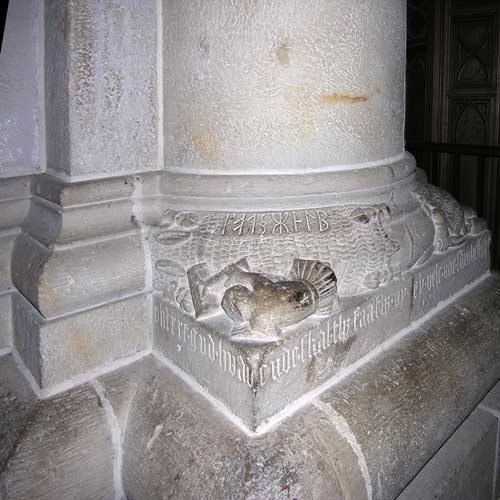
The inscriptions were made in 1525 by the German mason Adam van Düren as he had finished his extensive renovation of the building.
Inscription 1: van Düren is apparently lamenting what an enormous task he just completed.
Pic. 2 The inscription on the "skin" in the middle of the picture apparently says (freely translated)
He is surely an ass/ Who takes upon him more than he can bear.
The inscription at the base of the pillar (under the sculptures) says
O Lord, what end will it bring, when we our own fragility do not comprehend.
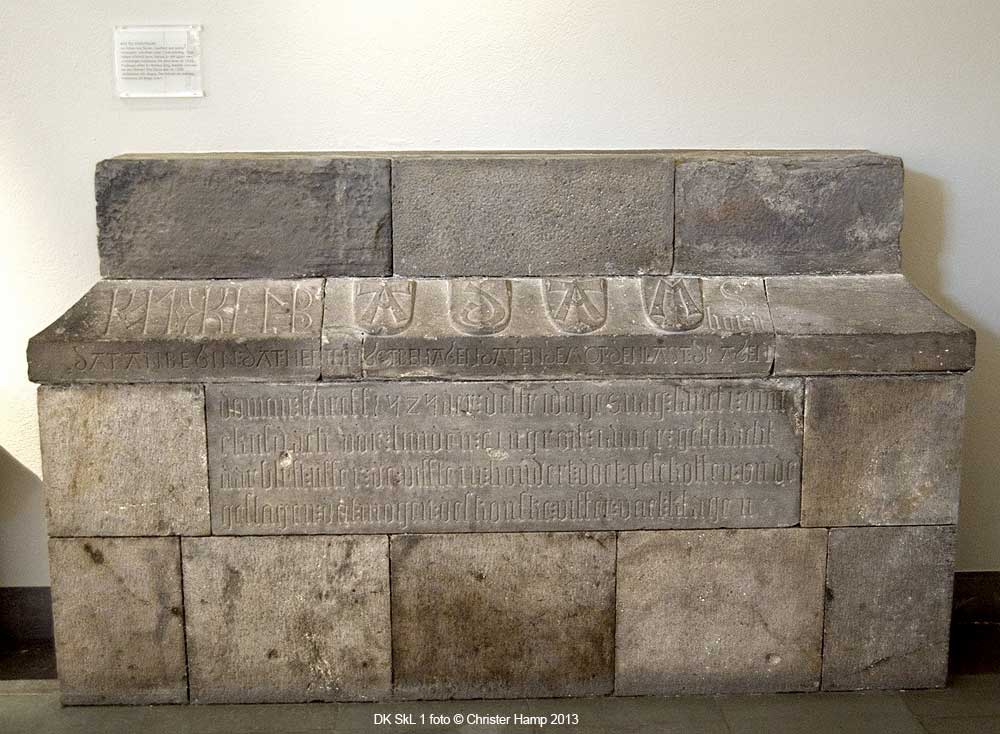
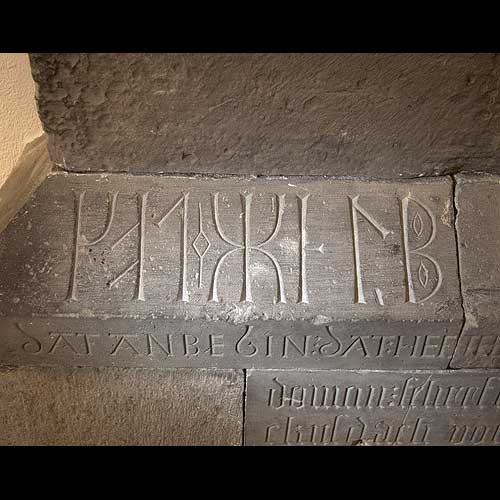
Inscription 2: From the base of a pillar that now stands in the nearby museum connected to the Cathedral, here van Düren complements "GOD HELP" with "children of Adam" (in Latin letters). This inscription is a commemoration of a nearby battle/massacre during a peasant's uprising the very same year van Düren finished his work at the Cathedral.
GOD HELP the children of Adam; the beginning is easy, the end is arduous. When this was written in 1525, the Friday after s:t Mark's day, there was great lamentation in Lund; there over 1500 were shot dead and beaten; over that, the women of Skåne may wail.
Pic. 2 Close-up of the runic inscription.
So QUESTION:
Why runes? Seriously, why is "God help" written in runes?
This is a really interesting question that might be too specific to find an answer on this sub (though I hope not!). There's a few factors at play. First, the second example clearly bears Adam's signature, as he carved his name with similar characters at Glimmingehus ca. 1500. Adam seems to have been fairly well known, so he might have hoped that his name would have drawn attention to this text. Alternatively, it might suggest that this text communicated something that Adam felt was personally important to him.
Second, this isn't the first time that Adam combined his signature with runic-shaped characters. On the of the Lund Cathedral baptismal font/well in the crypt (really cool interactive tour here), Adam has carved his name as a signature next to runic characters ISIO, which have been interpreted as representing the date 1514. This is paired with an image and text (and I'm translating from a Swedish translation, rather than the font itself): "The hungry louse bites the sheep, that's certain. God help the sheep who is scabbed, who is scabbed and cannot scratch, for which the hungry louse must rejoice." Anita Larsson of the Lund Cathedral interprets this as a symbol of the devil attacking the innocent, but hints that Adam may have intended something more specific about the church and society. "Mats Medeltid" suggests that this represents conflicts between peasants and the nobility. I'm no expert on the history of Scania in the early 1500s , but it seems that Adam wanted to heighten awareness among the flock of Lund cathedral—presumably Scania's peasants—that they were being bled dry and chafing, whether by the church, by the nobility, or by conflicts among the various kings who wanted possession over Scania.
This brings us to your first example, where Adam placed a runic invocation to God along the inscriptions: "He is surely an ass / who takes upon him more than he can bear" and "O Lord, what end will it bring, when we our own fragility do not comprehend." This echoes the sentiments Adam expresses on the well wall, warning his readers about unappreciated burdens that threaten to break them. And the runic letters help connect this carving to the well wall, creating visual harmony and a coherent message throughout the cathedral.
With your second example, Adam placed the runic invocation alongside a lament for a peasant massacre of 1525. This seems to be the flip side of the the well and your first example. The lamb has now risen up against the louse, but it hasn't gone well. Perhaps Adam felt responsibility for encouraging the revolt, since he calls the dead peasants "Adam's children." And again, he may have taken similar considerations to the pillar, trying to create harmony throughout the cathedral, balancing his calls to revolt against his lament for the result, and unifying the two with the repeated use of runes.
But why employ runes? He could have achieved similar unity through any other motif, for example repeating the image of the louse. I suspect that runes had a particular meaning in Scania in the early 1500s, although I can't say exactly what. One of our latest medieval texts written in runes is the Codex Runicus, a Scanian law book put together around 1300 and would eventually end up in the hands of Ole Worm. So it's possible that medieval runes were seen as a distinctly Scanian expression of identity (probably regardless of the fact that Viking-Age runes were more widely used).
According to the English Wikipedia page on the Codex Runicus (and unfortunately I can't check the source for note 3), Olaus Magnus—who was a contemporary of Adam van Düren—believed runic texts were associated with the Swedish Catholic church, most notably including at Uppsala. It doesn't necessarily matter whether this claim was true as long as at least some people believed it to be true. If so, then maybe Adam's use of runes in Lund were meant to encourage a pro-Swedish and/or pro-Catholic peasantry in Scania.
TLDR Again, the religious and political events of 1500s Scania are far outside my expertise, so I can't unravel the precise implications of Adam's use of runes. However, it seems like Adam used runes to signal his interest in a pro-Sweden or pro-Catholic agenda. The accompanying carvings and text suggest that he was targeting Scanian peasants, although it's possible that merchants and even minor nobility might have sympathized with the victim lamb as well. The choice of the phrase "God help" may have merely been a convenient invocation, especially since it appears on many of the runestones that survived from the Viking Age (typically as part of the phrase "God help the soul of ...").