It seems odd to me that cradles developed in Mexico and Chile, but not North America, where the native people would have first encountered usable land. Probably a stupid question, but there a plenty of lush river in Canada & the US, so I'm just curious.
The term "Cradle of Civilization," often used to refer to places such as Mesopotamia where so called complex urban societies arose, is quite the loaded term. While it is not a phrase to be used exclusively to one area or another, it does impose an "othering" of places outside said cradle and leads to problematic conclusions since it is often based on generalizations, further resulting in the foundations of such arguments using stereotypes. In this case, that Turtle Island (North America) Indigenous groups did meet these supposed requirements to be a "Cradle of Civilization." Certainly to the Indigenous peoples, their civilizations were the cradles of life, both in the sense of where they were placed and in their standards of what constitutes a "civilization." The phrase has formed an identity around an area that has a deep history and that many people view as the birth place of urban complexity, lending itself to the exclusion of other interpretations. Let's consider several examples.
In this post, I explain how the concept of sovereignty was and is part of Native American political thoughts. In doing so, I highlight several examples of Indigenous civilizations and then go into one specific example. Here is a relevant portion, though, to establish that Indigenous groups in what is now the United States (and can apply to Canada) had what could be considered by past and contemporary standards to be "civilizations:"
In North America, for example, the Indigenous Hopewell Culture overlapped with the Indigenous Adena Culture and covered enough land that it extended from the Great Lakes to the Gulf of Mexico.[In North America, for example, the Indigenous Hopewell Culture overlapped with the Indigenous Adena Culture throughout the Ohio River Valley, connecting with various spots through a vast trade network and spreading Hopewell Culture enough that it extended from the Great Lakes to the Gulf of Mexico.] They lived in permanent communities and practiced horticulture. What set them apart from many other cultures is that they built monstrous earthen monuments. Tens of thousands of these mounds have reportedly been built across the country. Commenting on them, Stannard (1992) says (bold mine) “No society that had not achieved a large population and an exceptionally high level of political and social refinement . . . could possibly have had the time or inclination or talent to design and construct such edifices” (p. 18).
On the East Coast of the United States, the Haudenosaunee, commonly known as the Iroquois Confederacy, operated a complex government structure with a functioning constitution, known as the Great Law of Peace, and an alliance between several nations. Their constitution even inspired elements of the United States Constitution (Johansen, 1982). The Haudenosaunee designated the lands within their boundaries according to the traditional homelands of the Tribes that comprised the alliance, but noted that these boundaries existed because of linguistic differences, not a separation of national boundaries via politics. To accomplish this, it was recognized that each of the comprising Tribes had to relinquish some of their existing sovereignty to the other nations of the Confederacy. (Notes, 2005).
The Maya civilization “governed fifty or more independent states and that lasted in excess of 1000 years” (Stannard, 1992, p. 37).
Of course, the notion of "Cradle of Civilization" is connected to resources, as you pointed out. While we can see that Indigenous groups in North America had high functioning societies before colonization, we need to know that they were sustainable. In this answer here, I explain that for my people, we were semi-nomadic, sustaining ourselves on game, fish, and gathering edible food from our natural environment. Moving slightly over, close to the Pacific Northwest region of the United States, the abundence of food there is practically considered legendary.
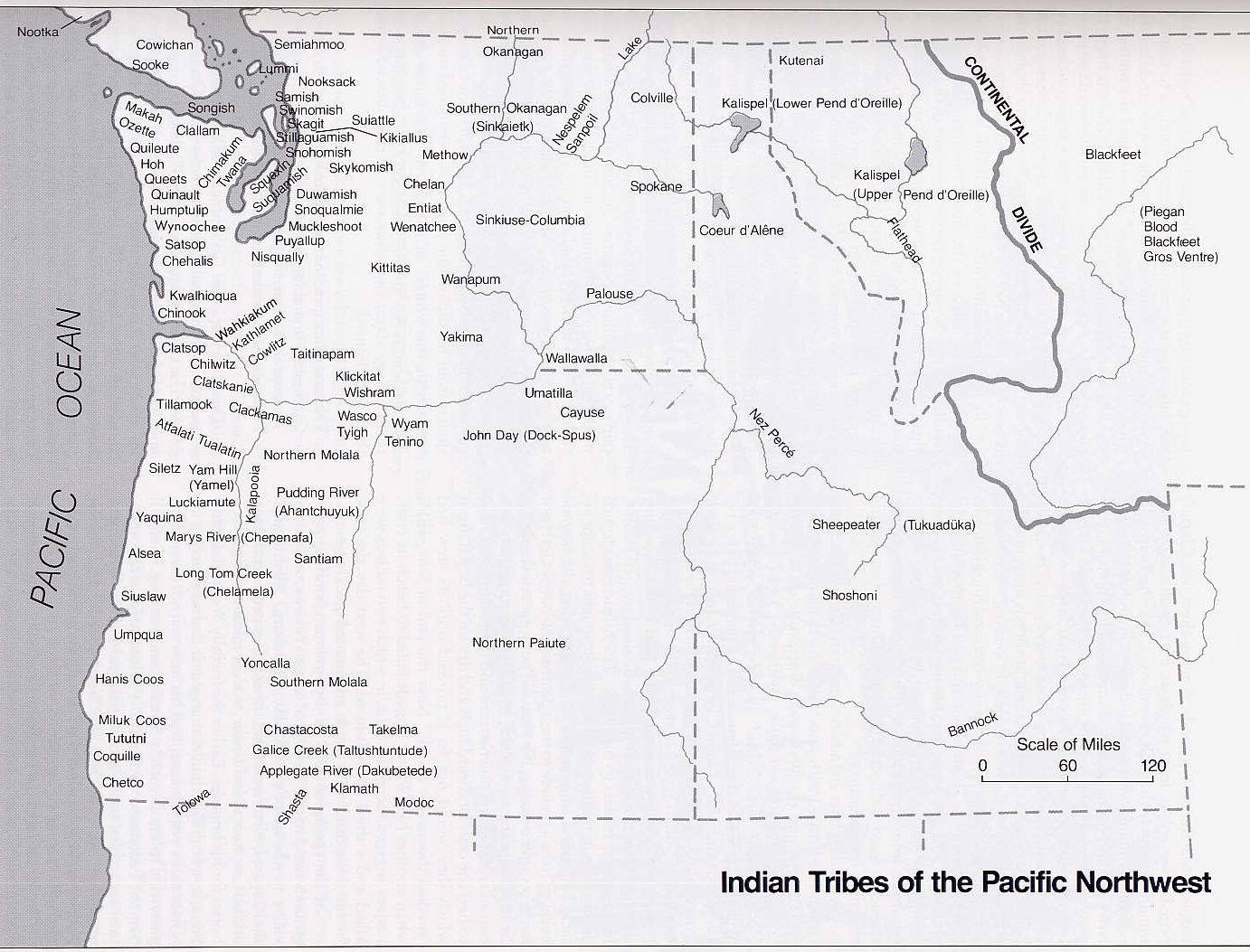
The Pacific Northwest Tribes, like the Puyallup, the Makah, Duwamish, Nisqually, Quinault, Chehalis, Suquamish, and many more, thrived on the variety of food and plentiful resources of fish, shellfish, and wild game. The rivers stemming from the mountain ranges, such as from Mt. Tahoma (Rainer), provided salmon fishing runs that penetrated deep into the land to create lush and bountiful areas for sustaining life. Because of these resources, numerous Tribes existed throughout the region. This map shows traditional territory of Tribes across the United States and zooming into the PNW area identifies how many Tribes were and are located there. This map is a bit more specific and breaks it down even more, but doesn't list exact boundaries. The Tribes here had complex political social and family units, sophisticated understandings of their environment, and utilized many of the natural resources to give rise to their civilizations and carry on their peoples. Because of this, we don't see a strong tradition of farming/agriculture in this area. There simply wasn't a need to develop these methods since the environment was providing more than enough. Much of the farming in these areas prior to colonization would have been relegated to little more than gardens. However, as noted in one of my previously linked answers, it was this hunting-gathering lifestyle that also led to more controlled population sizes.
Besides the ones noted in my comment here, there are many more examples provided on the subreddit, which can be located in the FAQ. /u/RioAbajo describes here some of the issues I've addressed as well, in that myths and stereotypes have cropped up that paint North American Indigenous peoples as lacking technological advancements and how that really isn't the case while also noting the role of access to resources in determining structures of these societies. /u/The_Alaskan writes here about different approaches to understanding the "progress" of development for civilizations and how, based on circumstance and location, even Europeans could have been considered "behind" when compared to Indigenous Alaskan peoples. And finally, /u/Reedstilt hits home with some of the more widely known examples of complex civilizations in North America, an example being the Poverty Point Culture.
So what can we conclude? The term "Cradle of Civilization" is problematic. In short, here's why:
If we judge things by the standards of Indigenous groups, areas around North America certainly can be considered "Cradles of Civilization," for they gave birth to their cultures and allowed them to thrive, develop, and grow. Of course, these societies didn't just spring forth in some sort of stochastic event, but they did develop in their own ways to meet the needs of their cultures and environments.
Edit: Adjusted a statement on the Hopewell Culture, identifying their cultural influence stretching to the Gulf of Mexico. Corrected a word, I misspoke when I reference political complexity, I should've referenced social. Also eliminated a sentence regarding small time gardening. I wouldn't be able to back that specific point up with a credible source.