Hi, /r/askhistorians!
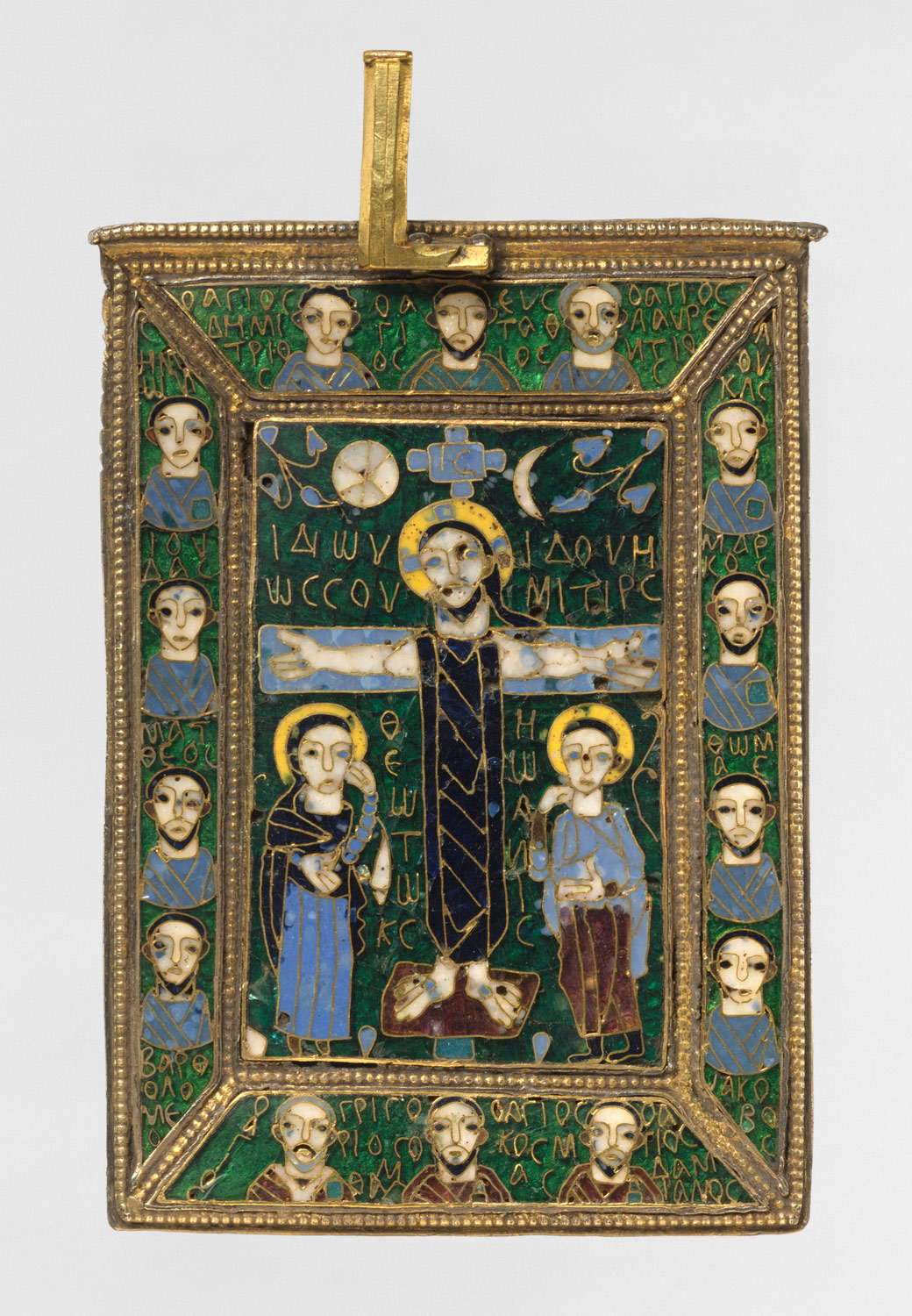
I was deep in wikipedia the other day, and came across this reliquary, which purports to contain a fragment of the true cross. I don't want to debate the historicity of relics of the cross; I just can't read the thing!
My Greek is extremely limited - I took one semester (pass/fail no less) of NT Greek my senior year in college. But as I study - for my own edification - ancient Judea and the Apostolic age, I do run across a lot of discussion about the Septuagint and the early texts of the New Testament. When it's in a book, and printed, I am familiar enough with the characters to usually puzzle out the pronunciation and make a guess as to what words in English it may be related to.
But looking at this beautiful piece of art, I don't even recognize some of the letters! The Met has, at this website, a more in-depth explanation of this piece, including a translation of the markings. It says "Inscribed in Greek: [On lid] Here is your son...Here is your Mother (on either side of Christ's head); Jesus; Mother of God; John" (and then goes on to talk about the border and the sides). I can't make any of that out.
Around the main figure, for example, I see: ιδων ωccον and ιδονμ μιτιρc - and I don't recognize the 'c' characters - much less am able to make sense fo it, even though I know what it says (google translate, in modern greek, translates it as "Εδώ είναι ο γιος σου, Εδώ είναι η Μητέρα σου").
Can anyone point me in the right direction?
This one is indeed a bit tricky. The artist really plays fast and loose with how the Greek words are usually transcribed. Apparently he used the letters omikron and omega as well as iota and eta more or less interchangeably. He also leaves out some letters probably because of the lack of space. The letter that looks like ‘C’ is a sigma. It was written this way since the Imperial Age. With this in mind let’s see what we can decipher.
Above Christ's head are the letters iota and sigma, short for Iesos = Jesus. The script on both sides of his head are excerpts from John 19,26-27. In the Byzantine type of the Greek bible text they read like this: Ἰδοὺ ὁ υἱός σου. Ἰδοὺ ἡ μήτηρ σου. / Idou ho huios sou. Idou he meter sou. = Behold, your son. Behold, your mother. A mosaic from the 11th century monastery of Hosios Loukas can show how they were usually transcribed in Byzantine depictions of the crucifixion. The words υἱός / huios (= son) and μήτηρ / meter (= mother) are shortened into υς / us and μηρ / mer which is indicated by the wavy line above. Besides that both sentences read like they do in the bible text. Our reliquary on the other hand is a little strange as it writes the word Idou once with the letter omega (ω) and once with an omikron (o). The word υἱός / huios is represented rather unclearly. I’d say it reads like this: UIC. That would mean the artist left out the letter omikron. Also the article ὁ / ho that should stand in front of it has apparently been left out. The word μήτηρ / meter is written as MITIR and the final word σου / sou (= your) is shortened into a single sigma.
The word between Mary and Jesus is her title of Θεοτόκος / theotokos (= mother of god) but it is written as ΘEΩTΩKC / theotoks meaning the first two omikrons are replaced by omegas while the last one is just left out. On the other side we see John’s name in Greek, Ιωάννης / Ioannes but it is written as HΩANIS. The letters eta and iota are switched out for each other and one nu is left out.
The border is decorated with busts of saints (top and bottom ) and apostels (left and right), all of them named. For the saints it always starts with ὁ Ἅγιος / ho Hagios (= the saint). The top shows Demetrios (ΔHMITRIOS / Demitrios), Eustathios (EUSTAΘIOC) and Lawrence (LAURENTIOC). The left saint on the bottom is named ΓRIΓOPIOS O ΘAUM which has to be Gregory the Miracle-Worker (Gregorios Thaumaturgos). Right beside him are Kosmas (KOCMAC) and Damianos (ΔAMIANOC). The apostles on the left are from top to bottom Simon (CHMΩN), Judas (IOUΔAC), Matthew (MATΘEOC) and Bartholemew (BAPΘOΛOMEO). On the right are Luke (LOUKAC), Mark (MAPKOC), Thomas (ΘΩMAC) and James (IAKOBOC).
Look on the sides. The letters that look like C are Sigma
Second from the top on the right is Marcos and below him is thomas (theta and omega start his name)
I want to share more but my friend just arrived so I will get to it later.