So I have been reading on cavalry a little bit, Including a couple of answers from Iphikrates, but I am still at a bit of a loss when it comes to understanding cavalry tactics.
I read the rules, but I'm not sure if I can lead the question, if I can; I have read claims of particularly the Hetairoi fighting on a wedge formation and leading charges, but them having a sort of throwing lance and a short sword kind of lead me to think it would be more of like a light skirmishing cavalry unit. And I am not convinced on the effectiveness of a charge of a unit of cataphracts or hetairoi without them having stirrups.
The most forceful argument for ancient shock cavalry is presented by Philip Sidnell in his book Warhorse: Cavalry in Ancient Warfare.
In it, he points out that while stirrups are handy, they are by no means necessary for shock cavalry; good riders largely don't need them. Early Modern cavalry, which fought with stirrups, often trained without them, and most modern riders will tell you that if you need stirrups, you're not a very good horseman. What's most important for the couched lance of medieval fame is a good saddle, rising high in front and back to make sure you stay in place. That said, even the saddle isn't that important; the Germans in Caesar's army fought without them, and repeatedly defeated the Gauls who did ride in good saddles. Moreover, there are ways to wield a lance besides couching that have proven quite effective, and do not require the medieval saddle or stirrups.
The lance of the Companions was not a throwing weapon; you can see in the Alexander Mosaic the thing is like twelve feet long, wholly unsuited to throwing. While Xenophon advocated the use of dual purpose spears, that could be thrown or used in melee, he was arguing against established Greek practice of carrying lances, and the Macedonians don't seem to have listened to him. I'll also note that if the ancient horseman was in danger of falling off his horse without stirrups, Xenophon didn't seem to get the memo, as he advocated the use of short, heavy slashing swords from horseback, which would require the most careful balance to use.
Moreover, Arrian describes the climax of the Battle of Gaugamela thus,
Alexander wheeled round towards the gap, and forming a wedge as it were of the Companion cavalry and of the part of the phalanx which was posted here, he led them with a quick charge and loud battle-cry straight towards Darius himself. For a short time there ensued a hand-to-hand fight; but when the Macedonian cavalry, commanded by Alexander himself, pressed on vigorously, thrusting themselves against the Persians and striking their faces with their spears, and when the Macedonian phalanx in dense array and bristling with long pikes had also made an attack upon them, all things together appeared full of terror to Darius, who had already long been in a state of fear, so that he was the first to turn and flee.
No mention of javelins being thrown, but straight up lancing dudes in the face pell mell.
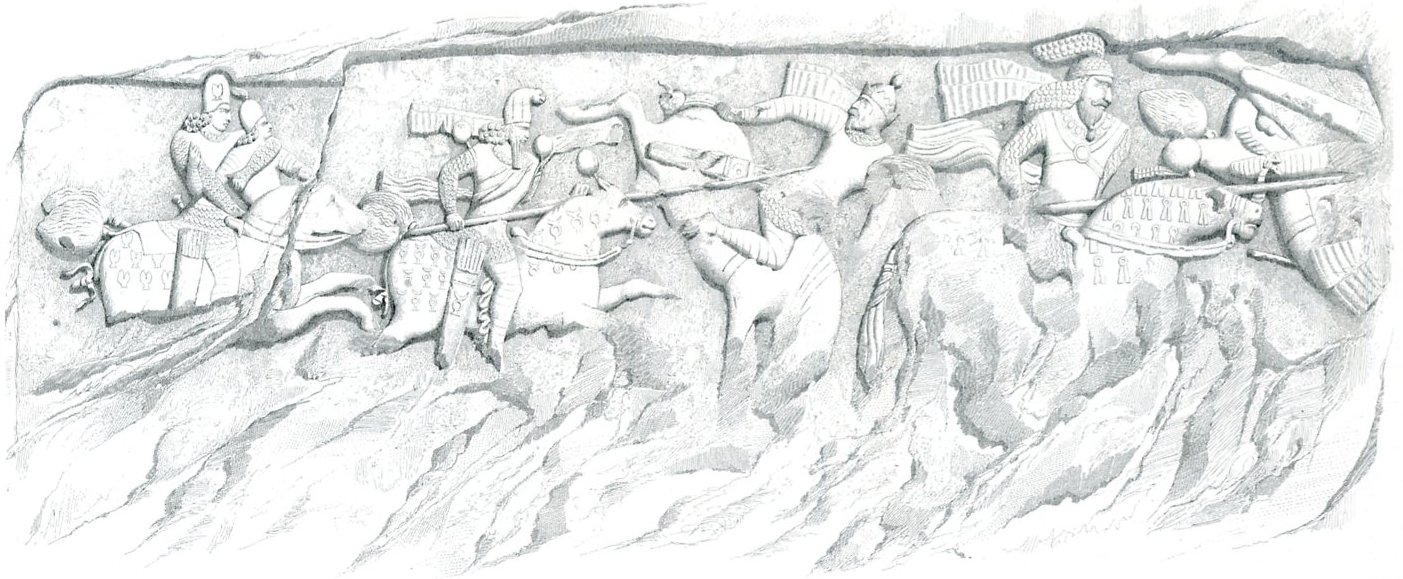
Similarly, the cataphracts in Persian and Roman service wielded effective lances for shock attacks; this was the kontos, wielded in both hands. This image is dramatized, but demonstrative. Have another example. There is no question that ancient cataphracts charged directly into the thick of the enemy; during the Byzantine period, they advanced at a trot or a canter straight into masses of pikemen to break through and kill the enemy commander. The Persians developed a good approximation of the modern saddle, with a high cantle in the back and and clamps across the rider's thighs, which ensured greater security.
The cataphract had a long lineage; Arrian describes heavily armored Saka horses at Gaugamela, and Antiochos III deployed six thousand cataphracts at Magnesia. The Assyrians had been the first to employ armored lancers, and around the same time, the Medians began breeding the horses of the Nisean plain to be bigger and stronger, the definitive traits of heavy cavalry mounts. During the Persian Wars, the Greeks were utterly terrified of the Persian horse; they had utterly crushed the revolting Ionians at the battle of Malene, and throughout the wars the Greeks sought to give battle only where they could nullify the Persians superiority in cavalry. Clearly, they were doing more than just light skirmishing to inspire this level of terror.
Among the Romans, the litany of decisive shock cavalry action recorded by ancient historians completely discredits the notion that the Romans didn't field good native cavalry. Fighting the Sabines in 490 B.C., the Roman commander won the battle at a stroke when he noticed their line was overextended, and led a cavalry charge straight through the center. Outside Veii in 483 B.C., the cavalry won a battle on their own while the infantry were on strike. They fought well against the Celtic and Epirot horsemen, only being defeated by novelties like chariots and elephants. At Telamon,
'The end came when the Celts were attacked by the Roman cavalry, who delivered a furious charge from the high ground on the flank; the Celtic cavalry turned and fled, and their infantry were cut down where they stood.'
Sidnell continues,
The Roman cavalry had defeated a superior number of enemy horsemen in a prolonged fight and, despite the loss of their commander, retained sufficient discipline and cohesion to re-form and launch the decisive attack on the enemy's infantry. What commander of any age could have asked more?