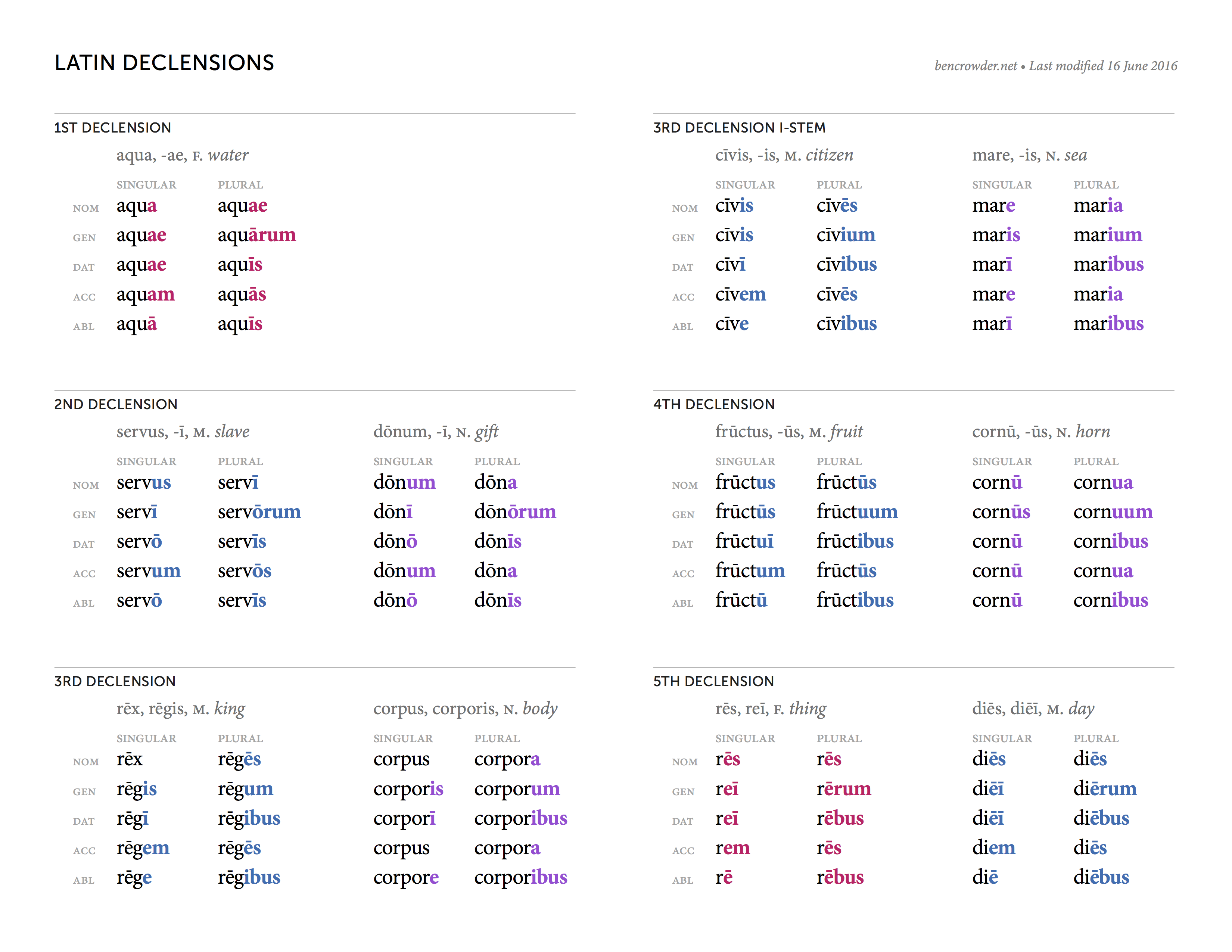
As a follow-up question: When did the current method of English Latin language instruction and classification (with "First Declension", "Second Declension", Declension Tables etc.) originate? Is it a recent product of standardized education or would a student at Oxford or Cambridge in the 1500s be using a very similar lesson plan?
Someone else will need to comment on classical Roman grammar (if we have surviving grammatical texts), but certainly the late Roman grammarians organised their grammars in a way that, though not exactly the same, any modern student of Latin should find generally familiar. So, for example, the most important grammatical text of late-antiquity, the Ars minor of Donatus (c. 350), goes about organising grammar like this:
How many parts of speech are there? Eight.
Which? Nouns, pronouns, verbs, adverbs, participles, conjunctions, prepositions and interjections.
There is then a section on each of these parts, which follow in a similar manner.
So, eg., for nouns:
What is a noun? It is the part of speech with case signifying a body or thing properly or commonly.
How many aspects are there of a noun? Six.
Which? Quality, comparison, variety [ie. gender], number, figure, case.
In what is the quality of nouns? There are two divisions: namely, a noun either names one thing and is said properly or names many things.
How many gradus of comparison are there? Three.
Which? Positive, as learned (doctus), comparative, as more learned (doctior), superlative, as most learned (doctissimus).
What nouns are compared? Those whose names signify only a quality or quantity.
The comparative serves what case? The Ablative without preposition: eg. we say this person is more learned than that one (doctior illo).
For the superlative, which case? Only the genative plural: eg. we say he is the most learned of poets (doctissimus poetarum).
How many varieties of nouns? Four.
Which? Masculine, as this teacher (hic magister), feminine, as this muse (haec musa), neuter, as this stool (hoc scamnum), and communal, as this[M] or this[F] priest (hic et haec sacerdos). There is besides one of all three sorts, because all are said, as this[M] and this[F] and this[N] is blessed (hic haec hoc felix); there is [also] the epicoenon, ie. indiscriminate, as dark sparrow (passer aquila).
How many are the number of nouns? Two.
Which? Singular, as this teacher, plural, as these teachers.
How many figures of nouns? Two.
Which? Simple, as decent power (decens potens), composite, as indecent powerless (indecens impotens).
In which modes are nouns composed? Four: from two complete, as suburban (suburbanus); from two corrupt, as effective citizen (efficax municeps); from one complete and one corrupt, as stupid (insulsus); from corrupt and complete, as clothes-dealer (nugigerulus); sometimes from multiple, as impregnable fearless (inexpugnabilis imperterritus).
How many cases of nouns are there? Six.
Which? Nomative, Genative, Dative, Accusative, Vocative, Ablative.
Through these, nouns, pronouns and participles of all kinds are declined in this manner: Teacher is an appelative noun, of masculine variety, singular number, simple figure and nomative or vocative case, which is declined thus: [I'm not going to translate this as it is long and repetitive, but it should be readily accessible to anyone who knows basic latin:]
nominatiuo hic magister, genetiuo huius magistri, datiuo huic magistro, accusatiuo hunc magistrum, <uocatiuo o magister>, ablatiuo ab hoc magistro; et pluraliter nominatiuo hi magistri, genetiuo horum magistrorum, datiuo his magistris, accusatiuo hos magistros, uocatiuo o magistri, ablatiuo ab his magistris.
Musa nomen appellatiuum generis feminini numeri singularis figurae simplicis casus nominatiui et uocatiui, quod declinabitur sic: nominatiuo haec Musa, genetiuo huius Musae, datiuo huic Musae, accusatiuo hanc Musam, uocatiuo o Musa, ablatiuo ab hac Musa; et pluraliter nominatiuo hae Musae, genetiuo harum Musarum, datiuo his Musis, accusatiuo has Musas, uocatiuo o Musae, ablatiuo ab his Musis.
scamnum nomen appellatiuum generis neutri numeri singularis figurae simplicis casus nominatiui accusatiui et uocatiui, quod declinabitur sic: nominatiuo hoc scamnum, genetiuo huius scamni, datiuo huic scamno, accusatiuo hoc scamnum, uocatiuo o scamnum, ablatiuo ab hoc scamno; et pluraliter nominatiuo haec scamna, genetiuo horum scamnorum, datiuo his scamnis, accusatiuo haec scamna, uocatiuo o scamna, ablatiuo ab his scamnis.
sacerdos nomen appellatiuum generis communis numeri singularis figurae compositae casus nominatiui et uocatiui, quod declinabitur sic: nominatiuo hic et haec sacerdos, genetiuo huius sacerdotis, datiuo huic sacerdoti, accusatiuo hunc et hanc sacerdotem, uocatiuo o sacerdos, ablatiuo ab ho et ab hac sacerdote; et pluraliter nominatiuo hi et hae sacerdotes, genetiuo horum et harum sacerdotum, datiuo his sacerdotibus, accusatiuo hos et has sacerdotes, uocatiuo o sacerdotes, ablatiuo ab his sacerdotibus.
felix nomen appellatiuum generis omnis numeri singularis figurae simplicis casus nominatiui et uocatiui, quod declinabitur sic: nominatiuo hic et haec et hoc felix, genetiuo huius felicis, datiuo huic felici, accusatiuo hunc et hanc felicem et hoc felix, uocatiuo o felix, ablatiuo ab hoc et ab hac et ab hoc felice uel felici; et pluraliter nominatiuo hi et hae felices et haec felicia, genetiuo horum et harum et horum felicium, datiuo his felicibus, accusatiuo hos et has felices et haec felicia, uocatiuo o felices et o felicia, ablatiuo ab his felicibus.
Whenever a noun in the ablative case singular ends "a" or "o" in what do we end the plural of the genetive? in "rum", dative or abaltive in "is".
Whenever a noun in the ablative case singular ends "e" or "i" or "u" in what do we end the plural of the genetive? if "e" is short, in "um"; if long, in "rum"; if "i", in "ium", if "u", in "uum" with the letter "u" doubled.
In what do we end the dative and ablative? in "bus" for all.
Someone studying Wheelocks will, for example, have learned four of the six aspects of the noun that Donatus talks about (although the discussion of gender doesn't identify multi-gender terms distinctly). Donatus doesn't, however, have a particularly explicit discussion of the 5 declensions as we think of them, although the last few lines do essentially delineate the declensions according to the singular ablative. However, other grammarians of late antiquity and the early middle ages discussed the five declensions as we would think of them in a very explicit fashion. I will use Alcuin's Ars grammatica (c. 800) as an example, because he lays it out very clearly, but we can see similar discussions in other earlier grammarians (eg. in the Artes of Sacerdos (c. 280)).
Alcuin discusses the division of declensions in terms of the singular genitive much as we do:
Frank: How many ends are there for the genitive case? Saxo: Five. And for that reason there are five declensions of nouns.
Frank: Tell me the singulars. Saxo: The first is in "ae", as "hic poeta, hujus poetae". The second in "i", as "hic doctus, hujus docti". The third is in "is" short, as "hic pater, hujus patris". The fourth is in "us" long, as "hic senatus, hujus senatus". The fifth is in "ei" distributed, as "hic dies, hujus diei".
He goes on to discuss fairly normal things like which genders are found in which declensions as well as pronouns and irregular exceptions.