In 80s/90s sci-fi a common theme is that in the not-so-distant future, America will be run by the Japanese. Some examples include Back to the Future 2 and the Alien series, and cyberpunk books like Snow Crash and Neuromancer. More are here. What lead to this, and how did it go away?
I want to link to a recent similar question that goes into detail about the Japanese economy during this time. Maybe u/yodatsracist can shed some light on this.
Hi, you might be interested in my older answers to a similar question:
This one is more tangential (it adds little directly relevant to your question), but you also might be interested in:
Your example of Weyland-Yutani from Alien (1979) is slightly before the first reference that I found writing that one, the Blade Runner film (1982), though I can't remember if the original actually mentioned Weyland-Yutani by name, or if that was something added in the sequel and retconned in. It's interesting, though, that this trope seems to start with a general globalization which has a partially Japanese face ("Apparently it was originally meant to be Leyland-Toyota, representing the merger of Britain's then-nationalized motor industry [British Leyland] with a Japanese giant." in Alien or Aliens; the city-speak of Blade Runner was not simply Japanese but a real mix) before articulating more forcefully as specifically Japan-focused anxiety towards the middle of the decade. It's also interesting that, as far as I could tell in my original answer and going through this TV tropes page, it's something that starts in films rather than novels. It's also interesting that the three pieces that seem to first make use of this association--Alien/Aliens, Blade Runner, and Neuromancer--turned out to all be massively influential, which probably helped make this trope become ubiquitous, at least until it transitioned to China as I explain in the first link (this has a separate TV Tropes page).
Thomas Piketty's 2014 opus, Capital in the Twenty-First Century, touches on some of the economic reasons behind the "Japanese will eat us alive" cultural trope. This trope is particularly noted in English-language media, which isn't surprising, for a single reason: World War II.
That massive conflict ended up causing massive economic and human damage, but the United States (and to a lesser extent, Great Britain) fared far better than the devastated Japan, France and Germany. That was bad for the people in those countries in the war's immediate aftermath, but it also gave an opportunity for rapid "catch-up" growth. Even today, you can see how developing economies grow far faster than mature, developed economies.
The trope you speak of wasn't merely a cultural one. It was also endorsed by a number of serious scholars and public commentators. Paul Kennedy's 1987 popular history, The Rise and Fall of the Great Powers, originally featured on its cover an image of national representatives marching on a globe: Britain descending, America on top but taking its first step downwards — and Japan climbing into America' place on the top.
"Due to its immensely successful growth since 1945, [Japan] enjoys a unique and very favorable position in the global economic and power-political order," Kennedy notes (p. 458, emphasis added). He elsewhere describes Japan as "the most spectacular example of sustained modernization in those decades," in part because of how it coasted off the more advanced American economy, "borrowing (and improving upon) sophisticated management techniques and production methods in the West" while also benefitting from huge foreign investment (initially from American defense expenditures in the region) and low wages (416-7). Beyond its initial growth in manufacturing, Kennedy says Japan's "achievements in the computing field are so well known as to be legendary," again in part because of "borrowing heavily from American technology" (462).
Summarizing elite consensus at the end of the 1980s, Kennedy writes that "only a few dispute the contention" that Japan is the economy "best positioned for the coming twenty-first century."^1 Beyond economic factors, he praises Japan's education system, savings rate, "the very high quality of the Japanese work force" (459-64).
"Just how powerful, economically, will Japan be in the early twenty-first century?" Kennedy asks. "Barring large-scale war, or ecological disaster, or a return to a 1930s-style world slump and protectionism, the consensus answer seems to be: much more powerful... It is worth recalling that in 1951, Japan's total GNP was one-third of Britain's and one-twentieth (!) of the United States'; yet within three decades it had risen to be double Britain's and nearly half the United States'" (467, emphasis in original).
Obviously many of these predictions about Japan's future dominance turned out to be slightly overheated. But it wasn't just inchoate nativist fear — lots of Very Serious People looked at stats in the late 1980s and came to the conclusion that Japan was overtaking the U.S. and Europe, at least economically.
Of course, Japan wasn't the only country to have this kind of catch-up growth. Many European countries similarly had a postwar boom; in France, they talk of the trente glorieuses, the Thirty Glorious Years between 1945 and 1975. Piketty argues that this massive European growth (when many western European countries were averaging more than 4 percent growth per year, compared to about 2 percent in North America) was "quite simply because Europe had fallen far behind the United States over the period 1914-1945 but rapidly caught up during the Trente Glorieuses. Once this catch-up was complete, Europe and the United States both stood at the global technological frontier and began to grow at the same relatively slow pace, characteristic of economies at the frontier." (Piketty, 96-7)
Of course, for the United States and Great Britain, being caught economically didn't necessarily feel so good or natural.
"Between 1950 and 1980, the gap between the English-speaking countries and the countries that had lost the war closed rapidly," Piketty writes. "By the late 1980s, US magazine covers often denounced the decline of the United States and the success of German and Japanese industry. In Britain, GDP per capita fell below the level of Germany, France, Japan, and even Italy" (98).
By the 1980s, European growth had slowed, but Japan's boom was continuing. This was boosted by an asset price bubble that finally popped in 1992, sparking a huge and lingering financial crisis and contributing to much slower growth rates than Japan had seen in the 1980s and before.
"During the 1980s, the value of private wealth shot up in Japan from slightly more than four years of national income at the beginning of the decade to nearly seven at the end," Piketty writes. "Clearly, this enormous and extremely rapid increase was partly artificial: the value of private capital fell sharply in the early 1990s before stabilizing at around six years of national income from the mid-1990s on" (172).
(By contrast, private wealth in the U.S. was about five times GDP before the 2008-9 Great Recession, in which it fell to four times GDP, "a drop of roughly the same size as the Japanese correction of 1991-1992." Piketty, 172.)
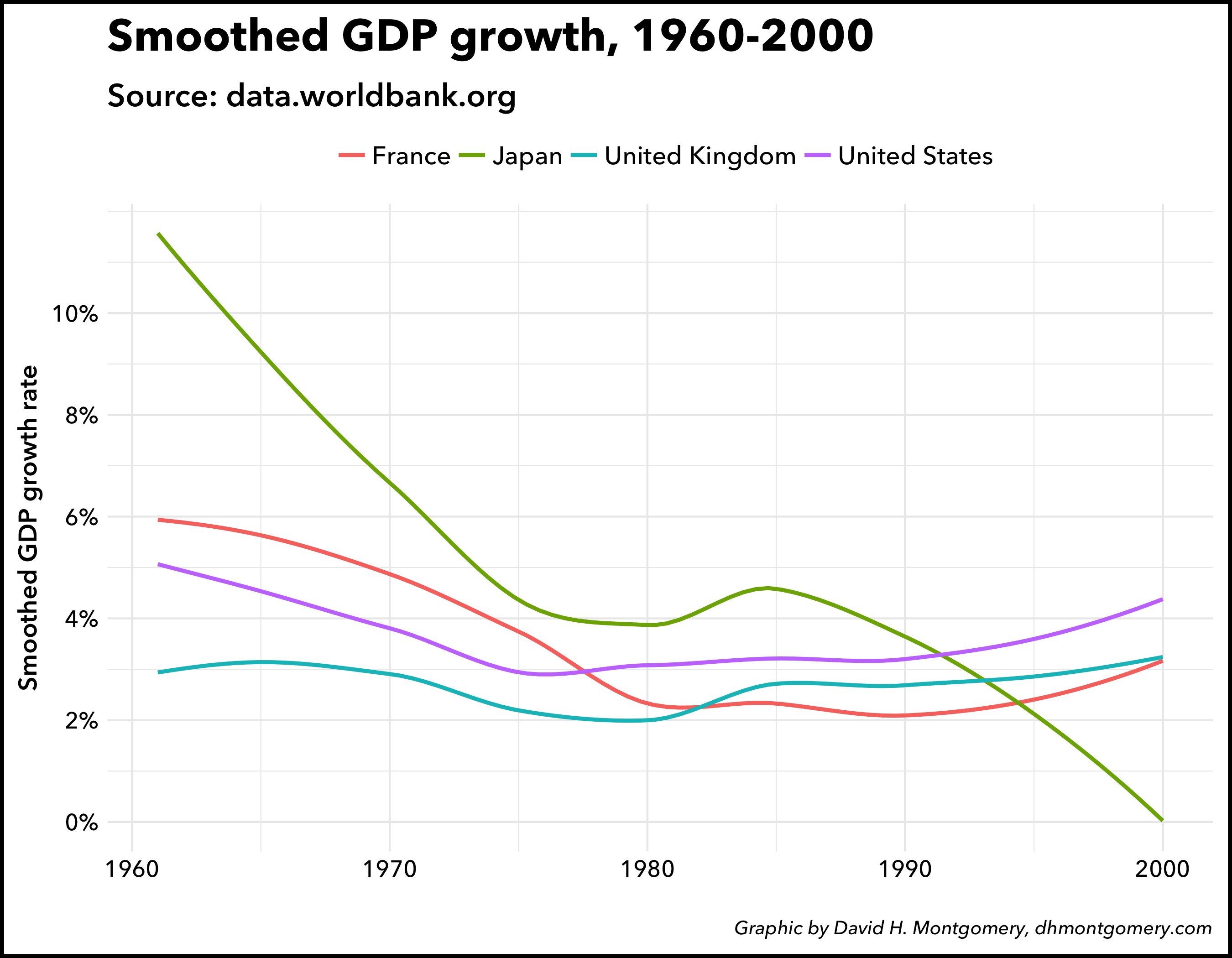
You can get a sense of this pattern in this chart I made from World Bank data, of (smoothed) annual GDP growth rates from 1960-2000. Japan grew far faster than key Western economies (and Britain somewhat slower) through the 1980s before steadily declining through the 1990s as the U.S., Britain and France picked up.
So the cultural moment you pick up on was dominated by real economic factors: Japanese economic success, both in its own right and compared to other developed economies. Experts looked at Japan and predicted that the massive growth it had seen over the past decade would continue into the future, an extrapolation that made them predict Japanese world economic hegemony. These predictions were shared with the public via the news media (those "US magazine covers" Piketty referenced). As it turned out, Japan's economy crashed and then stagnated in the 1990s, partly for structural reasons and partly because a share of its 1980s boom had been illusory.
^1: Amidst his praise, Kennedy does note a few potential threats to Japan's economic preeminence: Western protectionism in reaction to Japanese success, the rise of other, lower-cost manufacturing countries in East Asia (China, South Korea, Singapore, Taiwan), and its already evident demographic issues ("because of the age structure of its population, by 2010 it will have 'the lowest ratio of working-age people (those 15 to 64 years old) among the leading industrial nations,' which will require high social security outlays and could lead to a loss of dynamism" (459-61).
I have no thoughts about 80s and 90s sci-fi. But I would speak a little bit about fears about the Japanese economy. Japan was the first nation to industrialize outside the "Western" world, starting from the Meiji Revolution. This economic growth accelerated during the post-war period. Economic growth rates were regularly upwards of 8% during the 1950s and 60s. From the 1970s and 80s onwards Japan went from being a maker of cheap textiles, bycicles, etc to a genuine innovator. Americans were buying Toyotas in stead of GM cars. RCI was clobbered by Sony. There was less visible erosion but just as important erosion in the position of the American shipbuilding and steel industries. Indeed, in 1987 Japanese GDP per capita exceeded that of the US after the Plaza Accords.
I suspect American anxiety went beyond just fear of economic competition. Anti-Asian racism has died down in terms of virulence, but it has historically been incredibly powerful. The internment of Japanese during WWII was just the top of a deep and bitter well. However, I think just as important was the sense that America's relative decline was the result of something wrong with America and the American way of doing business.
Japanese capitalism (keep in mind business in Japan is far from static and institutional structures have changed a lot over time) differed from American capitalism in many ways. The government , and especially the Ministry of Trade and Industry (MITI) played a much more prominent role in coordinating industry. While Japan is a democracy, a single party dominates politics, and real power is in the hands of the bureaucrats. Many Japanese companies cooperated instead of competed. Workers and manager worked hard because of their personal commitment, and the relations rather than contractual obligations. Japanese corporations considered maximizing shareholder value just one of many competing interests, rather than the primary motivation.
The fear and anxiety went away because it turns out the Japanese model was different, but it wasn't obviously superior. GDP per capita growth slowed down dramatically during the 1990s. Samsung and other Asian electronics beat Sony and Toshiba at their own game. Japanese firms have struggled in the new world of software design, and Japanese businesses struggled to adapt to current business patterns. Government debt as a share of GDP exploded as the government struggled to find answers to the new economic malaise. I suspect this more than anything is why fears of Japanese takeover are no longer nearly as important.