The antiwar movement, civil rights, and rock and roll all were destabilizing to the United States. Why didn’t the USSR support these movements more, considering if these were painted as communistic that would have galvanized a significant yourh population towards the east?
While a number of Western , largely conservative, critics of the New Left and the wider 1960s counterculture as communist, this did not mean the New Left was Marxist-Leninist in nature or that the USSR identified with them.The Soviet leadership was ambivalent about the New Left and this mirrored the generalized ambivalence the New Left's ideologues held for the USSR. Although the New Left espoused a harsh critique of American society, their ideological focus was more in line with younger communist movements and leaders like Mao, Ho Chi Minh, or Che. Brezhnev and other Soviet leaders had experience with this type of ideological independence with both Tito and Mao during the 1940s and 50s and that had led them to be leery of ideological movements that deviated from Marxist-Leninist orthodoxy. Conversely, many within the New Left perceived Moscow as being run by old men and the emerging gerontocracy under Brezhnev did not exactly present a picture of revolutionary dynamism. The fact that the SDS did grew out of an American progressive milieu instead of the American Communist Party added a further layer of skepticism for Soviet leaders.
Moreover, the New Left would also occasionally criticized Soviet actions; one of the precursors of the New Left in Britain, the Communist Party Historians Group, which included such luminaries like E. P. Thompson and Eric Hobsbawm, openly critiqued the Soviet invasion of Hungary in 1956. There were similiar sentiments over the Soviet's crushing of Prague Spring. Graffiti both at Berkeley's and Chicago's1968 protests drew explicit connections between American police actions and Czechoslovakia. While this graffiti (welcome to Czechago) was more about thumbing the eye of the anticommunism of the West, it was not a celebratory picture of the USSR, especially in contrast to how the "Old Left" romanticized the Soviet worker state in the 1930s.
The transgressive cultural precepts of the New Left, especially its liberal stance on sexual mores, were at odds with the social conservatism that typified Soviet leadership during the Brezhnev era. One of the odder quirks of Soviet state attitudes towards music in the late 1960s and 1970s was they felt that rock bands exemplified by the Rolling Stones, The Doors or Jimi Hendrix were a cultural plot by the capitalism to sap the revolutionary vigor of youth through an appeal to hedonistic excess. Many teachers and other Soviet cultural gatekeepers lamented that the arrival of Beatlemania in the late 1960s via the Baltics or western Ukraine, which was more open to connections with Western Europe, as pulling Soviet youth towards esoteric Indian philosophy and spirituality rather than more grounded subjects. The Soviet state was very quick to repress its own counterculture whose hippies took their cues from the global movement (long hair, sexual freedom, etc.).
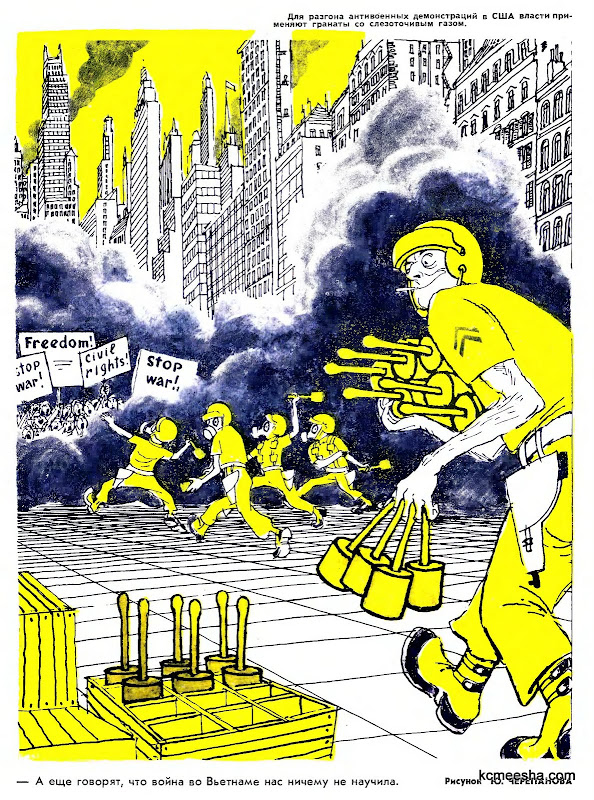
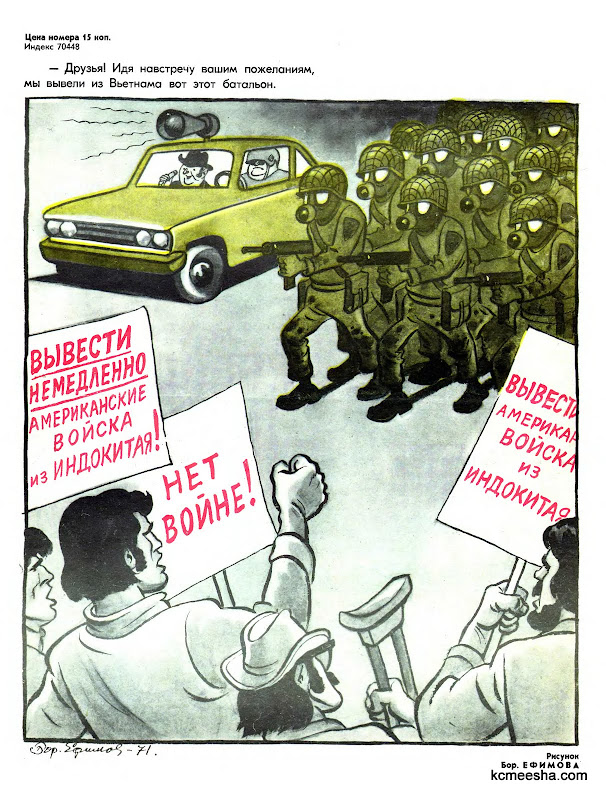
When faced with the rise of this movement in the West, the Soviet leadership was quite confused as to what to make of it. For example, these two Soviet cartoons 1 and 2 show solidarity with the war protesters as true representatives of the struggling masses that the USSR was on the side of. In contrast, this cover "Distinguishing Badges" of the 1969 Soviet satirical Krokodil mocked the West's fashion of long hair and androgynous clothing as does this Soviet cartoon that attacked the fashionable Soviet youth. This cartoon mocking stylish fringes would not be so out of place in Western anti-hippie discourse such as Mad Magazine.
Writing in 1975, the German journalist Klaus Mehnert observed:
The New Left is not one of the perennial topics that Soviet writers have to write about, rather it is a marginal phenomenon in Soviet writing [emphasis original]. Therefore, it is studied only by those especially interested. Seldom have I found anyone in the Soviet Union who even knew the New Left’s name.
Menhert found that although the Soviet state published extensively about the New Left and student protests, the state was more interested in the fact that the New Left was protesting than what in fact the New Left was actually saying.
Sources
Dworkin, Dennis L. Cultural Marxism in Postwar Britain: History, the New Left, and the origins of cultural studies. Duke University Press, 1997.
Katsiaficas, George N. The Imagination of the New Left: A Global Analysis of 1968. Boston, Mass: South End Press, 1987.
Mehnert, Klaus. Moscow and the New Left. Berkeley: University of California Press, 1975.
Risch, William Jay. The Ukrainian West Culture and the Fate of Empire in Soviet Lviv. Cambridge, Mass: Harvard University Press, 2011.