No, but at the risk of soapboxing, it is an object lesson of how the ‘looting’ of artefacts for sale destroys much of the historic value. Without the context in which it was found, dating of objects around it, it is just an interesting sculpture.
The general consensus seems to be that it's either a fake, perhaps modeled after the figures from the causeway of Unas, or from somewhere else entirely. Whatever it is, it certainly doesn't seem Egyptian. The only references to the statue I've been able to find are news articles from 2011, and those agree that the statue does not look at all Egyptian.
"For sure it's pre-Hellenic, but not from the Mediterranean area," said Davi Carutta, a professor of archeology from Brazil, before settling on sub-Saharan African as his guess.
"Sculpture mystery baffles Concordia researchers," CBC News, March 17, 2011
CWA contacted Robert Morkot of Exeter University, expert in Egyptian art, who said: ‘I have seen nothing quite like it. It is certainly atypical in having two figures facing in this way. Squatting figures do exist, and the starving figures in relief on the Unas causeway at Saqqara are an obvious link. I would say it is not Pre-dynastic but, without context, context, context, we might never know.’
"Egyptian Enigma: The Starving of Saqqara," Current World Archaeology, May 7, 2011
The only person who has attested to the statue's supposed authenticity is Jean-Jacques Fiechter.
In an essay about The Starving of Saqqara, Swiss art historian Jean-Jacques Fiechter weighed in on the side of authenticity.
"An experienced collector and connoisseur such as Vincent Diniacopoulos would not have bought this piece, nor shipped it at great cost to Canada, had it not been considered authentic," Fiechter wrote.
"Unravelling the mystery of an ancient statue," CTV News, March 20, 2011
Needless to say, this is terribly naive and a flimsy argument. The collections of art collectors and museums are full of fakes, such as the statue of Tetisheri that was one of the most cherished pieces in the British Museum.
So what do Egyptian statues look like?
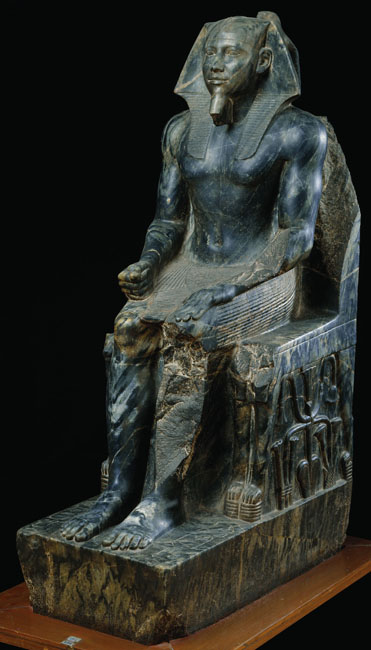
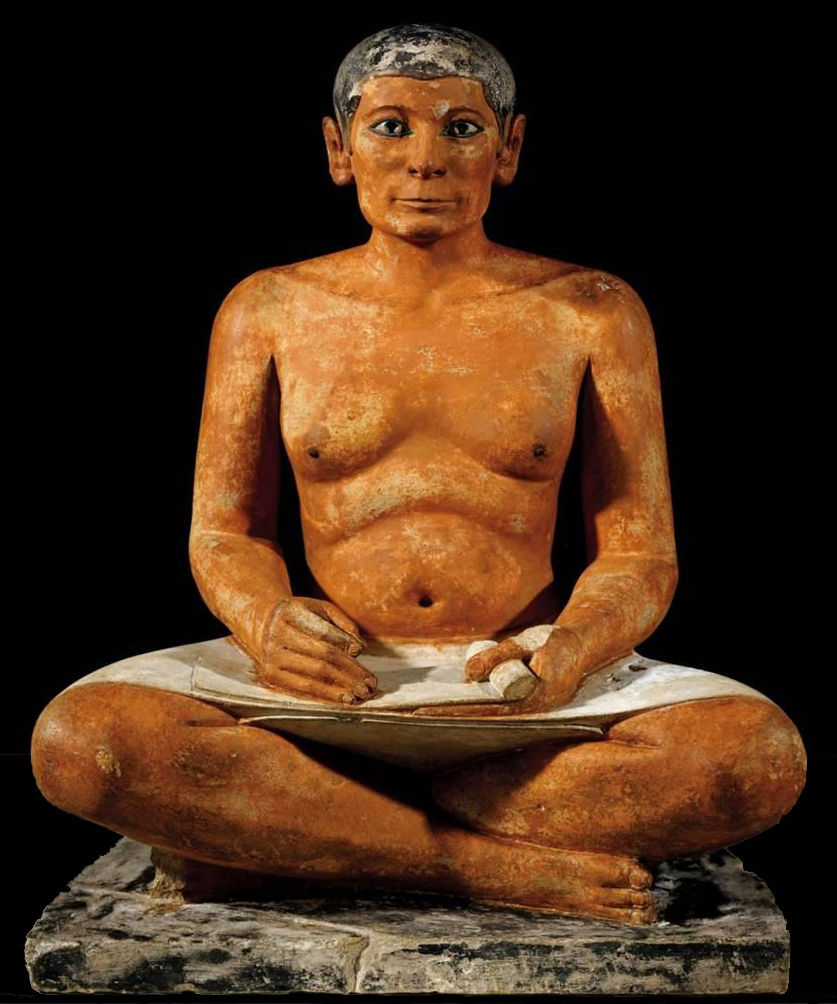
First, a bit about Egyptian statues. Some Egyptian statues were left in their natural color, whereas others were painted. Typically statues made of wood, such as the famous statue of Ka-aper, and statues made of granodiorite and other hard and expensive materials, such as the statue of Khafre from his valley temple, were left unpainted. Limestone statues, on the other hand, were commonly painted in the traditional colors of reddish-brown for men and yellowish-white for women. The statues of Rahotep and Nefret are one example from the Old Kingdom; the statue of Seneb and his family is another example.
As you can see in the above examples, Egyptian statues almost invariably depict the tomb owner or the tomb owner and his family. It was the tomb owner who commissioned the works, after all, and he wanted to focus on himself. Toward the end of the Old Kingdom, there was a surge in interest in the carving of servant figurines, who are always shown busy at work performing deeds for the tomb owner. These servant figurines culminated in the wonderfully detailed tomb models of the Middle Kingdom.
Egyptian statues show the deceased looking straight ahead, arms rigidly down by his side, placed on his/her lap, or (if female) wrapped around her husband. Egyptian sculptors produced other highly standardized statues as well, like the seated scribe form and the block statue, which was designed to maximize the writing surface area.
As you may have noticed by this point, the "Starving of Saqqara" is strikingly different compared to examples of Egyptian art. The crouched position of the two figures, particularly their orientation toward one another, would make this virtually unique in the corpus of Egyptian sculpture. The open mouths and depiction of teeth are likewise at odds with Egyptian convention. Egyptian artists sought to capture the essence of a person in a statue, a sort of Platonic ideal that would last for eternity. Consequently, Egyptian statues tend to be very rigid and devoid of facial expression other than a faint smile or glower. Finally, the proportions of the head are very different from those we see elsewhere in Egyptian sculpture. There are exceptions to this in Egyptian art, admittedly - the infamous Amarna art and depictions of dwarfs, to cite two examples - but even these exceptions are highly standardized and known from multiple examples.
Further reading:
Egyptian Statues by Gay Robins
The Art of Ancient Egypt by Gay Robins
A Companion to Ancient Egyptian Art by Melinda Hartwig
Egyptian Art in the Age of the Pyramids, Met Museum publication