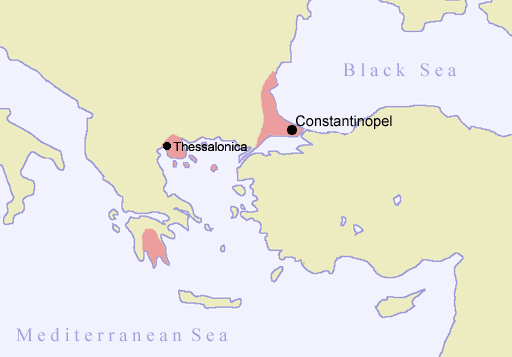
Yes, but only very minor territories that were retaken by the Ottomans very soon after the end of the Civil War with the ascension of Murad II.
By the time the Ottoman Civil War started, the Byzantines were reduced to just the city of Constantinople itself and the region of Morea on the southern coast of Greece. The Emperor of the time, Manuel II, attempted to use the Ottoman civil war to his advantage in order to support a candidate to the throne that was on friendly terms with him, which was the eventual victor, Mehmed I. Though this isn't to say that Manuel chose him as his own preferred candidate, but more that Mehmed I used him as a power play to claim the throne and promised the Byzantines land and friendly relations for their support.
Through Manuel's support of the victorious party in the civil war, as well as some opportunistic excursions by Manuel's son John VIII, the Byzantines recaptured Thessaloniki in central Greece, as well as towns of Varna and Nesebar in Bulgaria, and the coastline opposite of Constantinople at Scutari. With the Empire looking like this after his recovery of territory during the Ottoman Civil War.
Manuel II was the last Byzantine emperor to recover any amount of territory for the Empire, but his gains were negligible and immediately lost after the death of Mehmed I in 1421. Manuel II tried again to influence the succession of the Ottoman throne, but failed to bring his candidate to the throne and instead the successor, Murad II, punished the Byzantines for their opposition to him by laying siege to Constantinople in 1422. The Byzantines did win that siege, but Murad II took back all of Manuel's previous gains in Bulgaria and Thessaloniki.
Manuel II is actually a very interesting character and a pretty savvy guy diplomatically given the near unworkable circumstances his empire was in, definitely a man worth looking into.
Barker, John. Manuel II Paleologus (1391–1425): A Study in Late Byzantine Statesmanship. Rutgers University Press. 1969.
Edit: typos