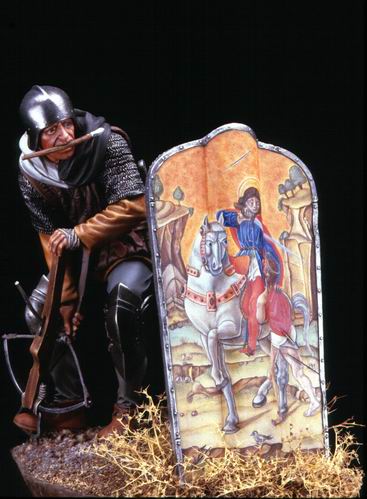
I always see pictures of french knights no holding a shield and 30 English arrows smashing through its armour. But why didnt the french use massive shields like the Romans did etc. Im sure you could make them thick enough to stop an arrow.
They did. Quite often. The reason why knights didn't use them, however, is twofold:
Size and weight. A pavise (which is what you're describing) is a big, heavy thing to lug about. They were typically employed by crossbowmen and archers, in two-man teams, who would use them in sieges as portable walls, effectively. Why a two-man team? These suckers were huge, for one. There are examples from the late 14th century that are over 1.75m in length, and weigh upwards of 22kg. That's not a thing you can just sling on your arm and run around with to deflect arrows. It's a mobile pillbox.
Utility. This goes back to the sheer size of these suckers, but how will a knight on horseback with armour, lance, primary weapon (like a mace or axe,) a sidearm, and a dagger, also be able to carry a 1.5m, 20kg slab of iron and wood to protect from archers and still maintain combat effectiveness as heavy shock cavalry or dismounted heavy infantry? Especially when using one of those suckers will require both hands to manoeuvre it around, which means that it's not particularly useful in a fight. especially if you're on horseback (how will you control the horse? How will you attack your enemies? How will you decide which side of your body to cover?)
Plate armour of the time was super effective against most weapons (including, for the vast majority, longbow arrows) so what got you often wasn't your plate being punctured, but the mail and padding between pieces of plate getting holes punched in them.
In a way, this question shows powerful indirect evidence for the efficacy of plate armour against arrows. In the 16th century, faced with increasingly powerful and numerous firearms (particularly heavy muskets, which could pierce even the finest armour), we see soldiers thickening their breastplates or adding reinforcing breastplates for bullet proofing. This is what you do when you're worried about your breastplate being pierced - you double down on the most important areas. But this thickening increased overall weight and encouraged the discarding of armour for limbs etc. By the 17th century this creates an 'all or nothing' approach to armour where soldiers adopted thick armour for their vital areas and no armour elsewhere - because the limb armour added weight and was unable to stop bullets anyway.
But we don't see anything like this in the later 14th or early 15th century. We see, instead, soldiers covering more and more of their bodies with plate armour, until in the early 15th century the plates no longer supplement mail, but instead make a hard exoskeleton of steel. Around the time of Agincourt, the last major exposed areas of mail are being covered or replaced by plate armour as the mail aventails of bascinets are replaced by the plate gorgets of great bascinets. We do see armour discarded, however - mail armour is increasingly minimized in the later 14th century (as early as the 1360's and 1370's in England) and reduced to supplemental armour for the arms, groin and throat. We do also see improvements in metallurgical quality - iron is replaced by steel, and heat treated armour is seen in the 14th century and Milanese makers are routinely heat treating armour in the early 15th. Better metal meant that armour of the same weight could be much more protective. In the case of the thinner areas of armour, the limbs, this might provide needed protection against longbow arrows and crossbow bolts (though limbs are hard targets to hit squarely). This point is important because while chest armour was thick enough to withstand arrows, thickening limb armour is less feasible because it has a disproportionate effect on mobility - imagine walking in weighted pants. While plate armour was good, these efforts to improve its metallurgy show that people wanted to make a good thing better. In any case, the developments of plate armour are not those we would expect if knights were worried about having their breastplates pierced with arrows. Instead, they are what we would expect as an effort to improve (increasing coverage, increasing strength) something that was effective, but not invulnerable.
There's a narrative in Anglophone armour history that sees the longbow as being very important in all of this. And from a certain perspective, you can see how armourers are busy eliminating the vulnerabilities of Crecy-era 'transitional' armour for the rest of the 14th century. But that's a rather limited perspective. The English do fight throughout Europe, but the longbow is hardly the only weapon on the late medieval battlefield, is is certainly not the most powerful. The experiments of Tobias Capwell measuring the force of lances show that the couched lance delivere several times the force of a longbow arrow. The introduction of plate armour provided better protection, but it also allowed armourers to add lance arrests that allowed men at arms to brace their lance against their chest, and in so doing more than double the force delivered to the lance-point. We should also consider polearms including early halberds, proto-pollaxes and others. All of these were threats that armourers were responding to in the designs of their armour, so we can't view all developments of armour as simply responses to arrows. In fact, the heaviest armours of the late medieval period - the mid 15th century Italian harnesses with their numerous overlapping plates - seem designed not with arrows in mind but to withstand lances.
More than this , we shouldn't view all armour developments as responses to increased offensive capabilities - some extremely deadly threats, like crossbow bolts and couched lances, had been on the medieval battlefield for hundreds of years before Crecy. In addition to the 'demand side' factors of needing to defend against new weapons, there were supply-side factors in terms of improved metallurgy that made plate armour possible and made it a good way to meet existing needs.
If you want to read more about arrows versus plate armour, u/Hergrim and others provide a kind of running discussion here.