If not, how did they react to being forced to learn lies?
It wasn't a lie. Careful study of Hiroshima and Nagasaki, as well as modeling nuclear effects, makes it quite clear that for people who are in a medium-to-light blast area, "Duck and Cover" does a great job at reducing burns and injuries. Even for people in a heavy-blast area, there are pretty significant mortality differences between people who are taking shelter and people who do not. Your chance of survival might go from 10% to 30% in some zones, for example. Does that matter? If you consider that 10% to 30% might be tens or hundreds of thousands of lives — then sure, that matters. But if your benchmark is "total survival" — then you've misunderstood the campaign, which never promised that.
Did the campaign elide over that fact? It did. Is that a lie? I think of it as more an omission based around the US government's persistent inability to admit that even with a strong Civil Defense program the deaths would be huge. That doesn't mean that Civil Defense wouldn't save a lot of lives that would otherwise be endangered, or not make a difference for national resilience and things like that. But the death toll would still be staggering.
"Duck and Cover" was about mitigating the effects of a nuclear attack from the USSR in the early 1950s. The assumption was that such an attack would be bomber-based and with a few, mostly-kiloton range nuclear weapons. That wouldn't be great. But it wouldn't be apocalyptic or existential to the nation by itself. It would also be relatively survivable. Consider this illustration by the sci-fi artist Chesley Bonestell, which is a nice example of what two Nagasaki-sized bombs dropped on New York would look like. Pretty terrible. But huge areas of the city, and region, would be relatively unscathed. And large areas would be in those medium-to-light blast ranges where "Duck and Cover" could help.
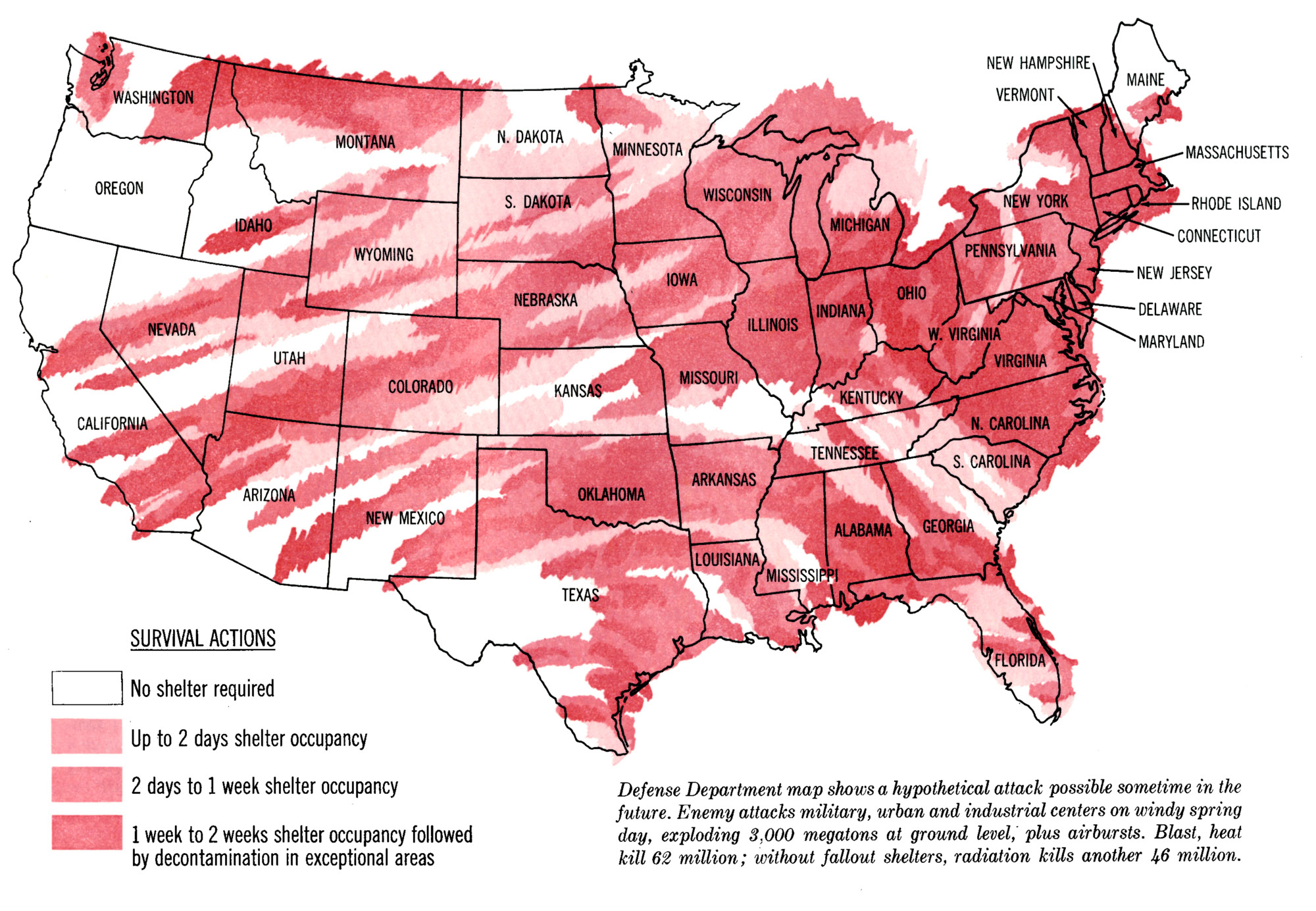
By the 1960s the strategic situation had changed dramatically. The Soviet arsenal had gotten quite large. It had incorporated multi-megaton warheads. It could be delivered by missiles that could not be defended against. In such a situation, your cities are probably mostly toast. If you have multiple, megaton-range warheads aimed at New York or DC, then people in New York and DC aren't going to have a great chance of survival, no matter what they do. The US government never really wanted to admit as much, so they had rather fanciful plans to try to evacuate big cities on short notice. Such a thing would not likely have worked well (it is hard to get out of DC or NYC on a sunny afternoon in rush hour — imagine if it were the panic of an incoming warhead motivating people to try to leave). For people further away from main targets, which would be most of the country, the main hazard would be nuclear fallout. The guidance here was to build or locate fallout shelters which could be used for several weeks. Here's a nice illustration from the Saturday Evening Post, 1963, of the fallout hazard from such an attack. Again, in such a situation, your people within blast zones are probably toast — "Duck and Cover" is probably insufficient. But fallout shelters would be useful for the ~50% or so of the US population who doesn't live in major cities or near military targets.
There are, to be sure, serious discussions that could be had over the value of Civil Defense versus the costs of it (e.g., do the number of lives saved warrant the effort?). And there could be (though I think this needs to be treated more seriously than it has tended to be) discussions about what kinds of consequences might follow nationally or internationally from strong Civil Defense investments (e.g., the old canard about whether investing in Civil Defense will make your government more likely to go to nuclear war, for which there is no evidence). And one could ask whether people would want to survive a nuclear war (I have had many people — even someone today! — tell me that they wouldn't want to survive a nuclear attack; I suspect that is the kind of statement that can only be made by someone who does not have the option in front of them, because the human drive for life is something that is hard to appreciate in the abstract).
But if the question is, would such activities increase the probability of survival for a large number of people? The answer is yes. Would it guarantee survival of all? Of course not. It never really claimed to. To be sure, especially some of the late Civil Defense advocates, the more hawkish sorts (like Edward Teller), could over-estimate the effectiveness of such policies and make it sound like a nuclear war would be nothing so terrible at all. Which is not true, and the Civil Defense agencies were aware that nuclear war would be an awful thing no matter what. Their ability to communicate that effectively was not always in evidence, to be sure.
Now, your main question is about how these were perceived at the time by the people who were taught it. There are fewer studies of this than one might hope (to my frustration). There are anecdotal accounts of many people who thought such activities were futile, and many people, then as now, reject such ideas with a "gut reaction" that "this can't save me." Usually that is not based in a deep understanding of nuclear threats, but instead based in an often misleading cultural notion of what a nuclear attack is like (the "big flash, end of world" idea). The reality is simultaneously more mundane and horrific, and people have tended to not want to dwell on that. The Civil Defense messaging from both the 1950s and 1960s had many deficits as well, including overly-cheery imagery that made surviving a nuclear attack look nothing so bad as spending some quality time with the family. This was rejected as implausible by many of the intended audience. By the 1980s, when the Civil Defense question was raised again in an even more politicized context (it was part of the Reagan administration's early 1980s "re-nuclearization" of the Cold War), this imagery of the 1950s-1960s was brought up as an example of the "cynical" approach to nuclear weapons in the past, as part of a criticism of the then-current nuclear policies. This 1980s framing is how Civil Defense is largely talked about today, though with the North Korean situation there have been several efforts (and I am part of one of them) to reframe this discussion.
So it is a somewhat complicated thing. I think historians today often inadvertently pick up the 1980s critique when they look at the materials of the past, and avoid taking it very seriously. I think they also sometimes do insufficient justice to the technical aspects of it, which are non-trivial in evaluating the importance of the work. I also think they fail to distinguish between the question of whether the work was technically accurate (at times, not exclusively) and whether the messaging was poorly thought-out, or at least seems so in retrospect. Again, it is very difficult to know exactly how these things were received because the not very much study was given to their reception at the time. One would not expect reception to such tropes to be transhistorical; consider how different our ads to sell laundry detergent are today compared to what was judged adequate 50 some years ago.
Strictly speaking, "duck and cover" as we know it (as a catchy cartoon featuring a friendly turtle) is not for avoiding nuclear fallout in the sense of radioactive material; it's for avoiding both flash burns to the front of the body caused by thermal energy further away from the epicenter of the blast (and thus further away from radiation) and injuries from debris due to the the blast wave of the nuclear explosion, such as broken glass and building rubble. Training individuals such as schoolchildren to react to the initial flash by ducking and covering in place was meant to prevent the laceration injuries that might be caused to individuals looking out glass windows to see what had happened to cause the flash. There are other historians on this subreddit who are familiar with how the locations and positions of individuals during the bombings of Hiroshima and Nagasaki influenced their survival as well as the nature of their injuries afterward, but the general perception that the "duck and cover" technique as taught in American schools in the 1950s was meant to communicate to students that nuclear fallout as received at the epicenter of an attack is survivable or they could somehow survive at ground zero of a nuclear attack just by ducking under their desks is a misapprehension of that campaign's intent. It's a response rooted in the idea that any nuclear attack (even at an early-1950s level of nuclear tech) would necessarily be so universally lethal that no kind of emergency response could possibly help, which is fairly controversial. T.J. Nelson's response to the depiction of this campaign in 1982's The Atomic Cafe is pretty snarky but gets at why that "ha ha, did people really think they could survive the bomb if they ducked under their desks and covered their heads with picnic blankets?" line of critique raises hackles. Calling the "duck and cover" campaign an intentional lie may be overstating it, but it's the product of a midcentury American civil defense ethos that's worth critical analysis beyond "were they really that stupid back then?".
EDIT: But this didn't really answer your question -- in short, yes, the "duck and cover" campaign was believed by both those putting it forward and likely by most who received it, but yes, in light of later developments in the Cold War and later political thought, a lot of the same adults who might have received that message as children were highly critical of it and its place in American civil-defense rhetoric around the Cold War. Guy Oakes' The Imaginary War describes the cultural climate of civil defense in the US, the same movement and zeitgeist associated with "duck and cover"-type campaigns, in terms of the psychological effect of staving off nuclear fear; I'm inclined to agree with this (even current US civil-defense disaster preparedness resources have a remarkably chipper tone, stressing how easy it is to decontaminate yourself) but I still don't think it's correct to call these civil defense campaigns total placebos that the United States and USSR both unambiguously knew wouldn't be of any real use during an attack.
In addition to my own answer, there have been some related questions asked on this subreddit that might be illuminating about the civil defense context the Bert the turtle duck-and-cover campaign rose out from: