I am creating a board game set in Medieval Western Europe which is heavily influenced by the concept of social mobility the way it is portrayed in CKII. You start off as a Count, work your way up to a Duke, then a King, and finally become an Emperor and win the game (the specific titles themselves don't matter to me, keep reading).
Historical accuracy isn't the point of my game. But it certainly would be a bonus.
So my question is: was there ever a time and a place (within Western Europe) where one could work their way up the social ladder of nobility and slowly earn more important titles? And if there was, what were those titles specifically? (it doesn't have to be Count-> Duke-> King-> Emperor like CKII shows, I just need the titles to go upwards)
So essentially I'm looking for a setting for my game where an upwards moving social status would be historically authentic. And apart from the fact that I'd want to find an answer in order to improve my game, I'm genuinely interested in the subject myself. Thank you all in advance.
You absolutely could. From Castile, I can give you various examples from the late Middle Age.
-Beltrán de la Cueva. He was born the son of a minor noble from Jaén. Through military service, Beltrán rose to the ranks of nobility. He was named Count of Huelma, then Count of Ledesma, finally Duke of Alburquerque. [Oviedo, volume I, pages 101-119]
-Gonzalo Fernández de Córdoba. Son of the lord of Priego. He was not supposed to inherit his father's lands and titles, so he joined to the Court as a page, then entered military service. His brilliant military record landed him the titles of Duke of Sessa, Terranova, Andria, Santangelo, and Montalto.[Oviedo, vol. 1, pages 169-173]
-Diego Hurtado de Mendoza was the II Marquess of Santillana, son of the marquess of Santillana. Diego, through his politic and diplomatic merits was granted the title of Duke of Infantado in 1475. [Oviedo, vol. 1, pages 33-69]
-Íñigo López de Mendoza, father of Diego Hurtado. He was the lord of Hita and Buitrago, son of a military commander that rose from a minor noble to being Admiral of Castile. Through diplomatic and political merits, Íñigo was created Count of Manzanares, and Marquess of Santillana, as well as an absurd list of titles. [ibídem].
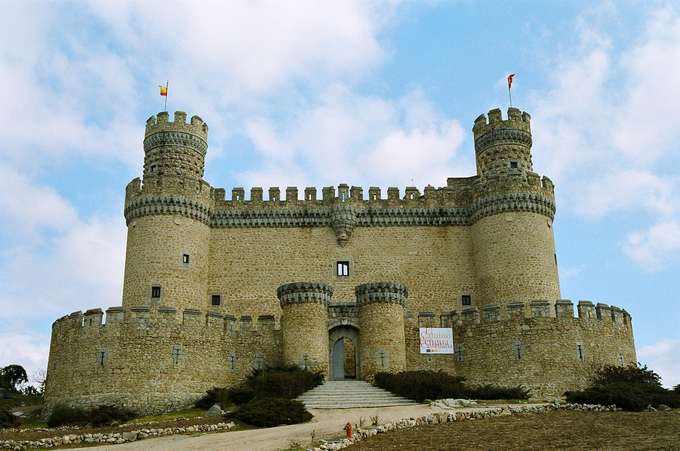
The Mendozas are probable the most obvious example of upwards social mobility within the nobility: Pedro González de Mendoza went from lord of Mendoza and Hita to Admiral. His son Íñigo, from lord to Count, and from Count to Marquess. Diego (Íñigo's son) rose from Marquess to Duke. All of this in justo a few generations. Compare the Tower of Mendoza (belonged to Pedro), to the castle of Manzanares (built by Íñigo), to the Palace of the Dukes of Infantado (built by Diego) and you get an accurate picture.
There are many more examples, and most of the times the promotions come from military merit.
For these specific cases and the late medieval Spanish nobility see
Fernández de Oviedo, Gonzalo, Batallas y Quinquágenas, 4 volumes. Madrid, Real Academia de la Historia, 1983 (vol. 1) and 2000 (vols. 2, 3, 4)